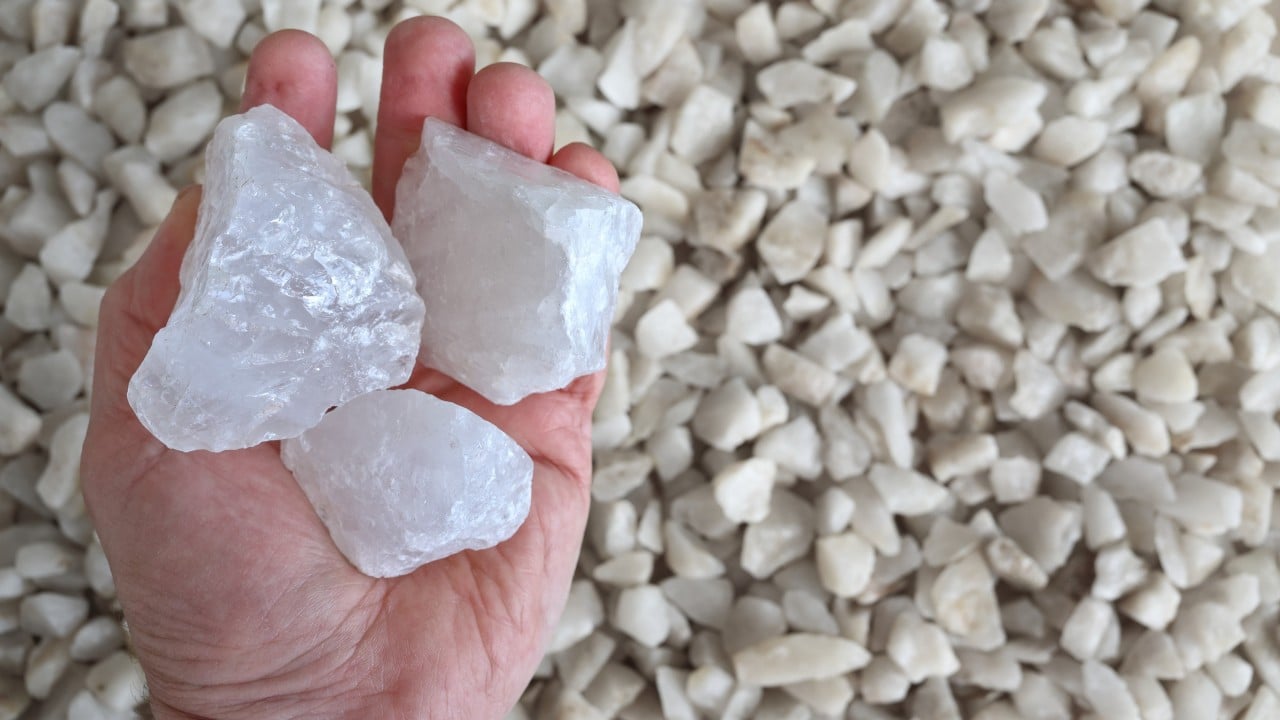
Geological discoveries often trigger speculative market responses, yet raw mineral characterization requires empirical validation. Recent analytical evaluations published by Chinese geologists regarding the Xiaohuaguo deposit in Hubei Province indicate that its purified quartz sand shares property profiles comparable to the industry benchmark established by North American raw materials. Dissecting the validity and operational consequence of this finding requires examining the metallurgical mechanics, impurity thresholds, and processing barriers that govern high-purity quartz markets.
The global supply chain for semiconductor manufacturing and photovoltaic crucible production relies heavily on quartz possessing exceptional silica content and minimal trace contaminants. High-purity quartz is defined not merely by initial silicon dioxide concentration, but by the specific species and lattice-bound locations of residual trace elements. The benchmark standard, historically sourced from the pegmatite deposits of Spruce Pine, North Carolina, achieves its status through a rare convergence of original granitic composition, long-term leaching, and specific structural inclusion profiles.
The recent study on the Xiaohuaguo deposit, conducted by researchers from the China University of Geosciences, the Wuhan Center of the China Geological Survey, and the Hubei Geological Bureau, reports total impurity levels in purified quartz samples dropping to 11.98 micrograms per gram. This measurement falls beneath the standard 50 microgram per gram upper limit for high-purity designations, and undercuts the stricter 20 microgram per gram threshold required for the inner layers of solar quartz crucibles. Furthermore, analysis of 17 individual trace elements confirms they remain within operational limits, while fluid inclusion characteristics and particle morphology closely mirror the industry reference material known as IOTA-CG sand.
Translating laboratory-scale purification success into industrial-scale output exposes the primary bottleneck of domestic substitution strategies: resource geometry and processing scalability.
The structural impediments facing alternative quartz deposits involve distinct operational variables:
- Inclusions and Lattice Traps: Impurities are frequently bound within mineral lattices or trapped inside microscopic fluid and solid inclusions, requiring aggressive chemical leaching and thermal treatment to remove without destroying the quartz host matrix.
- Beneficiation Energy Costs: Removing lattice-substitutional elements such as aluminum, titanium, lithium, sodium, and potassium demands multi-stage processing, including high-temperature chlorination and advanced magnetic separation, which escalates operational expenditure per metric ton.
- Reserve Volume Verification: Initial geological assessments of the Xiaohuaguo deposit were conducted without deep drilling, leaving total extractable reserve volume and grade consistency across the entire ore body unquantified.
Geological surveys frequently identify high-grade samples from surface outcrops or shallow pegmatite veins, yet mining operations require predictable ore consistency over multi-year production horizons. While the metallurgical data confirms that Xiaohuaguo raw material can be processed to match the chemical signature of premium grades under laboratory protocols, commercial viability depends on whether these concentrations persist across economically recoverable volumes.
Industrial consumers in the photovoltaic and semiconductor sectors evaluate quartz inputs based on crucible lifespan and thermal stability. Minor variations in hydroxyl groups or alkali metal impurities accelerate devitrification during high-temperature crystal pulling, leading to crucible failure and ruined silicon ingots. Replicating the Spruce Pine standard requires matching not just the bulk chemical assay, but the identical minimization of lattice-bound defects that prevent micro-bubble formation under extreme thermal loads.
Strategic planning for advanced manufacturing supply chains must decouple raw material discovery from immediate processing capability. Domestic sourcing initiatives reduce import exposure, but bridging the gap from a medium-sized, surface-evaluated deposit to an industrial supply requires systematic deep-core drilling, pilot-plant beneficiation scaling, and validation testing by downstream crucible manufacturers. Capital allocation should prioritize empirical verification of deposit continuity over speculative capacity expansion.
China might have rare earths, but the US has ultra high purity quartz
This video provides a concise overview of the geographical concentration and strategic value of the North American high-purity quartz reserves that competing deposits seek to match.