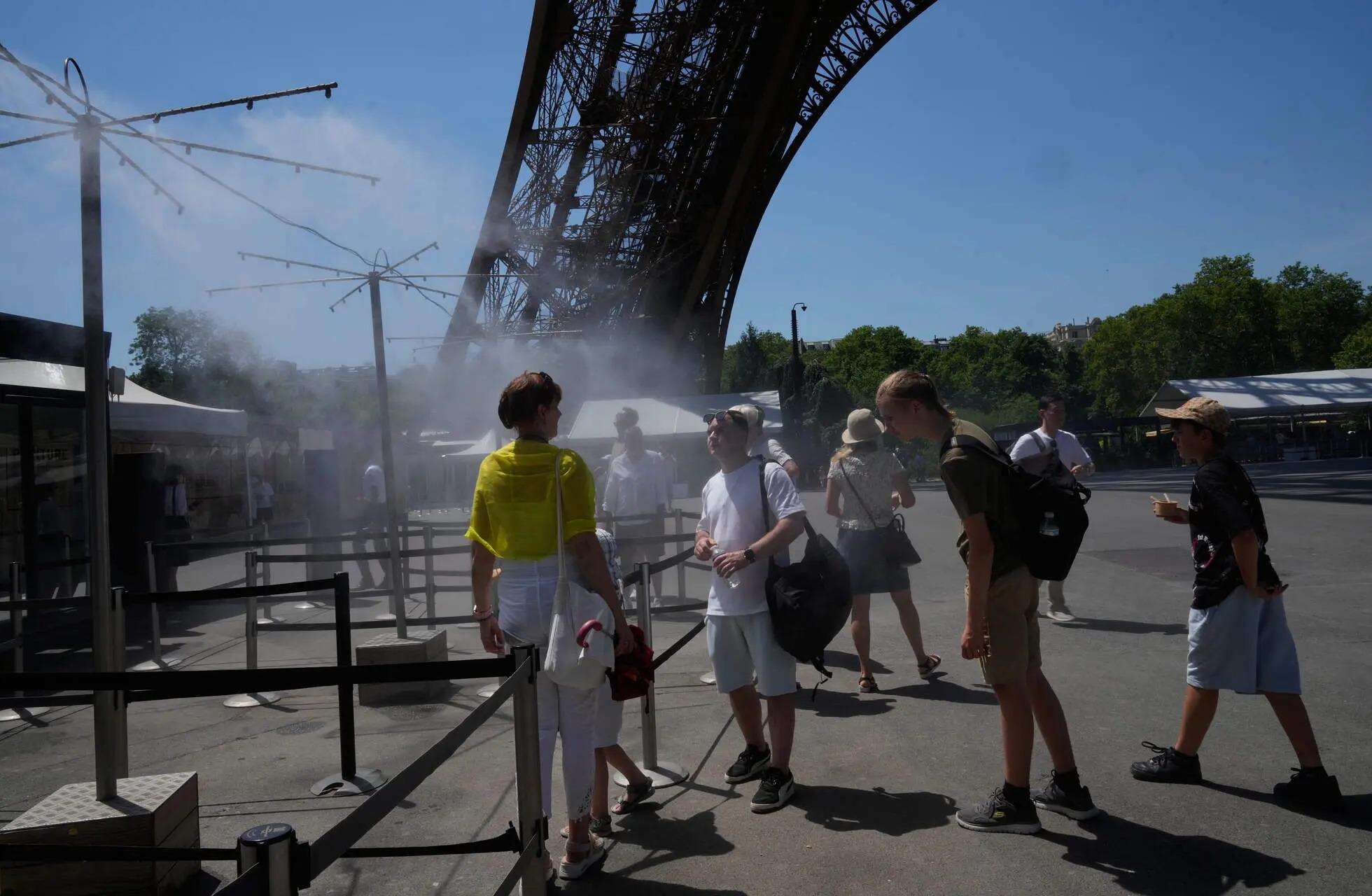
The legacy media is running its standard summer playbook. Headlines scream about "red alerts," apocalyptic temperature spikes, and health systems collapsing under the weight of an unprecedented climate catastrophe. It is a predictable, copy-paste narrative that treats every spike in the thermostat as an isolated act of God.
They are missing the entire point.
Europe does not have a heat crisis. Europe has a structural design and infrastructure crisis that it refuses to fix.
For decades, the continent has relied on an outdated architectural philosophy and an fragile power grid, assuming that mild summers were a permanent birthright. Now, instead of retrofitting cities and decentralizing power systems, politicians issue panic-inducing press releases telling citizens to stay indoors and drink water. It is lazy, reactive governance.
Having spent fifteen years analyzing infrastructure resilience and energy grid vulnerabilities across both North America and Europe, I have watched municipal governments blow millions on short-term "cooling centers" while actively blocking the systemic overhauls required to actually survive a warming world. The narrative that we are helpless victims of a sudden weather anomaly is a lie designed to shield incompetent urban planning from scrutiny.
The Myth of the Unprecedented Emergency
Every year, the public is told that the current heatwave is a freak mutation of nature, completely impossible to predict. The data says otherwise.
Data from the Copernicus Climate Change Service shows a clear, multi-decade warming trend across western and southern Europe. This is not a surprise twist in a movie; it is a predictable trajectory. Yet, European health systems and infrastructure are caught off guard every single July.
The mainstream press focuses entirely on the thermometer reading. They fail to understand that a temperature of 40°C (104°F) in Madrid or Paris causes vastly more devastation than the same temperature in Phoenix or Dubai. Why? Because of structural complacency.
- Air Conditioning Prohibitions: In cities like Paris and Berlin, rigid historic preservation laws make installing external split-system air conditioning units nearly illegal for standard residential buildings. Citizens are forced to rely on inefficient portable units that vent heat back into the building envelope.
- The Thermal Mass Trap: European masonry architecture is designed to trap heat. While this saves energy during a damp January, it turns brick and concrete apartment buildings into literal kilns during a prolonged July heatwave. Without active cooling, these structures bake from the inside out, never cooling down overnight.
- The Urban Heat Island Effect: Asphalt-heavy design and a lack of green corridors mean European metro areas retain heat up to 10°C higher than surrounding rural areas.
When the media blames the weather for overflowing emergency rooms, they are letting municipal planners off the hook. The premium on historic aesthetics is directly killing vulnerable populations.
The Flawed Premise of "Just Reduce Demand"
When a heatwave hits, European grid operators immediately pivot to a single, flawed strategy: begging consumers to turn off appliances to prevent a blackout. This is a symptom of a deeply fragile, centralized energy network that has failed to adapt to modern realities.
Consider the baseline mechanics of a standard European grid during a thermal peak. As temperatures rise, the efficiency of traditional thermoelectric power plants (nuclear and gas) actually decreases because the water bodies used to cool them become too warm. At the exact moment demand for cooling spikes, supply capacity shrinks.
The standard solution offered by legacy environmental pundits is a forced reduction in consumption. This is not a strategy; it is rationing.
The contrarian truth is that Europe needs a massive, aggressive expansion of localized solar and localized battery storage specifically mapped to cooling loads. Solar generation peaks at the exact same time cooling demand peaks. By refusing to fast-track decentralized microgrids due to bureaucratic red tape and centralized utility lobbying, European nations ensure their own vulnerability.
Imagine a scenario where every apartment block in southern Europe featured mandatory solar awnings paired with localized lithium-iron-phosphate (LFP) storage. The grid load would drop significantly during peak daylight hours. Instead, the continent remains tethered to a top-down distribution model designed in the mid-twentieth century.
Dismantling the "People Also Ask" Assumptions
If you look at public queries during a European summer, the questions asked reveal a complete misunderstanding of the problem. Let us address the most common, flawed premises directly.
"Why can't Europe's health systems handle heat waves?"
The premise here is that hospitals lack beds or doctors. The brutal reality is that European health systems are built around predictable, seasonal workflows. They are heavily optimized for winter respiratory spikes but completely unequipped for summer cardiovascular surges. Heat increases blood viscosity and forces the heart to pump harder to cool the body. Because European hospitals themselves frequently lack centralized HVAC systems in older wings, the very institutions meant to treat heat stroke become environments that exacerbate it.
"Is air conditioning making the outdoor heat worse?"
This is a favorite talking point of anti-development purists. They argue that air conditioning units pump hot air onto the streets, worsening the local climate. While technically true on a micro-scale within narrow alleys, the macro-solution is not to ban AC and let elderly citizens suffer in 38°C apartments. The solution is water-cooled district cooling networks—underground infrastructure that circulates chilled water to entire districts, moving heat entirely away from the urban center efficiently. Stockholm uses this tech for winter heating and summer cooling; western Europe has largely ignored it.
"Can planting trees solve the European heat crisis?"
Urban forestry is highly beneficial, but it is treated as a magical cure-all by politicians looking for an easy photo opportunity. Planting saplings today does nothing for a concrete dense district next month. Trees require years to mature, massive amounts of water that are strictly rationed during droughts, and significant subterranean space that is currently blocked by ancient utility lines. It is a secondary tactic wrapped in the language of a primary solution.
The Architecture of Complacency
Look at the built environment across the United Kingdom and northern France. The housing stock is dominated by uninsulated, unventilated brick terraces or post-war concrete blocks. These buildings feature tiny windows that do not allow for cross-ventilation, or giant un-shaded glass panes that create a greenhouse effect.
We are told that retrofitting these buildings is too expensive. What is missing from that calculation is the economic toll of inaction.
| Metric | The Standard Approach | The Resilient Alternative |
|---|---|---|
| Primary Focus | Behavioral mitigation (stay inside, hydration apps) | Structural engineering (district cooling, envelope retrofits) |
| Grid Management | Demand response throttling and rolling brownouts | Decentralized solar + storage microgrids on all multi-family housing |
| Urban Planning | Temporary cooling centers in public libraries | Mandatory exterior shading, cool roofs, and relaxed AC zoning laws |
| Economic Cost | Billions lost in worker productivity and healthcare surges | Upfront capital expenditure offset by long-term energy independence |
Admitting the downside to an aggressive infrastructure overhaul is necessary: it will be incredibly disruptive. It requires tearing up historic streets to lay district cooling pipes. It requires overriding local zoning boards that care more about the color of a roof tiles than the survival of the tenants underneath them. It means spending capital on boring, invisible climate adaptation rather than flashy, politically expedient subsidies.
Stop Treating Weather Like an Invading Army
The continuous usage of military language—"Europe on red alert," "combating the heatwave," "systems on the brink"—is a psychological trick. It frames the weather as an external enemy that could not possibly be defended against, turning structural negligence into an act of wartime survival.
It is a evasion of accountability.
Phoenix, Arizona, experiences weeks on end above 43°C (110°F). Its society does not collapse every summer because the infrastructure was built with the assumption that heat is a baseline reality. Europe must abandon the romantic, outdated notion that its climate will remain perpetually mild. The climate has changed; the infrastructure has not.
Stop checking the weather app and start looking at building codes. Stop blaming the sun and start blaming the zoning laws. The solution is not to suffer quietly in the dark with a wet towel around your neck while praying for rain. Rip out the administrative barriers, decentralize the power generation, and engineer the cities to fight back.
Deliver the retrofits or keep burying the vulnerable. Those are the choices. Everything else is just noise.


