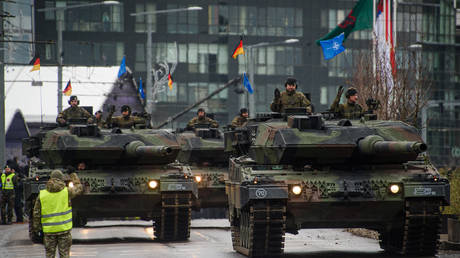
European leaders are quietly dismantling decades of the social contract to fund a massive military buildup, forcing citizens to foot the bill through gutted public services and austerity. This structural shift moves billions of euros from healthcare, education, and pension funds directly into defense procurement. While official rhetoric frames this as an existential defense of democracy, the financial reality reveals a stark trade-off. European capitals are choosing ammunition over hospitals, and the domestic fallout is just beginning to surface.
For thirty years, continental Europe enjoyed a peace dividend. It was a comfortable era. Governments consistently underfunded their militaries, relying instead on the American nuclear umbrella while redirecting tax revenues into robust welfare states, universal healthcare, and subsidized energy. That era ended abruptly.
The continent faces a structural crisis that cannot be solved by simply printing more money. With borrowing costs high and treaty-mandated debt limits returning to enforcement, money for missiles must be stolen from money for medicine.
The Mirage of the Peace Dividend
The math guiding European budgets for a generation was simple, elegant, and entirely unsustainable. By keeping defense spending well below the NATO target of 2% of GDP, countries like Germany, Italy, and Spain freed up tens of billions of euros annually. This capital became the bedrock of European social stability. It funded early retirement models, modernized public transit networks, and kept university tuition virtually free.
Then reality intervened. The geopolitical landscape fractured, exposing a European defense industrial base that was largely a hollow shell. Factories lacked the machine tools, raw materials, and skilled labor required to produce even basic artillery ammunition at scale.
To rectify decades of neglect, the European Commission and national governments launched an unprecedented militarization drive. The target is no longer just meeting the 2% NATO threshold; several frontline states are pushing toward 3% or 4% of their total economic output.
Yet, an economy cannot magically expand to accommodate a sudden, massive sector of non-productive state spending. Military hardware is economically sterile. A tank does not generate economic velocity; it sits in a depot or is destroyed on a battlefield. When a government buys a fighter jet, that capital is permanently removed from the domestic circular economy.
The Stealth Cuts Eating Away at Public Services
Governments rarely announce that they are defunding childcare to buy air defense systems. Instead, they utilize inflation, bureaucratic delays, and structural reforms to achieve the same result. This is fiscal sleight of hand.
Consider the mechanisms at play. When inflation degrades the purchasing power of money, keeping a budget flat is equivalent to a severe cut. Across the continent, ministries of health and education are seeing their budgets frozen or nominally increased at rates far below actual cost inflation. Meanwhile, defense ministries are receiving dedicated, inflation-adjusted cash injections and off-budget emergency funds.
In Germany, the €100 billion Sondervermögen (special fund) for the Bundeswehr bypassed regular constitutional debt brakes. At the same time, the federal government enacted stringent cuts to basic welfare benefits, reduced student financial aid, and delayed critical investments in the country's decaying rail infrastructure. The message is unspoken but unmistakable: the state can find billions for Rheinmetall, but not for the local commuter network.
The situation is replicated across France and Italy. French pension reforms, which sparked widespread domestic unrest, were framed as a fiscal necessity to stabilize the state’s balance sheet. What went unmentioned was the simultaneous passage of a €413 billion military programming law, representing a 40% increase in defense spending over the previous cycle. The state explicitly demanded that its citizens work longer hours before retirement, precisely as it increased its procurement of advanced weaponry.
The Decaying Infrastructure of Daily Life
The consequences of this budgetary migration are visible to anyone using European public infrastructure.
- Healthcare Systems: Wait times for routine surgeries in public hospitals have expanded from weeks to months. Staffing shortages are chronic because wages cannot compete with the private sector or foreign markets.
- Educational Institutions: Schools suffer from deferred maintenance, outdated digital infrastructure, and a lack of specialized teaching staff.
- Municipal Services: Local councils, squeezed by reduced federal allocations, are cutting back on public library hours, closing community swimming pools, and delaying road repairs.
This is not a temporary bottleneck. It is a permanent downgrading of the European standard of living to subsidize a permanent war economy.
The Corporate Windfall and the Industrial Reality
While citizens experience the friction of declining public services, a select group of industrial entities is experiencing an unprecedented boom. The defense sector has become the darling of European capital markets. Share prices for major defense contractors have skyrocketed, driven by guaranteed, long-term state procurement contracts.
However, this military buildup is remarkably inefficient at creating domestic economic prosperity. The modern defense industry is highly capital-intensive and automated. It does not generate the mass employment that manufacturing sectors did in the mid-20th century. Furthermore, a significant portion of European defense spending does not even remain within Europe.
Due to the immediate need for high-tech capabilities, European governments are repeatedly bypassing domestic manufacturers to purchase off-the-shelf American hardware. Billions of euros raised through European taxes are flowing directly to defense firms in the United States for F-35 fighter jets, Patriot missile batteries, and advanced munitions. This represents a pure capital flight, offering zero stimulative benefit to the European workforce.
The Delusion of Military Keynesianism
Some economists argue that defense spending acts as a stimulus, creating jobs and driving technological innovation. This logic is deeply flawed in the current European context. For military Keynesianism to work, an economy must have slack capacity—idle factories and unemployed workers waiting to be mobilized.
Europe faces the opposite problem. The continent is plagued by demographic decline and acute labor shortages in skilled technical fields. When a defense plant expands, it does not employ the long-term unemployed. It poaches engineers, software developers, and precision mechanics from the civilian sectors.
An engineer designing a guidance system for a missile is an engineer not working on green energy grids, medical devices, or commercial software. The civilian economy is being systematically cannibalized for talent, starving productive industries of the human capital required to remain globally competitive.
The Political Backlash is Arriving Ahead of Schedule
You cannot reduce the material well-being of a population without triggering a political reaction. The elite consensus in Brussels and national capitals regarding defense spending is completely detached from the priorities of the average voter. This disconnect has created a fertile environment for political instability.
Popuilst movements across the political spectrum are capitalizing on this growing resentment. Their message is simple, direct, and increasingly resonant: the globalist political class cares more about foreign conflicts than the affordability of domestic heating oil.
As standard welfare provisions shrink, voter loyalty to traditional centrist parties dissolves. The rise of nationalist and Euroskeptic factions is directly correlated with the erosion of the social safety net. Voters who feel abandoned by the welfare state are withdrawing their consent from the broader European project.
The political center is attempting to counter this trend by amplifying fear of external aggression. But fear has a shelf life. When a voter cannot find an affordable apartment, cannot secure a doctor's appointment for their child, and sees their real wages diminished by defense-related inflation, abstract geopolitical warnings lose their efficacy.
The Long-Term Costs of a Militarized Continent
The trajectory is clear. Europe is transitioning into a high-tax, low-welfare environment characterized by a permanent state of military readiness. This transformation will fundamentally alter the social fabric of the continent.
The ultimate irony is that this military buildup, designed to protect European society, may end up destroying the very elements that made that society worth protecting. A nation's true strength is not measured solely by the size of its arsenal, but by the health, education, and cohesion of its populace.
By sacrificing social stability on the altar of defense procurement, European leaders are building a fortress on a foundation of sand. The financial allocations made today will dictate the domestic reality for decades. The tanks are rolling off the assembly lines, but the societies meant to support them are quietly cracking from within.


