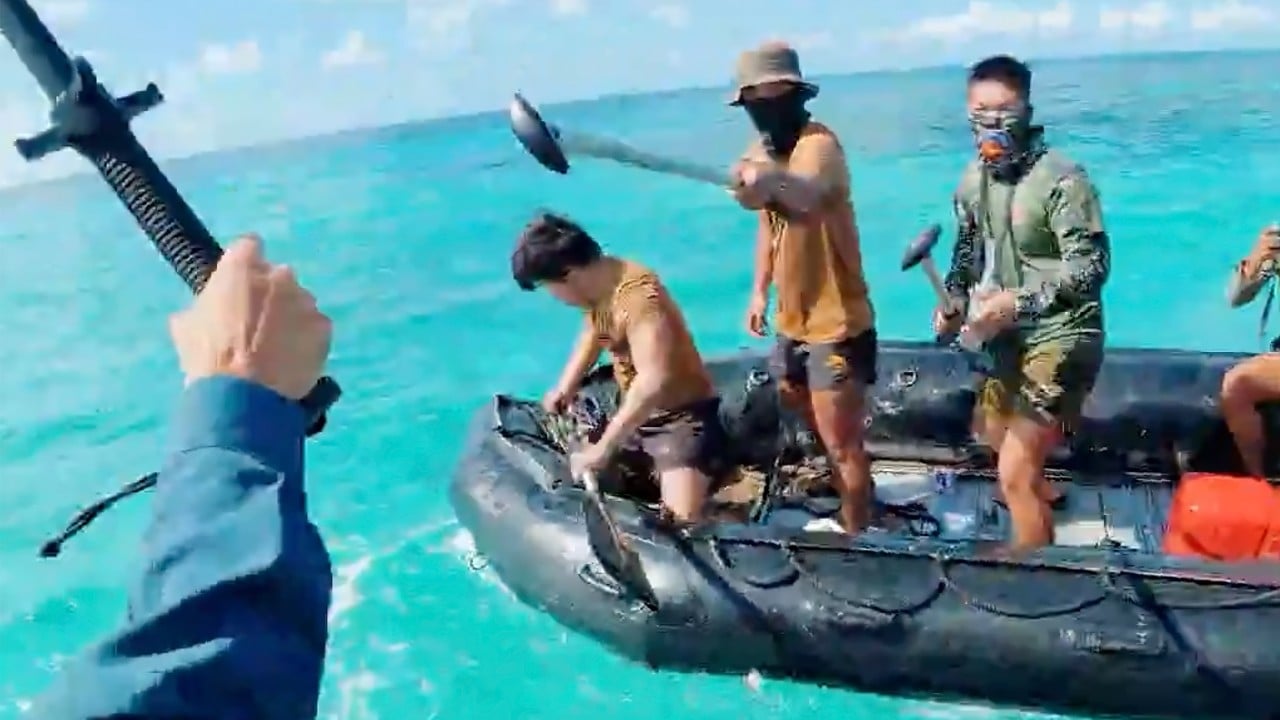
China has lodged formal diplomatic protests against the Philippines following another high-stakes maritime confrontation near Second Thomas Shoal. The disputed feature in the South China Sea, known locally as Ayungin Shoal and in China as Ren'ai Jiao, remains the primary flashpoint in a widening geopolitical standoff. Philippine supply vessels attempting to reach the BRP Sierra Madre—a grounded World War II-era navy ship serving as a military outpost—encountered aggressive intercepts by Chinese Coast Guard and maritime militia hulls. This latest clash underscores a rapidly deteriorating security environment where routine resupply missions now risk triggering regional conflict.
Beijing's foreign ministry claims Philippine craft illegally intruded into surrounding waters without permission, prompting what it termed necessary control measures. Officials in Manila counter that their forces were operating well within the Philippines' Exclusive Economic Zone, executing a lawful rotation and resupply operation. The core issue goes beyond diplomatic complaints. It centers on Beijing's systematic attempt to enforce total control over a submerged reef located roughly 105 nautical miles from the Philippine island of Palawan, yet more than 600 nautical miles from China’s mainland coast.
The Anatomy of a Standoff
The mechanics of these maritime encounters have become predictably dangerous. During resupply runs, Philippine civilian boats escorted by coast guard ships attempt to navigate a blockade established by dozens of Chinese vessels.
The tactics deployed by Chinese forces have escalated significantly.
- Water Cannon Interference: High-pressure jets targeted directly at wooden supply boats disable navigational radar, shatter windshields, and injure crew members.
- Acoustic and Optical Weapons: The deployment of military-grade lasers and high-decibel acoustic devices temporarily blinds and disorients Philippine navigators.
- Direct Hull Impact: Dangerous maneuvers and intentional ramming tactics by larger steel-hulled coast guard ships cut off smaller supply craft mid-transit.
These actions are designed to force Manila into abandoning the BRP Sierra Madre. Grounded deliberately in 1999 to stake Manila's sovereign claim, the rusting LST-821 hull is structurally degrading. Time, salt water, and wave action are eroding the steel faster than maintenance crews can shore it up. Beijing’s operational strategy relies on restricting construction supplies from reaching the ship. If the hull collapses or becomes uninhabitable, the Philippine military presence disappears, leaving the shoal open to immediate occupation by Chinese forces.
Legal Mandates Versus Enforcement Reality
The legal framework governing this disputed body of water was clarified nearly a decade ago. In 2016, the Permanent Court of Arbitration in The Hague issued a unanimous ruling on a case brought forward by the Philippines. The tribunal concluded that China’s expansive maritime claims based on historical maps had no foundation under the United Nations Convention on the Law of the Sea.
Crucially, the arbitral award explicitly ruled that Second Thomas Shoal is a low-tide elevation located within the Philippine exclusive economic zone and continental shelf. As a low-tide feature, it cannot generate an independent territorial sea or exclusive economic zone of its own. Therefore, Chinese claims of sovereignty over the surrounding waters lack international legal standing.
Beijing refused to participate in the arbitration and declared the ruling null and void. China continues to operate on its own doctrine of historical control, dismissing the UNCLOS framework whenever it conflicts with territorial ambitions. The resulting dynamic pits international legal consensus against sheer physical force on the water. Manila possesses the legal right to the shoal, while Beijing possesses the naval capacity to deny access to it.
Strategic Implications for Regional Alliances
This operational stalemate places immense pressure on international alliances, most notably the 1951 Mutual Defense Treaty between the United States and the Philippines. Under Article IV of the treaty, an armed attack in the Pacific on either nation's public vessels, aircraft, or armed forces would compel each party to act to meet the common dangers.
Washington has repeatedly affirmed that the BRP Sierra Madre qualifies as a public vessel, meaning a lethal incident during a resupply mission could theoretically trigger a direct military response from the United States. This calculus creates a complex deterrence puzzle.
Beijing operates deliberately in the grey zone between diplomatic pressure and open war. By utilizing maritime militia fishing vessels and coast guard hulls rather than gray-hulled People's Liberation Army Navy warships, China attempts to enforce its sovereignty while keeping tactics just below the threshold of an "armed attack."
Manila faces an asymmetric dilemma. Acquiescing to Chinese demands effectively surrenders sovereign rights guaranteed under international law. Pushing back with militarized force risks escalating a localized confrontation into an international theater of war.
To counter this asymmetry, the Philippines launched a deliberate public transparency initiative. By placing international journalists aboard resupply vessels, Manila ensures that every water cannon blast, ramming attempt, and dangerous intercept is documented and broadcast globally in real time. This strategy stripped away the veil of ambiguity that previously obscured grey-zone operations, exposing China's coercive tactics to international scrutiny.
Transparency alone, however, does not repair a deteriorating hull or deliver concrete repair materials past a physical blockade.
Structural Vulnerability and the Operational Horizon
The crisis at Second Thomas Shoal is bound to a physical timeline dictated by structural physics. The BRP Sierra Madre is disintegrating.
Engineers familiar with the vessel note that decades of exposure to salt spray have compromised the main deck and internal bulkheads. Without continuous, large-scale structural reinforcement—requiring tons of cement, steel girders, and heavy equipment—the ship will eventually break apart under its own weight during a severe storm season.
Beijing understands this countdown completely. Every supply run blocked or turned back accelerates the timeline toward structural failure. If Philippine forces are unable to conduct heavy maintenance, the garrison will eventually become unsustainable, forcing an evacuation on safety grounds.
Should Manila attempt a major engineering operation to permanently reinforce the vessel, China will likely interpret the delivery of heavy building supplies as a violation of the status quo and use maximum non-lethal force to prevent it. If Manila limits its missions purely to basic provisions like food and water, the ship will eventually succumb to environmental decay.
The diplomatic protests filed in Beijing and Manila are not mere rhetorical exchanges. They reflect an escalating contest over the international rules-based order, where the physical survival of a rusted ship determines who controls a crucial strategic sector of the South China Sea.