The Cold Echo of a Lecture Hall
The fluorescent lights in the University of Buenos Aires (UBA) don't just flicker anymore; they feel like they are gasping. In the hallways of the Puan building, where decades of philosophy and literature have been debated until the sun came up, there is a new, sharper kind of silence. It is the silence of a budget that has run out of breath.
Sofia is twenty-one. She is the first in her family to step foot on a university campus. Her grandfather worked the docks; her father drives a delivery van through the chaotic, potholed streets of the capital. For Sofia, the UBA wasn't just a school. It was a secular cathedral. It was the promise that in Argentina, your last name didn't have to be your destiny.
Now, she studies by the light of her cell phone because the electricity bill is a debt the rector cannot pay. This is not a metaphor. This is the reality of a "chainsaw" economy.
The numbers coming out of the Casa Rosada are staggering in their clinical detachment. President Javier Milei’s administration has frozen the 2024 budget at 2023 levels. On paper, that sounds like a pause. In a country where year-on-year inflation has crested over 280%, it is an execution. A budget that bought ten lightbulbs, three research kits, and a professor’s lunch last year now barely covers a single ream of paper.
The Invisible Stakes of a National Identity
Argentina is a country defined by its contradictions, but its pride in public education was always the connective tissue. This is the land of five Nobel Prizes—four of them tied to public universities. While the rest of Latin America often reserved higher education for the elite, Argentina built a ladder.
When you take a chainsaw to that ladder, you aren't just "trimming the fat." You are amputating the future.
Milei argues that the universities are centers of "indoctrination," a claim that resonates with his base but falls apart under the weight of a thousand diverse voices in a single classroom. He speaks of fiscal responsibility as if it were a god that demands human sacrifice. But what happens when the sacrifice is the next generation of oncologists, aerospace engineers, and architects?
Consider a hypothetical student named Mateo. Mateo is a third-year engineering student. He is brilliant. He is the kind of mind that a developing nation should be desperate to keep. Under the current austerity measures, Mateo’s laboratory has no reagents. His professors, whose salaries have lost 30% of their purchasing power in a matter of months, are looking at job postings in Spain or Chile.
The brain drain isn't a future threat. It is a leak that has become a flood.
The Day the Streets Shook
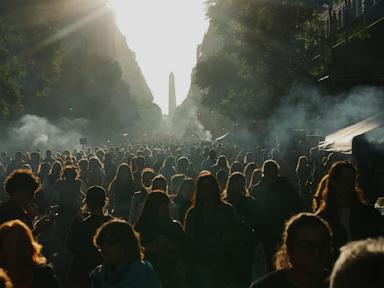
In late April, the frustration broke. It wasn't just the students. It was the mothers, the grandfathers, the doctors who had graduated forty years ago, and the kids who hoped to enroll in ten. Over half a million people flooded the Plaza de Mayo.
They didn't carry weapons. They carried books.
They held them high above their heads—well-worn copies of Borges, thick medical textbooks, battered manuals on civil law. It was a silent, paper-thin barricade against a government that views education as an expense rather than an investment. The imagery was visceral. A sea of people, disparate in their politics but united by the singular belief that a classroom is a sacred space.
The government’s response was a shrug of the shoulders and a tweet. They pointed to the "audits," suggesting that the universities were hiding money in the shadows. It is a classic move: if you want to destroy a public institution, first convince the public that it is corrupt.
But for those walking through the darkened cloisters of the UBA, the "corruption" is hard to find. What they see instead are peeling walls, broken elevators, and world-class researchers bringing their own toilet paper from home because the department can no longer afford the basics.
The Mathematics of Despair
Let’s look at the logic of the "Chainsaw."
$Budget_{2024} = Budget_{2023}$
In a vacuum, that equation looks like stability. But when you add the variable of Argentine inflation ($i$), the result is a collapse.
$$Value = \frac{Budget_{2023}}{(1 + i)}$$
When $i$ is 2.8, the real value of that budget is less than a third of what it was. This isn't fiscal policy; it’s a controlled demolition. The administration claims there is "no money." And yet, the cost of losing an entire generation of intellectual development is a debt that no amount of fiscal surplus can ever repay.
The human cost of this math is Sofia. She now works two jobs—one at a cafe, one cleaning apartments—to cover the transit costs that have tripled since subsidies were slashed. She arrives at her 8:00 PM lecture exhausted, only to find the classroom shuttered because the university can't afford the security guards or the heating.
She sits on the curb and opens her book anyway.
Beyond the Balance Sheet
There is a psychological toll to being told your aspirations are a "drain on the state." It creates a culture of precarity. When a student doesn't know if their department will exist next semester, they stop dreaming of how to improve their country. They start dreaming of how to leave it.
This is the hidden cost of Milei’s crusade. You can balance a ledger by cutting funding to a physics lab, but you cannot balance the loss of a breakthrough that never happens. You can save a few billion pesos by suppressing teacher salaries, but you cannot calculate the cost of a child who sees their teacher’s poverty and decides that learning is a dead end.
Argentina is currently an experiment in raw, unfiltered neoliberalism. The world is watching to see if a country can be rebuilt by tearing down its most successful institutions. But a country is not a business. A business can declare bankruptcy and disappear. A country has to live with the ghosts of the opportunities it killed.
The Echo in the Plaza
As the sun set over the massive crowds in Buenos Aires, a chant rose up—not a violent one, but a rhythmic, haunting reminder. “La universidad de los trabajadores, y al que no le gusta, se jode.” The university of the workers, and if you don’t like it, too bad.
It is a reminder that in Argentina, the university was the one place where the daughter of a maid could sit next to the son of a judge. It was the great equalizer in a society that is becoming increasingly fractured.
Sofia was there in the crowd, holding her book. She didn't feel like a "deficit" or a "statistical error." She felt like a citizen.
The lights may be dimming in the lecture halls of Buenos Aires, and the elevators may be frozen between floors, but the spirit of the protest suggests that the people aren't ready to sit in the dark just yet. They are learning a different kind of lesson now—one that isn't found in a syllabus. They are learning what it costs to fight for the right to think.
The tragedy isn't that the money is gone. The tragedy is the belief that the money was the only thing that mattered.
A desk is just wood and metal until a student sits at it. Without the student, it’s just scrap. If the current trajectory continues, Argentina will have plenty of scrap, and a very long, very quiet walk toward a future that could have been.
Sofia closes her book. The streetlights flicker on, powered by a grid that is as fragile as her tuition. She starts the long walk home, her backpack heavy with the weight of a dream that is being taxed into extinction.