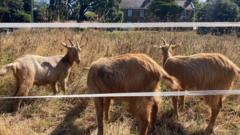
Rare breed conservation operates under a severe market failure. Standard economic valuation relies exclusively on immediate utility, production volume, and transactional liquidity. Livestock breeds that fail to optimize for high-throughput industrial supply chains face systematic population contraction, regardless of their genetic uniqueness, disease resistance, or historical value. The integration of Royal Golden Guernsey goats into a formal conservation herd represents a structural intervention against this market failure. Protecting heritage livestock is not merely an act of historical preservation; it is an exercise in biological risk mitigation and genetic option value maintenance.
The Structural Fragility of Monoculture Agriculture
Modern agricultural systems prioritize efficiency through homogenization. Global food production relies on a narrow band of high-yielding livestock strains optimized for intensive feeding operations. This hyper-specialization introduces systemic fragility. When an agricultural sector reduces its genetic diversity, it concentrates its vulnerability to pathogen mutations, climatic shifts, and feed supply disruptions.
Biological monocultures lack the genetic variance required for evolutionary adaptation. The Royal Golden Guernsey breed possesses distinct metabolic efficiencies, hardiness profiles, and foraging adaptability shaped by centuries of isolation on the Channel Islands. Treating these animals as obsolete assets ignores the economic principle of option value. An option value represents the worth of preserving a resource for potential future uses whose exact utility remains unknown.
[Intensive Industrial Agriculture]
       │
       ▼ (Drives efficiency via homogenization)
[Narrow Genetic Baseline]
       │
       ▼ (Creates systemic risk)
[Vulnerability to Pathogens / Climate Shocks]
       ▲
       │ (Mitigated by)
[Rare Breed Conservation / Royal Golden Guernsey]
When a commercial dairy strain collapses under the pressure of a novel disease or extreme temperature spikes, the recovery pathway depends entirely on the existence of resilient, unoptimized heritage genetics. The conservation herd functions as a physical liquidity pool of genetic assets.
The Conservation Economics Framework
Executing a rare breed conservation program requires navigating distinct resource allocation constraints. Unlike commercial livestock enterprises driven by revenue optimization per square foot, conservation herds operate under a cost-recovery or subsidy-backed framework. The economic architecture rests on three distinct operational pillars.
Asset Maintenance and Genetic Purity
Maintaining a rare breed requires rigorous lineage tracking to prevent inbreeding depression. Small population sizes inevitably lead to genetic drift. The primary operational cost is not feed or land, but the rigorous management of breeding matrices. Conservation managers must calculate the effective population size to ensure that genetic variance remains stable over generational cycles.
Biosecurity and Geographic Redundancy
Concentrating a rare breed in a single location introduces catastrophic tail risk. Disease outbreaks, extreme weather events, or institutional failures can wipe out an entire global population if specimens are centralized. Effective conservation architecture mandates decentralized herd placement. Moving Royal Golden Guernsey goats into a structured conservation herd establishes geographic redundancy, splitting the biological asset pool across distinct physical environments.
Ecosystem Service Monetization
Heritage goats provide localized utility that standard industrial breeds cannot replicate. Their browsing behavior differs from sheep or cattle; they preferentially target woody weeds, scrub, and invasive vegetation. This biological clearing mechanism delivers value in landscape management, fire fuel reduction, and soil restoration. Conservation programs that fail to monetize these ecosystem services rely entirely on finite philanthropic or governmental grants, creating a permanent funding bottleneck.
Operational Constraints and Resource Bottlenecks
Transitioning rare livestock into a conservation framework exposes acute operational friction. Feed conversion ratios in heritage breeds typically lag behind industrial counterparts. They grow slower, produce lower milk volumes relative to feed input, and require specialized veterinary oversight attuned to their specific physiology.
This creates a capital allocation dilemma for managing institutions. Every acre allocated to a low-yielding conservation breed represents an opportunity cost against high-output land use. To justify this allocation, the institution must reframe the output metrics. The return on investment is measured in genetic insurance premiums, educational utility, and landscape management efficiency rather than immediate commodity sales.
Furthermore, supply chain integration for secondary products remains underdeveloped. While niche markets exist for artisanal goat cheese and specialty fiber, the infrastructure to process and distribute outputs from low-volume heritage herds lacks economies of scale. Producers face high unit costs across processing, transport, and regulatory compliance. Overcoming this barrier requires cooperative resource pooling among independent rare breed stewards to aggregate volume and stabilize market access.
The Mechanics of Breed Preservation and Genetic Drift
Preserving a lineage like the Royal Golden Guernsey requires strict adherence to population genetics. Genetic drift occurs when allele frequencies change over generations due to random chance rather than selection. In populations numbering in the hundreds or low thousands, the impact of drift can rapidly erode unique physical and metabolic traits.
Conservation herds mitigate this through coordinated studbook management. The introduction of animals into a formalized conservation herd is not a passive housing arrangement; it is a calculated injection into a managed pedigree database. Each animal's coefficient of inbreeding must be computed prior to mating protocols. If a lineage becomes too bottlenecked, the phenotypic traits that define the breed—such as the characteristic golden coat color, dairy conformation, and docile temperament—can be compromised through recessive genetic disorders.
The operational protocol demands meticulous record-keeping. Every birth, transfer, and mortality event feeds into an algorithmic tracking model designed to maximize genetic diversity across the surviving population. Without this quantitative oversight, a conservation herd devolves into a localized petting farm, losing its scientific and economic utility as a genetic reserve.
Strategic Deployment of Heritage Livestock
Integrating heritage breeds into modern agricultural landscapes requires a shift from sentimental preservation to rigorous asset management. Organizations holding these animals must treat them as living R&D laboratories for climate resilience. As global weather patterns destabilize traditional agricultural zones, the metabolic traits of breeds evolved on marginal lands will increase in demand.
The immediate priority for the Royal Golden Guernsey conservation herd involves establishing standardized health protocols, expanding the geographic distribution across independent farm partners, and integrating genomic sequencing into the studbook registry. By mapping the genotype of the current herd against commercial counterparts, researchers can isolate the specific genetic markers responsible for hardiness and feed efficiency.
Scale the network of secondary custodians to ensure that no single institutional failure threatens the baseline population. Establish regional breeding cooperatives that share genetic material without incurring the high mortality risks associated with long-distance livestock transport. Transition the economic model from grant dependency toward verified ecosystem service contracts, positioning the herds as biological tools for land remediation.