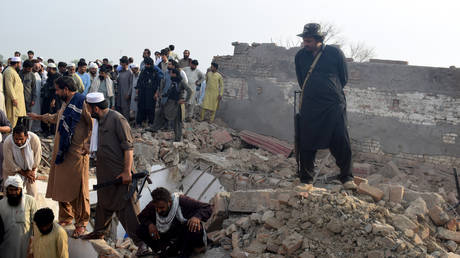
The tea in the bazaar of Bajaur was still hot when the world stopped.
It is a specific kind of quiet that follows an explosion in a mountain marketplace. It is not the silence of peace, but the deafening vacuum left behind when sound vanishes, replaced instantly by the frantic rustle of dust settling over overturned wooden carts, spilled turmeric, and shredded canvas.
At least sixteen lives ended in that instant. Sixteen souls who woke up with ordinary Tuesday plans—to buy flour, to trade livestock, to exchange gossip about the harvest—became a statistic on a news ticker thousands of miles away. But numbers on a screen do not bleed. They do not show the boots of rescue workers sinking into red dust, nor do they capture the sharp, metallic tang of cordite mingling with the earthy scent of the valley.
To understand violence in northwest Pakistan is to understand geography. This is a region carved by wind and history, where ancient stone watchtowers cling to jagged cliffsides, and borders are lines drawn in sand that the wind constantly reshapes. The Khyber Pakhtunkhwa province has long been a crucible. It is a place where empires go to stall and where local communities bear the invisible, crushing weight of geopolitical fallout.
Consider what happens when a bomb detonates in a crowded bazaar. The shockwave travels outward, shattering storefronts, but the emotional shrapnel travels much further. It pierces the fragile trust holding a community together.
In this hypothetical reconstruction based on recurring patterns documented by international monitors and local journalists, let us look at Tariq. Tariq is forty-two, the father of four, and a vendor who sells dry fruits in the Bajaur district. His morning routine is as rhythmic as the rising sun: unlocking his wooden stall, sweeping away the overnight grit, and arranging his mounds of walnuts and raisins with practiced symmetry.
When the blast occurred two blocks away, Tariq did not think of politics. He did not think of insurgent factions or counter-terrorism strategies. He thought of his youngest daughter’s shoes, which he had promised to pick up from the cobbler later that afternoon.
That is the true tragedy of conflict in the borderlands. It is the sudden, violent interruption of the mundane.
The security apparatus that responds to these tragedies is vast and often opaque. Following the blast, emergency responders rushed through choked mountain roads. Hospitals in Khar, the main town of the Bajaur tribal district, were instantly overwhelmed. Doctors and nurses, operating on adrenaline and dwindling supplies, faced the grim triage familiar to combat zones. Cots filled. Corridors turned into makeshift surgical wards. The local blood bank, perpetually underfunded, put out frantic appeals over loudspeakers mounted on local mosques.
These are the logistics of survival in a contested zone. They are messy, desperate, and heartbreakingly human.
Why do these attacks persist? The answer requires stepping back from the immediate carnage and looking at the structural fractures of the region. Northwest Pakistan shares a porous, mountainous border with Afghanistan. For decades, this terrain has served as a sanctuary and a transit route for various militant groups, including local factions of the Tehreek-e-Taliban Pakistan (TTP) and affiliates of regional extremist networks.
The state's response has historically oscillated between large-scale military operations—such as the historic Zarb-e-Azb campaign—and localized intelligence-based sweeps. Yet, clearing a territory is vastly different from holding it. When military forces push militants out of the rugged valleys, the remnants often resort to asymmetric warfare. They do not fight armies; they target marketplaces, mosques, and police checkpoints. They target civilians precisely because civilians are defenseless.
This creates an agonizing paradox for the residents of the region. To side with the state is to invite retaliation from insurgents who melt back into the civilian population by nightfall. To remain neutral is to live in perpetual crossfire, suspected by both sides of harboring the enemy.
The human cost of this unending friction is measured in displacement and psychological trauma. Generations of children in the tribal districts have grown up knowing the distinct whistle of incoming mortar fire better than the sound of schoolyard games. They can distinguish between the roar of a military helicopter and a civilian transport vehicle by pitch alone.
Yet, resilience here is not a poetic abstraction; it is a daily survival mechanism. Within hours of the dust clearing in Bajaur, shopkeepers whose windows were blown out began sweeping up the glass. Neighbors who lost cousins shared what little food they had with families displaced from neighboring hamlets. The bazaars, bruised and bleeding, slowly creaked back open.
Because life, stubborn and unyielding, refuses to surrender to terror.
As the sun dips behind the jagged silhouette of the Hindu Kush, casting long, bruised shadows across the valley, the silence returns. It is not the quiet of peace, but the heavy stillness of endurance. In the homes left vacant by the sixteen souls lost in the blast, lamps are lit. The kettle is put on the fire. And the people of the northwest wait for dawn, carrying a weight the rest of the world only glimpses through a screen.


