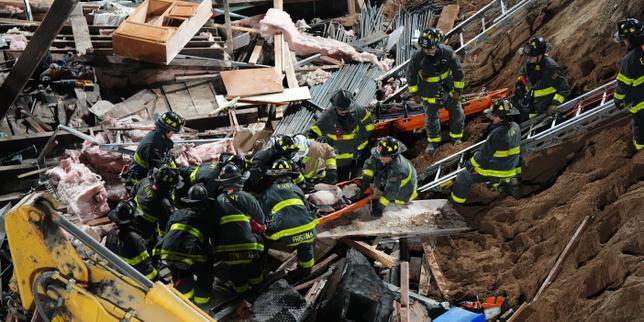
The sirens in New York sound different when the foundation gives way. They lose their usual urgent rhythm, flattening into a long, continuous scream that bounces off brick and brownstone until every street corner feels like the edge of a crater.
On an ordinary morning in Brooklyn, gravity suddenly stopped being a background law of physics and became an executioner. A building did not merely collapse. It folded. It groaned with the weight of decades, shuddered against the pavement, and turned into a mountain of pulverized mortar, iron, and broken living spaces in less time than it takes to draw a breath.
At least eight people lost their lives in those few seconds. Eight lives that were, moments earlier, pouring coffee, reaching for doorknobs, or looking out windows at the grey November sky.
The Sound of Falling Brick
Disaster in a city of eight million people is rarely quiet, but structural failure has a specific, terrifying acoustic signature. First comes the crack—a sharp, whip-like snap as load-bearing joists shear under unmanageable weight. Then, a low rumble that vibrates through the soles of your shoes before it hits your ears.
Imagine standing on a subway platform when an express train thunders past, but the platform itself is sliding into the dark.
Emergency crews arrived while the dust cloud still hung thick in the air, coating streetlights and emergency vehicles in a fine, chalky veil. Rescuers didn't scramble over rubble like action heroes; they crawled. They moved inch by inch, straining to hear the faint sound of knuckles tapping against wood or a muffled voice beneath tons of shattered masonry.
- The Initial Impact: The structure collapsed into its own footprint, crushing lower levels instantaneously.
- The Response: First responders deployed acoustic sensors, search dogs, and heavy rescue equipment, working against the constant threat of secondary collapses.
- The Loss: Eight fatalities were confirmed as search teams cleared the primary debris field.
Numbers fail us in moments like this. Eight is a statistic on a news ticker, easily digested between weather reports and traffic updates. But eight means eight unmade beds. Eight cell phones ringing on kitchen counters somewhere else in the city, answered by no one.
When the Inviolate Fails
We make a silent pact with the cities we inhabit. We trust that the ceiling above us will stay above us. We walk under concrete overhangs and sleep in apartments stacked twelve stories high because we believe in the invisible engineering that anchors our lives.
When an apartment building in Brooklyn collapses, that pact shatters.
Buildings are living systems. They settle, they flex, they breathe. They absorb the vibrations of passing trucks, the thermal expansion of summer heat, and the slow, relentless freeze of winter water creeping into microscopic fissures. But when maintenance lapses, when structural modifications weaken load pathways, or when age simply catches up with unreinforced masonry, the margin for error vanishes.
Consider what happens inside a wall over thirty years. Moisture seeps past aging sealant. Rebar inside the concrete begins to oxidize, expanding as it rusts, pushing outward from within—a phenomenon engineers call spalling. The concrete flakes away, losing its structural bond. The load shifts to neighboring bricks that were never meant to carry it. The building holds, day after day, month after month, until one small, seemingly insignificant trigger turns static weight into kinetic catastrophe.
The Geography of Grief
In the hours following the collapse, the surrounding blocks in Brooklyn froze. Neighbors stood at police barricades, wrapped in coats thrown hurriedly over morning clothes, staring at a gap in the skyline where a home used to be.
Disaster strips a neighborhood down to its rawest elements. Strangers shared thermos cups of hot coffee. First responders, their faces caked in grey dust, worked in shifts until their hands trembled from exhaustion. The air smelled of ruptured gas lines, wet concrete, and cold damp earth.
The investigation will take months. Engineers will examine fracture points, pull city permit records, test the integrity of surviving brickwork, and map the failure sequence node by node. There will be press conferences, legal inquiries, and calls for stricter building inspections across all five boroughs.
None of that changes the immediate truth on the ground.
A city is built of stone and steel, but it exists entirely in the human mind. It is a collection of shared routines, safe havens, and predictable paths home. When a building falls, it takes a piece of that collective security with it, leaving a silent void where life was happening just moments before.