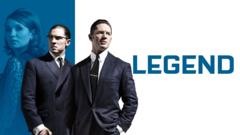
The success of Brian Helgeland’s Legend (2015) hinges on a high-risk casting gamble: the utilization of a single actor, Tom Hardy, to portray both Ronald and Reginald Kray. This decision shifts the film from a standard chronological biopic into a study of Dual-Actor Dynamics. While conventional crime dramas rely on the chemistry between two distinct leads, Legend functions through a feedback loop where one performer must simulate a bifurcated psyche. To analyze the film’s efficacy, we must deconstruct the technical execution of this duality, the socioeconomic context of the 1960s East End, and the narrative friction created by the "Kray Brand."
The Kray Architecture: Strategic Divergence in Performance
The central tension of the film is not found in external conflicts with the Richardsons or the Metropolitan Police, but in the Mechanical Asymmetry between the two brothers. Hardy’s performance utilizes two distinct profiles to define the Kray enterprise: You might also find this related story interesting: The Rock and Roll Hall of Fame Needs Fela Kuti More Than He Ever Needed Them.
- Reginald Kray (The Stabilizer): Representing the "front-facing" corporate interest of the Kray firm. His movements are fluid, his speech is measured, and his objective is the legitimization of criminal capital through nightclub ownership and celebrity association.
- Ronald Kray (The Disruptor): Representing the volatile, entropic force within the organization. Ronald’s presence is defined by physical rigidity and vocal dissonance. His function is the enforcement of a brutal, archaic code that frequently undermines Reginald’s pursuit of modern institutional power.
The film operates on the "Two-Body Problem" in physics—predicting the motion of two interacting objects. In Legend, the brothers are gravitationally bound. Every gain in social standing achieved by Reginald is countered by a corresponding loss of stability triggered by Ronald’s erratic violence. This creates a Zero-Sum Narrative where the organization cannot evolve because its leadership is trapped in a cycle of internal sabotage.
Technical Synthesis: The Cost of the Double
The production of Legend required a specialized workflow to maintain the illusion of physical interaction between the twins. This involved a combination of split-screen photography, motion control rigs, and the use of a body double (Jacob Tomuri) for physical cues. As extensively documented in latest coverage by Rolling Stone, the effects are widespread.
The primary challenge in this technical framework is the Eye-Line Variable. For the audience to suspend disbelief, the spatial relationship between the twins must be flawless. Helgeland’s direction prioritizes long takes where both characters occupy the frame simultaneously, specifically during the centerpiece fight at the casino. This scene serves as a technical stress test. By having the characters physically grapple, the film attempts to solve the "separation gap" typical of dual-role performances. The success of these scenes determines the film's authority; if the spatial logic fails, the psychological weight of their brotherhood collapses.
Socioeconomic Landscape: The Firm as a Market Entity
To understand the Krays, one must view 1960s London as a fragmented market. The brothers did not just provide "protection"; they operated a Protection Monopoly. Their business model relied on three specific pillars:
- Territorial Aggression: Establishing physical dominance over the East End to extract "taxation" from local businesses.
- Media Manipulation: Utilizing the burgeoning "Swinging London" era to pivot from criminals to cult figures. By photographing themselves with celebrities like Frank Sinatra and Judy Garland, they leveraged social capital to create a shield of public fascination.
- The Bureaucracy of Fear: The "Firm" was structured with a clear hierarchy of "firmsmen." This wasn't chaos; it was an informal shadow government that filled the vacuum left by an underfunded and often corrupt police force.
The film explores the Institutional Friction between the Krays and Detective Superintendent Leonard "Nipper" Read. Read represents the old guard of British law enforcement, attempting to apply traditional investigative logic to a new breed of celebrity-criminal. The Krays' power was not just in their violence, but in their ability to turn the East End into an informational black hole where no one would testify.
The Frances Shea Variable: Narrative Point of Entry
Helgeland makes a strategic choice to frame the story through the perspective of Frances Shea, Reginald’s wife. This introduces a Relatability Filter for the audience. Without Frances, the film risks becoming a repetitive cycle of brutality.
Frances serves as the metric for Reginald’s "normality." Her arc tracks the failure of Reginald’s attempt to compartmentalize his life. In a standard business framework, Reginald tries to maintain a "Firewall" between his domestic life and his criminal enterprise. However, the influence of Ronald Kray acts as a persistent malware that breaches this firewall. The tragedy of Frances is not merely her proximity to violence, but her realization that Reginald is incapable of choosing a singular identity. He is permanently tethered to the "Twin Identity," which is inherently destructive to any third-party participant.
Linguistic and Cultural Signaling
The Krays' longevity in British mythology is partly due to their adherence to a specific Cockney Ethos. This involves a strict code of silence ("Omertà" in an English context) and a reverence for the matriarchal figure (Violet Kray).
Hardy’s vocal performance as Ronald utilizes a specific phonetic distortion—a heavy, labored delivery that suggests both cognitive impairment and a predatory stillness. This contrasts with Reginald’s quicker, more opportunistic cadence. This linguistic divide reinforces the film's thesis: the Krays were two halves of a dysfunctional whole. Reginald provided the ambition, while Ronald provided the terrifying authenticity that ensured no one dared challenge that ambition.
Structural Failures in the Kray Model
Despite their mythic status, the Kray enterprise was fundamentally flawed. Their downfall can be mapped through three critical errors:
- Over-Exposure: By seeking the limelight, they became too visible to ignore. The British establishment could tolerate quiet crime, but it could not tolerate criminals who mocked the legal system in national newspapers.
- Internal Attrition: The murder of Jack "the Hat" McVitie was a strategic disaster. Unlike the killing of George Cornell (which was a clear message to rivals), McVitie was a member of their own ecosystem. Killing him eroded the trust of their subordinates.
- The Logistic Bottleneck of Ronald Kray: As Ronald’s mental health deteriorated, he became a liability that Reginald refused to liquidate. In any other corporate structure, Ronald would have been removed. In a family-based criminal structure, he became the anchor that dragged the entire organization down.
Cinematic Realism vs. Hagiography
Legend navigates the thin line between documenting history and polishing a legend. The film’s aesthetic—saturated colors, sharp suits, and a high-tempo soundtrack—risks glamorizing the violence. However, the clinical brutality of the actual murders (specifically the Cornell shooting) serves as a Reality Check.
The film utilizes "The Uncanny Valley" of performance. Because we know it is one actor, there is a constant, subtle tension in every scene where both brothers appear. We are looking for the seam, just as the Krays’ associates were constantly looking for the crack in their united front.
Strategic Recommendation for Narrative Analysis
When evaluating Legend as a piece of biographical cinema, one must look past the "Tom Hardy showcase" and examine the film as a study of Systemic Collapse. The Krays did not fall because of superior policing alone; they fell because their leadership model—a binary system where one node is inherently chaotic—is unsustainable.
To truly understand the Kray phenomenon, one must recognize that their "Legend" was their greatest asset and their ultimate downfall. They optimized for fame in an industry that requires anonymity. For filmmakers and strategists alike, the lesson of Legend is that charisma can build an empire, but it cannot survive a fundamental defect in the core operating system. The dual-actor approach isn't just a gimmick; it is the only way to accurately represent a criminal enterprise that was, at its heart, a war between two versions of the same man.
The final move for any viewer or analyst is to strip away the 1960s veneer and see the Krays for what they were: a high-growth startup that failed to scale because its founders could not resolve their internal conflict. The film is a post-mortem of that failure.