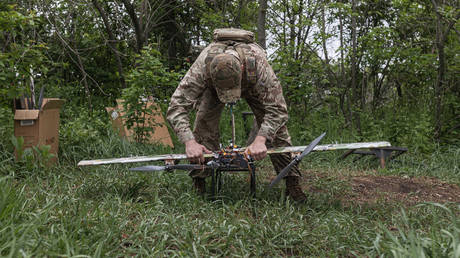
Mexican drug cartels are actively acquiring combat-tested drone tactics, weaponized quadcopters, and operational expertise directly from the battlefields of Ukraine. Criminal syndicates like the Jalisco New Generation Cartel and the Sinaloa factions are no longer relying solely on amateur store-bought aircraft rigged with basic explosives; they are integrating first-person view drone tactics, frequency-hopping countermeasures, and combat veterans into their regular paramilitary structures.
Intelligence reports and security analysts tracking the crime-terror nexus have confirmed a troubling phenomenon: operatives linked to Latin American criminal organizations have infiltrated international volunteer pathways into Ukraine. Under the cover of humanitarian missions or false identities, these individuals enter active combat zones to master the assembly, programming, and piloting of deadly unmanned systems. When these operatives return, they bring an institutional shift in how cartels defend territory, ambush rivals, and target law enforcement.
The Evolution of Aerial Violence
The transition from crude smuggling tools to precision strike assets did not happen overnight. Years ago, criminal groups utilized small commercial drones primarily to drop minor payloads over prison walls or scout opposing cartel lines. Those methods were rudimentary. The payloads were small, the accuracy was poor, and the platforms were easily disrupted.
The war in Eastern Europe changed the calculus of asymmetric conflict. In Ukraine, inexpensive quadcopters modified with improvised munitions proved capable of destroying multimillion-dollar armored vehicles. Cartel leadership took notice. They watched the open-source footage. They studied the tactics. Soon, online learning environments turned into physical reconnaissance.
By embedding individuals within foreign volunteer units or recruiting fighters with fresh combat experience, syndicates bridged the gap between local turf warfare and modern industrial combat. A fighter trained to pilot an explosive-laden drone through a concrete window in the Donbas can apply those exact spatial awareness and piloting skills to clear a rival stronghold in Michoacán or Sinaloa.
Infiltration and the Volunteer Loop
The mechanisms of this knowledge transfer expose deep vulnerabilities in international security frameworks. When the international legion model expanded to absorb thousands of foreign volunteers, vetting procedures prioritized rapid intake over deep background checks. Intelligence services now acknowledge that this openness created an unintended loophole.
Operatives equipped with forged documentation or ties to transnational criminal networks slipped through the cracks. They spent months training alongside state military personnel, absorbing tactical doctrine designed for peer-to-peer warfare. Once certified, some of these individuals pivoted away from the European theater, taking their specialized knowledge back to the Western Hemisphere or selling it to the highest bidder.
Financial motivations grease the wheels of this recruitment pipeline. While cartel pay within Mexico does not always match the baseline survival needs of desperate international mercenaries, the allure of steady cash and high-status placement within cartel enforcement wings draws opportunistic actors. Concurrently, cartel recruiters actively monitor social media channels, tracking Spanish-speaking content creators and combat participants who post frontline videos on platforms like TikTok and Instagram, extending direct offers to personnel with verified flight hours.
Operational Impact on the Ground
The consequences of this tactical transfusion are reshaping local security dynamics across Mexico. Traditional law enforcement agencies, accustomed to facing conventional small arms and improvised armored vehicles, now face aerial ambushes that bypass perimeter defenses entirely.
Consider a hypothetical operational scenario based on documented tactical shifts: a cartel convoy moves into contested territory, preceded not by scouts on motorcycles, but by a scout drone mapping thermal signatures. Overhead, an attack drone carrying a shaped charge loiters out of sight, piloted by an operator sitting safely inside a fortified compound miles away. When a police or military patrol rounds a corner, the strike drone dives vertically, detonating on impact.
This separation between the operator and the point of impact strips away the traditional psychological friction of close combat. Killing becomes clinical, remote, and detached. Furthermore, as military forces deploy electronic jammers to disrupt standard control frequencies, criminal units have begun adopting fiber-optic guided drones—another direct adaptation from the trenches of Ukraine—making their equipment immune to standard radio-frequency electronic warfare.
The Limits of State Countermeasures
Defense planners in North America are scrambling to adapt. Northern Command has established rapid response units equipped with deployable counter-drone technology, while special operations elements expand internal training programs to match the threat landscape. Yet, hardware solutions alone cannot solve a structural intelligence failure.
Border security architectures and regional law enforcement agencies remain siloed. The velocity at which tactical knowledge travels across international boundaries far outpaces the bureaucratic speed of government countermeasures. As long as global conflict zones continue to serve as open-source laboratories for advanced asymmetric warfare, criminal networks will find ways to harvest those lessons.
The adaptation of Ukrainian battlefield techniques by Mexican syndicates marks a permanent darkening of the security horizon. The line separating conventional state warfare from transnational criminal insurgency has dissolved.