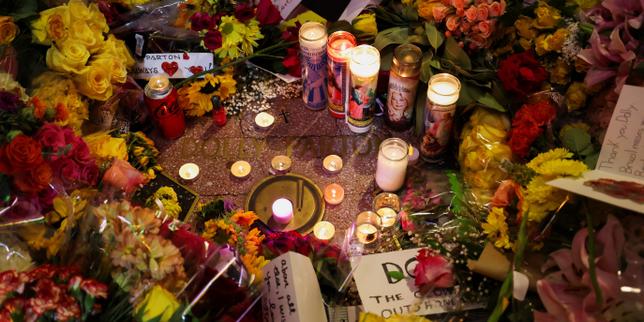
The country music icon Dolly Parton passed away at the age of eighty, taking with her an era of show business built entirely on unyielding work ethic, self-deprecation, and a profound understanding of human nature. Across the United States, official flags dropped to half-staff by presidential order, while millions grappled with the rare realization that the person everyone thought would simply outlive time itself had finally clocked out. Yet the official mourning misses the point. The collective grief is not merely for a singer who wrote catalog standards like Jolene and I Will Always Love You; it is a sudden, terrifying awareness that the corporate-media machine no longer produces anyone remotely resembling her.
For six decades, Parton navigated the treacherous waters of global fame while wearing a rhinestone-encrusted suit of armor that she forged herself. She understood the currency of self-awareness long before social media algorithms made performance art mandatory for every waking hour. When interviewers poked fun at her appearance, she leaned into the joke with surgical precision, famously remarking that it costs a lot of money to look this cheap. That single sentence deflected millions of dollars worth of misogynistic critique while keeping complete control of the narrative firmly in her acrylic-tipped hands. She was a masterclass in corporate and artistic independence disguised as a sweet-talking mountain girl.
The Architecture of an Empire Built on Borrowed Notes
To understand why her passing leaves an unfillable vacuum, one must examine the business model she pioneered. Most artists sign away their publishing rights for a quick advance and a fraction of future royalties. Parton did the opposite. When Elvis Presley wanted to record I Will Always Love You in the mid-1970s, Colonel Tom Parker demanded half of the publishing rights as a condition of the deal. Parton politely refused. It was a risky financial gamble for a songwriter who was still establishing her mainstream footprint, but keeping those rights eventually turned into a multi-million-dollar catalog that funded her future endeavors.
That shrewdness defined her trajectory. She did not wait for Hollywood or Nashville executives to hand her opportunities. When she wanted a physical monument to her Appalachian roots, she built Dollywood in Pigeon Forge, Tennessee, transforming a struggling rural county into a tourism juggernaut that employs thousands of local residents. She did not lend her name for a quick endorsement check; she took equity, created operational oversight, and ensured that her business ventures poured money directly back into the hills where she grew up.
Consider the sheer scale of her literacy initiative, the Imagination Library. Without taking federal grants or corporate bailouts initially, she scaled a program that mails millions of free books monthly to children worldwide. It operates with a clockwork efficiency that puts most government agencies to shame. She solved a systemic education gap using personal capital and local community networks, proving that grassroots philanthropy does not require a board of venture capitalists to succeed.
The Politics of Absolute Neutrality
In an era where every public figure is badgered into taking immediate, performative stances on polarized cultural issues, Parton maintained a masterclass in strategic neutrality. She loved people first, ideologies second. That approach drew occasional criticism from hyper-partisan commentators on both sides of the aisle who demanded she pick a team. She refused. She reasoned that if you alienate half of your audience, you lose the ability to sing to them, to comfort them, or to fund your charitable operations.
Her refusal to accept the Presidential Medal of Freedom—first because of her husband's declining health, and later due to scheduling conflicts and a desire to avoid political optics—demonstrated an uncommon spine. She did not need a shiny lapel pin from a politician to validate her contributions to American culture. She knew her worth was anchored in the hearts of working-class people who sang her lyrics in dive bars, church basements, and highway rest stops across the country. That independence is entirely extinct in contemporary entertainment. Today's stars live in fear of public relations storms, curating every micro-expression to avoid digital cancellation. Parton simply laughed, put on another wig, and did whatever she wanted.
Why the Industry Cannot Replicate the Blueprint
Modern pop and country stars are manufactured through focus groups, TikTok virality cycles, and algorithmic optimization. They are products designed for immediate consumption and rapid depreciation. Parton was an anomaly because she possessed authentic roots combined with hyper-modern commercial acumen. She bridged the gap between nineteenth-century Appalachian folk tradition and twenty-first-century global branding without ever sounding insincere.
The music industry has changed into a sterile factory where artists are heavily managed subsidiaries of multinational conglomerates. Songwriting camps feature a dozen writers piecing together tracks for maximum streaming metrics. Parton sat down with a cassette recorder and wrote anthems that captured universal human pain in three simple chords. Her authenticity was not a marketing strategy; it was the baseline reality of a woman who grew up sharing a bed with her siblings in a cabin with no electricity.
The flags will go back up after a week. The news cycle will pivot to the next manufactured crisis or temporary chart-topper. But the cultural landscape is significantly colder without the woman who proved that you can conquer the world while remaining fiercely kind. Nobody is coming to save the throne she left vacant because nobody left in the spotlight possesses the courage, the intellect, or the heart to sit in it.