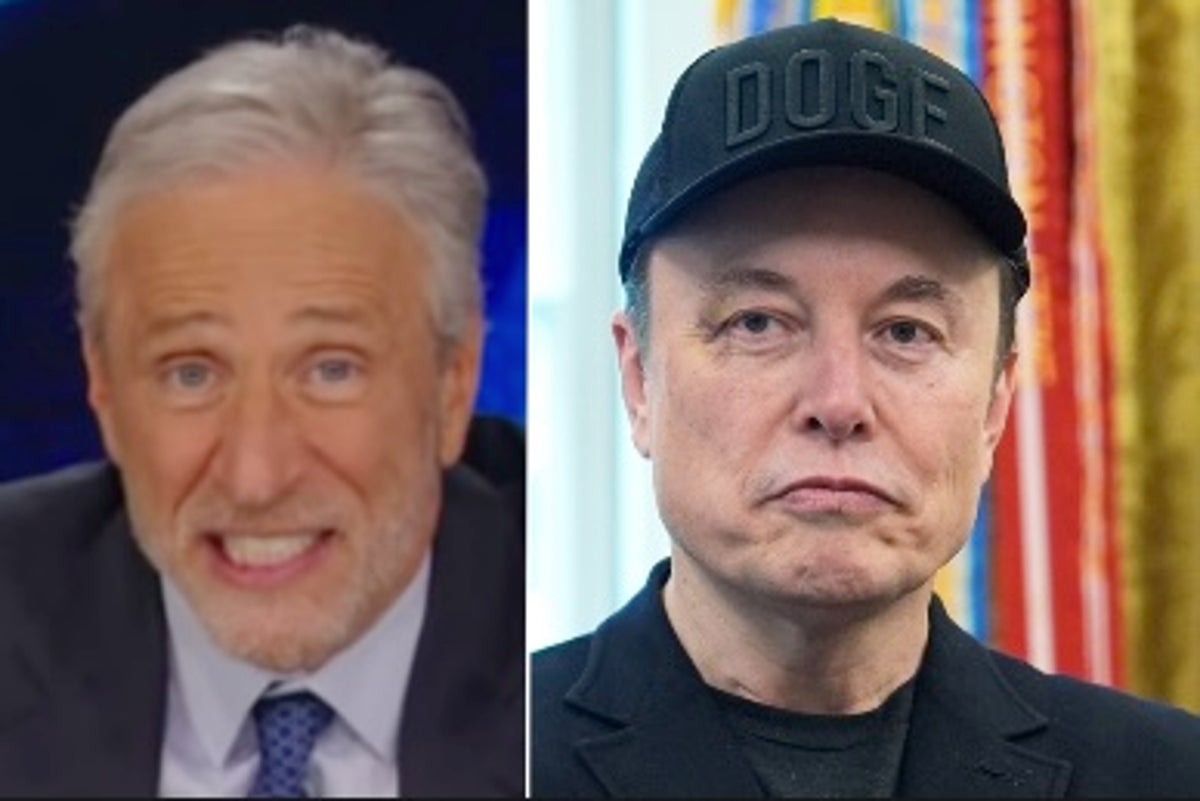
The screen glows with a cold, blue light that feels more like a stare than a reflection. On one side of the digital divide sits a man who owns the sky, or at least the satellites threading through it. On the other, a man who spent decades behind a desk, peeling back the layers of political absurdity with nothing but a pen and a smirk. When Elon Musk and Jon Stewart collide, it isn't just another celebrity spat. It is a fundamental tremor in the bedrock of how we talk to each other.
To understand why a billionaire would label a beloved comedian an "extremely skilled propagandist," we have to look past the character counts and the blue checkmarks. We have to look at the machinery of the modern town square.
The Architect and the Satirist
Elon Musk views X as a grand engineering project. To him, the platform is a biological super-intelligence, a hive mind where the only rule should be the absolute velocity of data. If the truth is out there, he believes it will eventually rise to the top if you just remove the filters. It is a technician’s view of human nature—logical, cold, and convinced that the "algorithm of free speech" can solve the messiness of tribalism.
Then there is Jon Stewart. Stewart represents the old guard of public discourse, a time when "truth" wasn't just raw data dumped into a feed. For Stewart, and the millions who grew up watching him, truth is something you arrive at through context, irony, and the relentless questioning of power. When Stewart critiques the current state of X, he isn't just complaining about a website. He is mourning the loss of a shared reality.
The friction started because Stewart dared to point out the obvious: the town square is currently a bit of a mess. He suggested that the removal of moderation and the rise of paid amplification had turned the platform into an echo chamber for the loudest, rather than the most accurate. Musk’s response was swift. He didn't just disagree. He went for the jugular, calling Stewart a master of propaganda.
It was a fascinating choice of words. Propaganda, by definition, is the spreading of ideas or information for the purpose of helping or injuring an institution, a cause, or a person. By calling Stewart a propagandist, Musk is suggesting that the comedian’s brand of "common sense" is actually a highly manufactured weapon used by the establishment to maintain control.
The Invisible Stakes of the Scroll
Imagine a woman named Sarah. She’s sitting on a bus in a mid-sized city, scrolling through her phone to kill time. She sees a clip of Stewart’s latest monologue. She laughs. It feels authentic to her. Then, she scrolls down and sees a post from Musk, claiming that Stewart is a tool of a dying media elite.
Sarah is now caught in a pincer movement. She isn't just consuming information; she is being forced to choose a side in a war she didn't sign up for. This is the "human element" that gets lost in the headlines. The constant friction between these titans creates a centrifugal force that flings the rest of us toward the edges.
The middle ground is disappearing. It’s being paved over to make room for more combatants.
When Musk attacks Stewart, he is signaling to his millions of followers that skepticism of his platform is a sign of brainwashing. When Stewart critiques Musk, he is signaling that the billionaire’s vision of "free speech" is actually a descent into chaos. They are both right, and they are both wrong, and the space between them is where the rest of us actually live. Or used to live.
The Engineering of Outage
The reality of our current digital life is that outrage is the most efficient fuel. It burns hot, it burns fast, and it keeps people looking at the screen. Musk knows this better than anyone. By engaging with Stewart, he isn't just defending his company; he is generating engagement. He is feeding the beast.
Consider the mechanics of the "Propagandist" label. It is a powerful word because it implies a hidden motive. It suggests that Stewart isn't just a guy with an opinion, but a cog in a machine. This is a classic rhetorical move: if you can’t disprove the message, destroy the messenger. It’s a tactic used in every political campaign since the invention of the printing press, but on X, it happens at the speed of thought.
The tragedy is that both men actually claim to want the same thing: a better-informed public. Musk wants it through a decentralized, unfiltered stream of consciousness. Stewart wants it through curated, thoughtful critique. They are two different doctors arguing over a patient who is currently bleeding out on the table.
The patient is us.
The Cost of the Conflict
We are paying for this feud with our attention and our sanity. Every time a major public figure dismisses a critic as a "propagandist" or a "shill," the possibility of a nuanced conversation dies a little more. We are being trained to see disagreement not as a difference of opinion, but as a moral failing or a conspiracy.
Think about the last time you had a productive conversation with someone you fundamentally disagreed with. It probably didn't happen on a screen. It probably happened over a meal, or while working on a project, where you could see the other person’s eyes and hear the cadence of their voice. You could sense their humanity.
On the platform formerly known as Twitter, humanity is stripped away and replaced by avatars. When Musk and Stewart fight, they aren't fighting as people; they are fighting as symbols. Musk is the disruptor, the genius-king who wants to break the old world to build a new one. Stewart is the skeptic, the voice of the people who remembers when things made a little more sense.
But symbols don't bleed. People do.
The people caught in the crossfire are the ones who just want to know what’s happening in the world without being insulted or manipulated. They are the ones who feel the rising anxiety of a society that can no longer agree on basic facts.
The Mirror of the Algorithm
We like to blame the leaders, but the platform is also a mirror. Musk provides the tools, but we are the ones using them. We are the ones who retweet the insults and ignore the nuance. We are the ones who find comfort in the "us vs. them" narratives because they make the world feel simpler.
The argument between Musk and Stewart is a perfect microcosm of our era. It’s a clash between the Silicon Valley ethos of "move fast and break things" and the traditional media ethos of "verify and contextualize."
Musk’s vision for X is a world where the crowd decides what is true. It is a radical experiment in digital democracy, or perhaps digital anarchy. Stewart’s vision is one where we acknowledge that some voices have more weight because they have put in the work to be credible.
Neither side is willing to blink.
Musk sees Stewart’s skill—his ability to weave a narrative, to use humor as a scalpel—as a threat. He calls it propaganda because it is effective. It moves people. And in the attention economy, movement is power.
Beyond the Blue Light
Eventually, the bus reaches Sarah’s stop. She tucks her phone into her pocket and steps out into the cool air. For a moment, the world is quiet. There are no notifications, no trending topics, no billionaires arguing with comedians. There is just the sound of traffic and the smell of rain on the pavement.
She walks past a neighbor and nods. The neighbor nods back. They don't know each other’s politics. They don't know who they follow on X. In that brief, silent exchange, there is more "truth" than in a thousand viral threads.
The real world is still there, waiting for us to return to it. It is messy, and slow, and often boring. It doesn't have an algorithm, and it doesn't offer the dopamine hit of a well-placed insult. But it is the only place where we can actually hear each other.
The digital coliseum will always be there, the lights will always be bright, and the gladiators will always be fighting for our gaze. We can stay and watch the bloodbath, or we can choose to look away.
The screen stays in the pocket. The walk home continues. The silence is the only thing that isn't for sale.