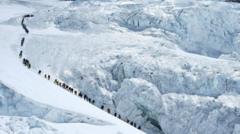
The mainstream media loves a big number. When 274 climbers stand on the summit of Mount Everest via the Nepalese southern route in a single 24-hour window, the press rushes to publish panoramic photos of the human snake winding up the Hillary Step. They frame it as a triumph of logistics, an awe-inspiring human achievement, or a tragic symptom of over-tourism.
They are missing the real story.
These massive, single-day summit spikes are not a sign that Everest has become a theme park. They are the result of a dangerous, collective psychological failure known as herd bias, engineered by commercial expedition operators who prioritize risk mitigation on paper over actual safety on the mountain.
When hundreds of climbers push for the top simultaneously, it is not because the weather is suddenly perfect. It is because the industry has trained climbers to fear being left behind more than they fear the physics of the Death Zone.
The Myth of the Perfect Weather Window
The standard narrative dictates that massive bottlenecks occur because the climate dictates a narrow sliver of time where summiting is possible. Journalists look at a crowd of 200 plus people at 8,000 meters and assume, "Well, that was the only day they could go."
That is a fundamental misunderstanding of high-altitude meteorology.
Alan Arnette, a veteran mountaineer and one of the most respected chroniclers of Everest seasons, has repeatedly pointed out that weather windows are rarely as rigid as the commercial operators claim. The "perfect window" is often a consensus fabrication.
What actually happens is a high-stakes game of psychological chicken. Expedition leaders look at the same meteorological data from Swiss or Austrian forecasting services. They see a dip in wind speeds below 20 mph. Instead of spacing out their attempts across a five-day period of acceptable weather, every major guiding company targets the exact middle of that window to maximize their statistical safety margin.
They are optimizing for their business metrics, not your survival. By crowding everyone into the same 24-hour slot, they ensure that if something goes wrong, there are dozens of other Sherpas and guides nearby to assist. It is a pooling of liability disguised as a safety strategy.
The Mathematical Failure of Efficiency
Let us break down the mechanics of a 274-climber day.
In the Death Zone—anything above 8,000 meters—the human body cannot acclimatize. It is dying. Supplemental oxygen bottles are not a luxury; they are a ticking clock. A standard supplementary oxygen cylinder lasts roughly five to seven hours depending on the flow rate, usually set between 2 to 4 liters per minute.
When you have nearly 300 people moving along a single fixed line on the Southeast Ridge, a bottleneck does not just slow you down. It alters the fundamental math of your life support system.
- The Waiting Tax: Standing still at the Bottleneck or the Hillary Step requires roughly 2 liters of oxygen per minute just to keep hypothermia at bay. You are burning your descent fuel while standing still.
- The Velocity Penalty: A line moves only as fast as its slowest participant. On a record-breaking day, you are tracking the pace of an unathletic tourist who paid $110,000 to be short-roped up the mountain.
- The Exposure Multiplier: Frostbite does not care about record statistics. Ambient temperatures at -30°C combined with zero movement mean blood flow drops to the extremities within thirty minutes.
I have watched commercial operations defend these crowded days by stating that their success rates remain high. What they fail to mention is the long-term toll: the undisclosed frostbite amputations, the permanent neurological damage from prolonged mild hypoxia, and the sheer luck required when a storm delays its arrival by just two hours.
Dismantling the PAA Fallacies
Whenever a record day is reported, the public asks the wrong questions. The collective internet echo chamber focuses on superficial fixes while ignoring the underlying economic incentives.
Why doesn't Nepal just limit the number of permits?
This is the most common critique, and it is entirely naive. Tourism department officials in Kathmandu view Everest as a primary economic engine. In a country where the per capita GDP hover around low figures, millions of dollars generated from $11,000 permit fees alone cannot just be rationed away without catastrophic local economic fallout.
Furthermore, limiting permits does not solve the bottleneck problem. If Nepal issues only 200 permits for the entire season instead of 400, guess what? All 200 people will still try to summit on the exact same "perfect" day because the psychological herd mentality remains unchanged.
Why don't guides just space themselves out?
Because the commercial guiding market has evolved into an oligopoly. A few massive local Nepali agencies now control the vast majority of clients. It is easier for these mega-operators to move their massive infrastructure—dozens of guides, hundreds of oxygen bottles, and clients—all at once rather than managing staggered, smaller teams over a week. It reduces their overhead costs. Managing a single massive summit push requires fewer total days of paid Sherpa labor at high camps than maintaining three separate smaller pushes.
The Operational Reality Nobody Wants to Face
If you want to survive Everest, or any major commercial peak like K2 or Manaslu, the solution is counter-intuitive: You must actively avoid the consensus best day.
The safest climbers on the mountain are often those who deliberately choose the marginal days. They summit in 25 mph winds instead of 10 mph winds. Why? Because a slightly higher wind speed means they have the entire mountain to themselves. They move at their own pace. They do not wait in lines. They spend three hours less in the Death Zone overall, meaning their total oxygen consumption is lower, and their risk of exposure drops significantly despite the worse ambient weather.
This approach requires an elite level of personal competence and a guide who isn't managing a flock of eighty clients. It requires rejecting the safety blanket of the crowd.
The industry sells the crowd as safety. "Look at all these people," a client thinks. "It must be safe to go."
The exact opposite is true. The crowd is the hazard.
Stop looking at a 274-person summit day as a milestone. It is a systemic failure of risk management. It is a monument to collective panic, where individual decision-making is surrendered to the safety of the herd. The moment you step into a line of two hundred people at 26,000 feet, you are no longer a climber. You are a component in a high-altitude traffic jam, waiting for someone else's mistake to cost you your toes, or your life.