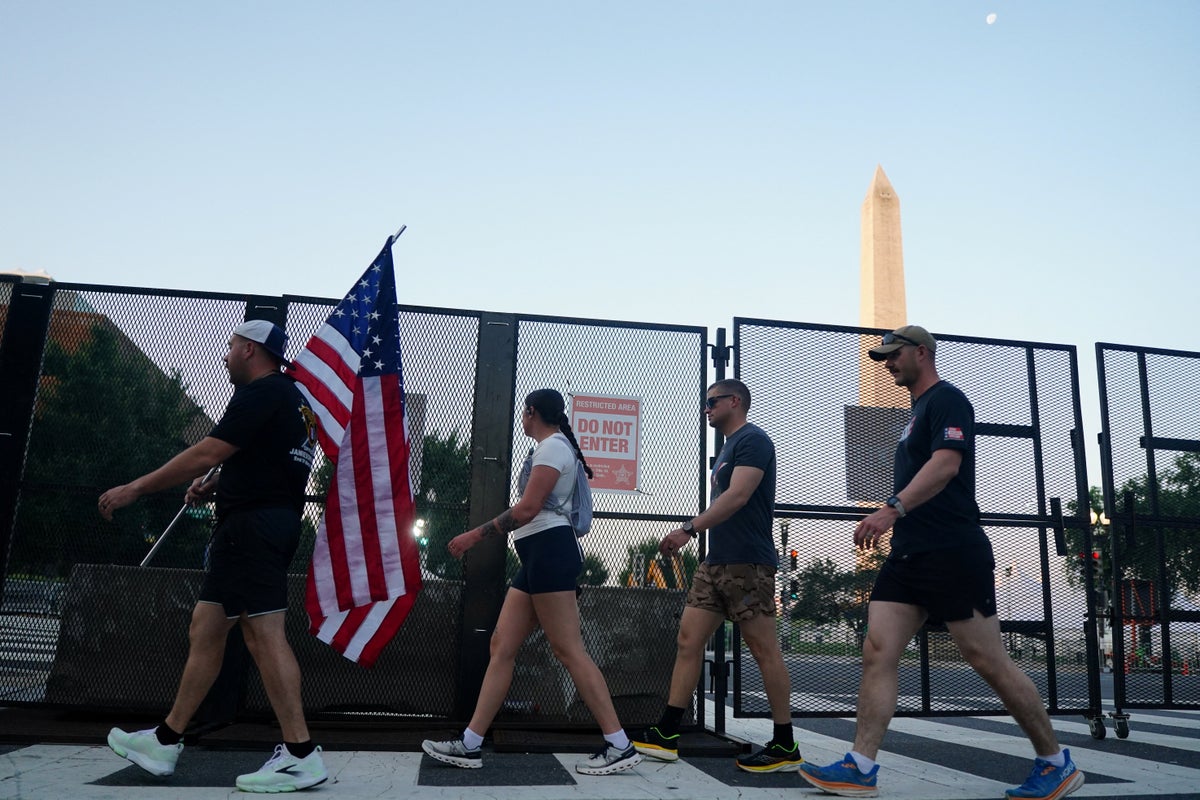
America's 250th birthday was supposed to be the ultimate party. Instead, the nation's capital choked under a brutal heat dome that brought the grandest plans to a grinding halt. When organizers abruptly canceled the iconic DC Independence Day parade late Friday night, they confirmed what many had feared for weeks. The elements won.
The National Weather Service dropped an extreme heat warning directly onto Washington, sending heat index values skyrocketing between 110°F and 115°F. You simply cannot march a band down Constitution Avenue in conditions that mirror a commercial oven. It is dangerous, irresponsible, and as we saw on the National Mall, physically impossible for hundreds of spectators who tried to brave the sun. Meanwhile, you can explore other events here: The Unseen Bridge Across the Atlantic.
For months, the hype machine promised an unforgettable semiquincentennial celebration. We were promised flyovers, massive concerts, and the largest fireworks display in American history. What we actually got was a stark reminder of how vulnerable our public events are to climate realities. Visitors who spent thousands of dollars on flights and hotels found themselves stranded in air-conditioned hotel lobbies, staring out at an empty parade route.
It is a total disappointment, but it was completely necessary. To explore the bigger picture, check out the recent report by The New York Times.
The National Mall Meltdown by the Numbers
The crisis did not happen in a vacuum. The warning signs flared up twenty-four hours before the parade was officially axed. On Friday, the Trump-backed Great American State Fair on the National Mall turned into an open-air medical emergency zone.
The DC Fire Department spent its Friday afternoon treating forty-four separate individuals for acute illnesses right on the Mall. Eleven of those people had to be rushed to local hospitals in ambulances. Seven of those cases were classified as serious. People were collapsing into the gravel, suffering from severe heat exhaustion and dehydration.
The situation grew so chaotic that the event's organizing group, Freedom 250, had to slam the gates shut on Friday afternoon just to let medical staff catch their breath. When they attempted to reopen on Saturday, they had to push the start time back to noon, hoping the worst of the morning humidity would lift. It did not.
The heat did not just affect the crowds. It broke the infrastructure. The fair's marquee Ferris wheel suffered a mechanical failure, leaving empty cars dangling in the scorching air. Performers at the Thursday night rehearsals for the annual Capitol Fourth Concert were barred from the stage by the U.S. Capitol Police because the ambient temperature on the metal staging structures was hot enough to cause second-degree burns.
Two Organizations and a Logistical Nightmare
The chaos on the ground exposes a deeper structural rift in how this milestone holiday was managed. Two entirely separate entities have been pulling the strings behind the scenes, and their conflicting styles did not help the emergency response.
On one side sits the America250 Commission. This is a bipartisan congressional body that has spent years planning long-term commemorative projects with strict transparency rules. On the other side is Freedom 250, a nonprofit created just eight months ago with heavy backing from the Trump administration. Freedom 250 took control of the prime real estate on the National Mall, handling the state fair and the massive fireworks show. Because they operate without the same public transparency requirements as the official commission, finding out who was making safety decisions during the heatwave became a guessing game.
The programming schedule itself caused widespread confusion. The Capitol Fourth Concert, which traditionally anchors the evening of July 4, had to be pushed up to Friday night, July 3. Why? Because Freedom 250 booked the entire Mall for Saturday night to accommodate Donald Trump’s personal address and a massive inventory of explosives.
Even the talent pool fractured. A significant number of high-profile musical acts quietly backed out of the weekend lineup in May, citing confusion over which organization was running the show and what the political tone of the event would be.
The Political Spectacle at 100 Degrees
Politics did not take a holiday, even as the mercury hit triple digits. President Trump spent Friday evening at the foot of Mount Rushmore in South Dakota, delivering a fiery, dark speech targeting political rivals whom he labeled "godless communists." He leaned heavily into military achievements and Second Amendment rights while the chiseled stone faces of his predecessors loomed in the background.
Immediately after that speech, he flew back to Washington to prepare for his central role on the Mall. Despite the parade cancellation and the medical emergencies, the administration refused to dial back its evening plans. Trump promised a "really long" speech from the main stage at 9:45 p.m., right before unleashing an onslaught of 860,000 fireworks shells from ten different locations, including eight massive barges floating on the Potomac River.
The contrast is wild. While local officials pleaded with the public to stay indoors to avoid heatstroke, the federal apparatus pushed forward with a forty-minute pyrotechnic bombardment billed as the largest in global history.
Predictably, the extreme weather quickly became weaponized online. Prominent election deniers and online commentators immediately claimed that the oppressive heatwave was not a natural event at all. Instead, they alleged it was a geoengineered weather attack designed by political enemies to ruin the President's signature celebration.
The Coastal Domino Effect
Washington was not the only city that melted under the July heat dome. The parade cancellations rolled across the East Coast like a line of falling dominoes.
In Philadelphia, Mayor Cherelle Parker managed to join officials to bury a national time capsule outside Independence Hall. The capsule contains artifacts representing modern American values and is locked until the year 2276. But the city's historic Salute to Independence Parade? Canceled. The risk to marchers in heavy wool colonial uniforms was too high.
Step outside the major metros, and the story was the same:
- Leesburg, Virginia called off its annual street procession entirely.
- Laurel, Maryland pulled the plug on its local events by Friday morning.
- Takoma Park, Maryland canceled its community march after organizers realized the liability of asking volunteers to stand on asphalt for four hours.
Tara Egan, the president of the Takoma Park Independence Day Committee, spelled out the reality in a blunt email to participants. She noted that parading in this specific heat is fundamentally reckless, and asking a community to gather on baking blacktop was completely irresponsible.
Even New York City did not escape the weather disruptions. While Vice President JD Vance stood in Manhattan urging Americans to reject what he called a "two-dimensional view" of the country's historic imperfections, the Sail 4th 250 parade of tall ships was hit by a violent flash storm. The sudden tempest forced organizers to evacuate the premier public viewing areas on Governors Island, cutting the maritime spectacle short.
How to Navigate the Remaining Mall Events Safely
If you are currently in Washington and still intend to watch the 860,000-shell fireworks display tonight, you need to abandon any traditional ideas of holiday comfort. The parade is gone, but the danger from the environment remains active.
The United States Park Police, the Secret Service, and FEMA have set up an emergency infrastructure across the Mall to keep the remaining crowds alive. Do not try to tough this out.
You must locate the air-conditioned cooling buses parked along the perimeter of the Mall. These are mobile stations designed specifically to lower your core body temperature if you start feeling dizzy. Free water distribution points and high-capacity refill stations have been set up near the monuments. Use them constantly.
Look out for your friends. If someone stops sweating, gets confused, or complains of nausea, do not look for a shady tree. Walk them directly to a medical tent or flag down a Park Police officer immediately. The local emergency rooms are already packed with dozens of fairgoers who waited too long to seek help.
The Pacific Northwest enjoyed pleasant, rain-cooled celebrations in the mid-60s today, but the East Coast is locked in a battle with a dangerous atmosphere. Enjoy the fireworks if you must, but treat this historic 250th anniversary for what it has actually become: an exercise in survival.