The humidity in Washington D.C. during early July does not just sit in the air; it heavy-presses against your chest like a wet wool blanket. If you stand on the National Mall long enough, the heat stops being weather and becomes a physical presence. On this specific Independence Day, the usual scent of sulfur from cheap sparklers and charred hot dogs blended with something entirely different. Aviation fuel. The heavy, metallic tang of low-flying fighter jets shook the glass in the food trucks and vibrated right through the soles of sneakers worn by families who had traveled across state lines.
For decades, the rhythm of the Fourth of July was predictable. It was a day of aggressive neutrality. Families wore faded Old Navy flag shirts, kids melted their popsicles onto the pavement, and politicians gave predictable, boilerplate speeches about unity that everyone politely ignored while waiting for the sun to go down. The holiday belonged to a vague, collective past.
Then, the stage shifted.
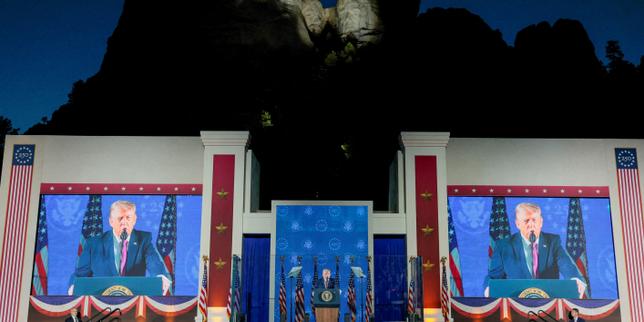
Imagine a spectator named Marcus. He is not a political operative or a pundit; he is a high school history teacher from Ohio who saved up for six months to show his teenagers the monuments. He expected to see the Lincoln Memorial. Instead, he found himself staring at a cordoned-off VIP section, rows of tanks stationed like prehistoric beasts on the asphalt, and jumbo screens broadcasting a singular face. The collective American origin story was being systematically rewritten in real time, shifting its focus from a group of chaotic, flawed revolutionaries in 1776 to a single, living protagonist.
This is the art of the gravitational pull. Some public figures do not just participate in the news cycle; they swallow it whole. When a national celebration is successfully redirected to orbit an individual, it fundamentally alters how a society remembers its own story.
The Architecture of the Spotlight
It takes a rare, specific instinct to look at a centuries-old tradition and decide it needs a master of ceremonies. Most politicians try to blend into the background of national iconography. They stand in front of the flag, hoping some of its historic dignity rubs off on them by osmosis. The strategy here is entirely inverted. The individual does not seek shelter under the flag; the flag is repurposed as a backdrop for the individual’s personal drama.
Consider the mechanics of how this happens. A standard political rally is easy to dismiss if you are not part of the tribe. You can turn off the television, scroll past the social media feed, or stay inside your echo chamber. But a national holiday is unavoidable. It is baked into the calendar. By inserting oneself into the precise center of a day dedicated to collective identity, the normal rules of political gravity are suspended.
Marcus watched as the crowds divided themselves. The physical space of the Mall, once a sprawling lawn open to anyone willing to fight for a patch of grass, became a mapped territory of access. Ticketed enclosures for donors. Special access paths. The architecture of the event spoke louder than any speech delivered from the podium. It said, quite clearly, that this day was no longer a shared inheritance. It was a performance, and invitation depended on allegiance to the lead actor.
This shift changes the psychological contract between a leader and the public. In a traditional republic, the leader is a temporary custodian of the office. They are a footnote in the grander story of the nation. When the narrative is successfully centralized, the nation becomes the footnote. The history of the country is re-framed not as a steady, messy march toward progress, but as a prologue leading up to the arrival of the current figurehead.
The Invisible Cost of Personalization
When everything becomes about a single person, our collective capacity to handle complex reality begins to atrophy. Nuance requires space. It demands that we look at systemic problems—economic shifts, institutional decay, cultural divides—and acknowledge that they are larger than any one individual's ability to fix or cause them.
But a personalized narrative offers a seductive alternative. It simplifies the chaos of the modern world into a simple, binary script: the hero against the detractors.
For the person standing in the crowd, this simplification feels electric. It provides immediate clarity. You no longer need to understand the Byzantine intricacies of trade policy or foreign diplomacy; you only need to trust the instincts of the person at the microphone. The danger is that this clarity is an illusion. It is a house built on the shifting sand of personality, and when that personality eventually exits the stage, the structure collapses, leaving the spectators entirely unprepared for the quiet, unglamorous work of self-governance.
The real casualty of this centralization is not the political opposition. It is the quiet spaces of American life. The moments where people who disagree on everything else can sit on a aluminum bleacher, watch a high school marching band pass by, and feel a faint, shared connection to something larger than their Twitter feeds. When the parade itself demands that you take a side on a single man, that shared connection vanishes. The bleachers become another battleground.
The View from the Outer Ring
Step back from the immediate noise of the Mall, away from the chanting crowds and the protestors holding signs at the perimeter. Look at the people who are simply trying to navigate the day. The street vendors selling bottled water for two dollars. The park rangers trying to keep people off the fragile roots of the cherry trees.
To them, the centralization of the narrative manifests as extra work, longer shifts, and heightened tension. The atmosphere feels fragile, as if a single stray spark could ignite something far more dangerous than fireworks. The celebration loses its joy and takes on the rigid, nervous energy of a military review.
We have arrived at a point where our collective memory is being privatized. The symbols that used to belong to everyone are being leased out to the highest bidder in the attention economy. It is a brilliant strategy for winning a news cycle, but it is a disastrous way to sustain a civilization. A culture that cannot celebrate its existence without turning the celebration into a referendum on a single ego is a culture that has forgotten how to talk to itself.
The fighter jets eventually flew back to their bases, leaving long streaks of gray smoke across the evening sky. The tanks were loaded back onto flatbed trucks, their treads leaving deep, dark grooves in the asphalt. The crowds filed out into the Metro stations, tired, sunburnt, and quiet.
Marcus took his teenagers back to the hotel. They didn't talk much about the declaration of independence or the ideals of the founders on the ride back. Instead, they talked about the security lines, the speeches, and the man who had managed to make the birth of a nation feel like a footnote in his own biography. The mirror had been held up to the country, and for one long, hot afternoon, the country looked exactly like Donald Trump.