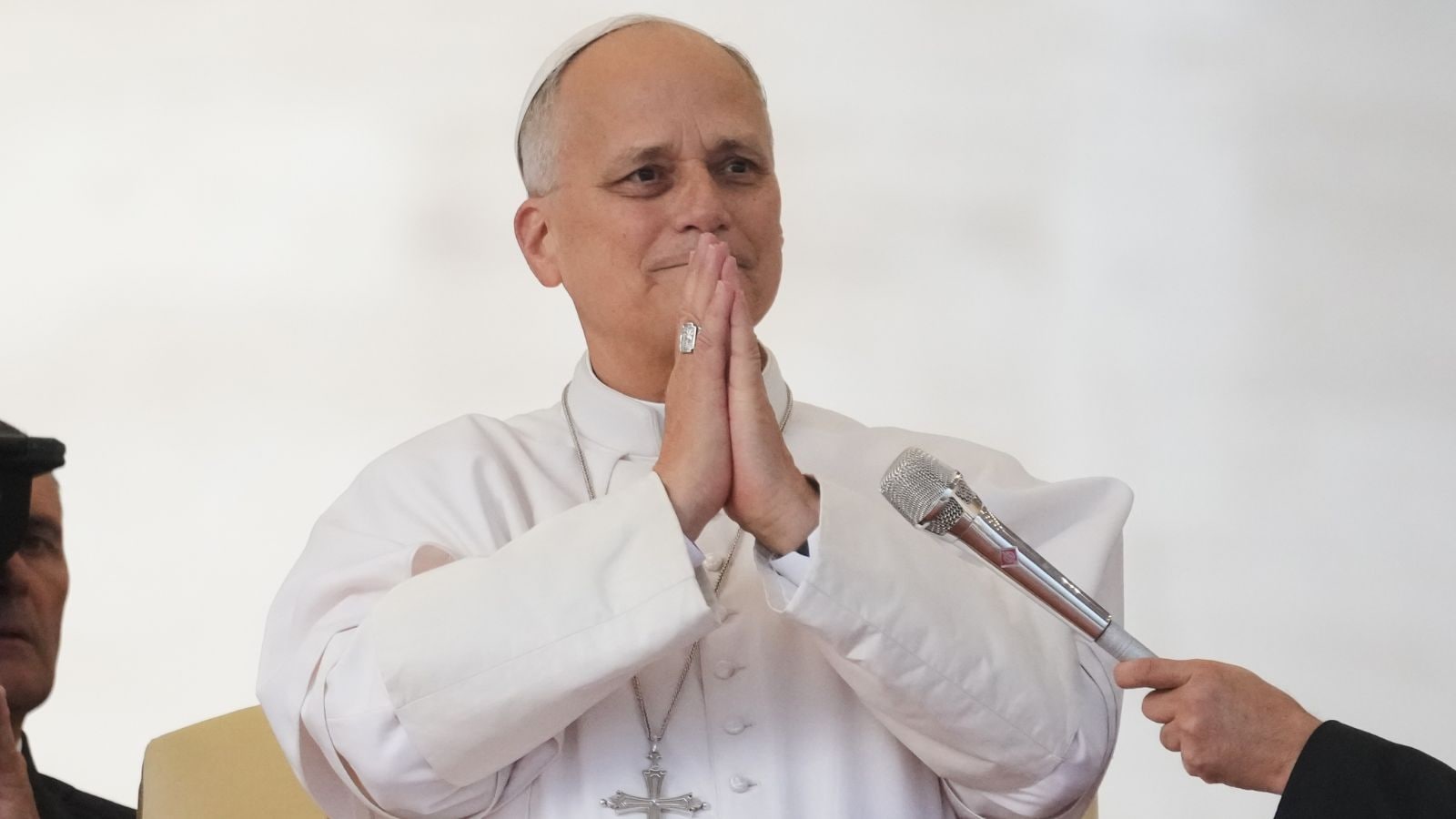
Pope Leo XIV is landing in Buenos Aires at a moment when almost nothing about the trip feels ceremonial. On paper, a papal visit to Argentina looks like standard Vatican diplomacy, especially when you consider how Pope Francis spent twelve years without ever making it back to his home country. Look closer at the timing, though, and you'll see a collision of domestic economic pain, sharp ideological friction with President Javier Milei, and an escalating international crisis involving Iran that puts Buenos Aires right in the crosshairs of global security debates.
Most mainstream coverage treats this visit like a simple political handshake between a libertarian firebrand and the head of the Catholic Church. That's a lazy read. If you've followed Argentine politics or Vatican statecraft for any length of time, you know nothing in Buenos Aires happens in a vacuum, and every public embrace carries three layers of subtext. You might also find this related story interesting: The Quiet Rebellion Against Empty Climate Promises (And Why COP31 Has Nowhere Left to Hide).
Why This Trip Matters Right Now
When Cardinal Robert Francis Prevost became Pope Leo XIV in May 2025, observers immediately wondered how he would handle Latin America. Unlike his Argentine predecessor, Leo XIV spent decades in Peru as a missionary and bishop, giving him deep roots in South America without carrying the personal political baggage of Buenos Aires's Peronist versus anti-Peronist divides. That distance actually makes his arrival in Argentina far more consequential. He isn't coming home as a local figure with old scores to settle; he's arriving as an outsider with moral authority who has seen firsthand what structural economic shocks do to working-class neighborhoods across the Andes.
And working-class neighborhoods in Argentina are hurting right now. As highlighted in recent reports by TIME, the effects are significant.
Javier Milei's aggressive austerity program—famously branded with the chainsaw metaphor during his 2023 campaign—did exactly what orthodox economists predicted on paper while inflicting the exact social pain critics warned about. Inflation cooled dramatically from the triple-digit nightmares of 2023 and early 2024, and Argentina posted rare fiscal surpluses by slashing public subsidies, freezing infrastructure spending, and shrinking state payrolls. Wall Street cheered. The International Monetary Fund nodded along.
Meanwhile, poverty rates surged past fifty percent during the sharpest phases of the adjustment before slowly edging downward, leaving millions of retirees and informal workers struggling to afford basic groceries and bus fares. Soup kitchens across Greater Buenos Aires, many of them run by Catholic parishes and the curas villeros (slum priests), have been stretched to breaking point. You can't walk into a parish in La Matanza or Villa 31 without hearing the same complaint from local clergy: the state stepped back overnight, and the Church was left holding the bag without the resources to fill the gap.
The Austerity Clash Nobody Wants to Say Out Loud
Publicly, both the Casa Rosada and the Holy See are keeping things polite. Milei, who once hurled brutal insults at Pope Francis before abruptly softening his tone and hugging him at the Vatican in early 2024, knows better than to pick a public fight with a newly minted pope in front of a majority-Catholic electorate. For his part, Pope Leo XIV isn't known for off-the-cuff political bombshells. His style is measured, canonical, and focused on Catholic social teaching rather than partisan slogans.
Don't let the polite diplomacy fool you. The friction between Milei's anarcho-capitalist worldview and the Vatican's economic doctrine is total.
Catholic social teaching, stretching back to Pope Leo XIII's 1891 encyclical Rerum Novarum—the very pope whose name Leo XIV chose—explicitly rejects both state socialism and unfettered free-market fundamentalism. Choosing the name Leo wasn't an accident. Leo XIII wrote extensively about the dignity of labor, the right to a living wage, and the moral duty of governments to protect vulnerable citizens from raw market forces. When Milei argues that social justice is an aberration and that taxation is theft, he isn't just disagreeing with left-wing Argentine politicians. He's directly contradicting the foundational framework of the modern papacy.
Here's what actually happens behind closed doors during visits like this:
- The Argentine Episcopal Conference sets the briefing papers. Local bishops have spent months documenting the exact drop in food assistance and medication subsidies for pensioners. Leo XIV won't arrive guessing about the numbers; he'll have parish-by-parish data in his folder.
- Public homilies do the heavy lifting. Instead of attacking Milei by name, expect the Pope to speak forcefully about "discarded populations," the moral danger of worshipping market efficiency, and the obligation of the state toward the poor. Everyone in Argentina knows how to read between those lines.
- Photo ops become political currency. Milei's team desperately wants images of the President standing beside the Pope to project international legitimacy and calm nervous voters ahead of legislative tests. The Vatican knows this, which is why every minute of the itinerary—especially visits to poor barrios—is negotiated down to the second.
Honestly, the smartest thing to watch during the broadcasts isn't the official speeches at the presidential palace. Watch where the Pope goes unscripted, which local priests he embraces on the tarmac, and how much time he spends in low-income parishes compared to government halls.
How Iran Became the Elephant in the Room
If domestic austerity were the only tension point, this visit would still make headlines across Latin America. What turns it into a genuine geopolitical headache is Iran.
Under Javier Milei, Argentina executed one of the sharpest foreign policy pivots in modern Latin American history. Gone is the traditional non-aligned balancing act of previous governments. Milei aligned Buenos Aires squarely with the United States and Israel, moving to designate Hamas as a terrorist organization, pledging to move Argentina's embassy to Jerusalem, and openly backing Western pressure against Tehran.
That alignment carries real history and real risk for Argentina.
Remember that Argentina suffered the two deadliest terrorist attacks in its history—the 1992 bombing of the Israeli Embassy in Buenos Aires and the 1994 bombing of the AMIA Jewish community center, which killed 85 people. In April 2024, Argentina's top criminal court formally ruled that Iran directed both attacks through Hezbollah, declaring Iran a "terrorist state." That ruling slammed the door on any lingering diplomatic ambiguity in Buenos Aires and raised immediate security alerts along Argentina's porous northern borders, particularly around the Tri-Border Area shared with Brazil and Paraguay.
As broader Middle East tensions involving Iran, Israel, and Washington continue to simmer throughout 2026, Milei has positioned Argentina as Tehran's most vocal critic in South America. For the Vatican, that creates a delicate balancing act.
The Holy See operates one of the oldest and most cautious diplomatic services in the world. Vatican diplomacy relies on keeping channels open with everyone, including Tehran, partly to protect dwindling Christian minorities across the Middle East and partly to preserve its role as a neutral mediator when conflicts spiral out of control. While the Vatican shares deep concerns about regional escalation and terrorism, it consistently avoids the kind of binary, bloc-versus-bloc rhetoric that defines Milei's foreign policy.
When Pope Leo XIV lands in Buenos Aires, security protocols will be at levels rarely seen in South America. Intelligence coordination between Argentine federal forces, Vatican gendarmes, and foreign partners has been ramped up specifically because a high-profile papal visit in a country that recently labeled Iran a terrorist state presents an obvious security target. At the same time, Vatican diplomats are working overtime to ensure the Pope's calls for peace and de-escalation in the Middle East aren't spun by local politicians as an endorsement of either side's military posture.
What People Commonly Get Wrong About Vatican Visits
If you read casual commentary online, you'll see two predictable mistakes.
First, people assume a pope visits a country to endorse its government. That's almost never true. Popes visit local churches, not presidents. Even when John Paul II visited Pinochet's Chile or Castro's Cuba, the goal was pastoral presence and institutional leverage, not political approval. Leo XIV visiting Argentina doesn't mean the Vatican backs Milei's economic shock therapy, any more than avoiding Argentina meant Francis hated his homeland.
Second, people underestimate how much internal Church politics shape these trips. The Argentine Church itself isn't a monolith. You have progressive priests working in urban slums alongside deeply conservative bishops who quietly prefer Milei's anti-abortion stance and traditionalist cultural rhetoric over progressive social policies. Leo XIV has to speak to both camps without fracturing an already tired local clergy.
What to Watch as the Visit Unfolds
If you want to cut through the noise and see who actually comes out ahead during Pope Leo XIV's time in Argentina, pay attention to three specific markers over the course of the trip:
- The language on social protection. Listen for whether Leo XIV explicitly defends state intervention on behalf of the poor or keeps his remarks purely spiritual. Direct references to public responsibility for healthcare, pensions, and nutrition will signal that the Vatican is siding firmly with the Argentine bishops' critiques of austerity.
- The Middle East phrasing. Watch how the Pope frames peace and security during his diplomatic address in Buenos Aires. If he emphasizes multilateral dialogue and international law while avoiding hardline rhetoric against Tehran, it's a clear reminder that the Holy See refuses to be folded into Milei's foreign policy alignment.
- Street-level turnout versus official staging. Argentina's economic crisis has left people exhausted and cynical toward institutions across the board. Massive, spontaneous crowds in working-class districts would give the local Church renewed moral leverage in its negotiations with the government over social aid funding.
Track those three signals rather than the scripted handshake photos at the airport, and you'll have a much clearer read on whether this papal visit shifts the political ground in Buenos Aires or simply highlights how wide the gap between the Casa Rosada and the Vatican really is.