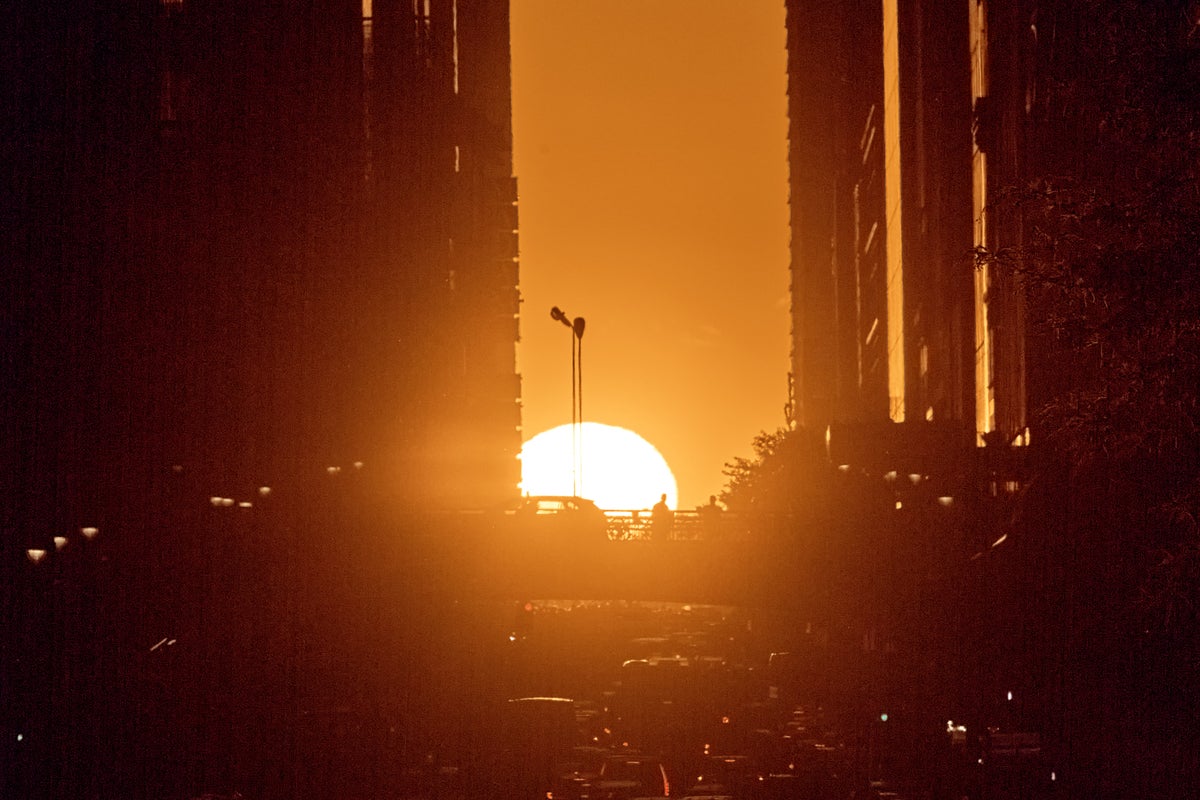
Manhattanhenge occurs when the setting sun aligns perfectly with the grid of Manhattan’s cross streets, illuminating the concrete canyons with a brilliant, direct beam of light. This phenomenon happens four times a year—two times with a full sun and two times with a half sun—typically falling in late May and mid-July. To capture the perfect photo, you must avoid the gridlocked crowds on 42nd Street and position yourself on wide, multi-lane streets like 14th, 23rd, or 34th Streets, preferably as far east as possible to allow the architecture to frame the shot.
But understanding the spectacle requires looking past the viral Instagram posts. The event is not an ancient mystery, nor is it a fluke of nature. It is the direct consequence of a 19th-century real estate gamble that permanently altered the geography of New York City.
The Grid That Chained the Sun
Every year, hundreds of thousands of people spill into the intersections of midtown Manhattan, blocking traffic and raising smartphones in a collective, secular ritual. They are chasing a moment popularized by astrophysicist Neil deGrasse Tyson in 1997. Yet, the physics governing this event were set in stone long before the advent of the camera.
The phenomenon relies on a fundamental misalignment. While most people assume Manhattan’s grid runs perfectly north-south and east-west, it does not.
In 1811, the Commissioners’ Plan laid out the modern layout of the city. The commissioners wanted to maximize the number of right-angled plots for houses and commercial buildings. They ignored the natural topography of the island, smoothing over hills and burying streams to enforce a rigid, geometric pattern.
Because the island of Manhattan is elongated, the architects rotated the grid 29 degrees east of true north to match the natural shoreline.
$$29^\circ \text{ East of True North}$$
This deviation is the entire reason Manhattanhenge exists. If the grid lined up with true geographic east and west, the alignment would occur precisely on the vernal and autumnal equinoxes. Instead, the 29-degree tilt shifts the dates. The sun aligns with the grid weeks before the summer solstice as it moves north along the horizon, and weeks after the solstice as it tracks back south.
The math is absolute. The orbit of the Earth determines the sun's declination, and the fixed angle of the asphalt determines the view. When those two angles match, the city becomes a giant solar observatory.
The Illusion of the Perfect Sunset
Most travel guides offer a sanitized version of the event. They promise a serene, cinematic experience where the sun kisses the pavement. The reality on the ground is chaotic, competitive, and frequently disappointing for amateur photographers.
The atmosphere creates a major optical hurdle. New York City suffers from intense urban heat islands and heavy particulate pollution. As the sun dips toward the horizon, its light must pass through a thick layer of smog, dust, and moisture rising from the Hudson River. This scatters the shorter wavelengths of light, leaving only the deep reds and oranges.
While this creates a dramatic color palette, it also distorts the shape of the sun. The heat radiating off the buildings causes the air to shimmer, creating a mirage effect that can make the sun look oblong or blurry rather than a crisp sphere.
Then there is the structural blockage. The horizon is not empty. Across the Hudson River lies New Jersey, which features its own rising ridgelines and high-rise developments. A cloud bank sitting miles away over the mainland can completely obscure the sun during the critical three-minute window, turning a highly anticipated event into a dull, gray evening.
Relying on luck is a bad strategy. Photographers must understand that the "half-sun" days often yield better results than the "full-sun" days. On full-sun days, the glare is frequently too intense for camera sensors, blowing out the highlights and turning the buildings into featureless black blocks. The half-sun event offers a more balanced exposure, sitting neatly on the horizon line like a coin on a table.
Anatomy of the Grid
Finding the right vantage point requires understanding how the width of New York streets affects light distribution. The city's grid is not uniform.
The 1811 plan established standard cross streets at a width of 60 feet. However, it also designated fifteen major wide avenues at 100 feet across to handle increased commercial traffic. These wider corridors are the lifeblood of the phenomenon.
| Street | Width | Pros | Cons |
|---|---|---|---|
| 14th Street | 100 feet | Clear view, less tourist congestion | Less iconic architecture |
| 23rd Street | 100 feet | Includes the Flatiron view | Framing can be obstructed by local construction |
| 34th Street | 100 feet | Empire State Building backdrop | Extreme pedestrian density |
| 42nd Street | 100 feet | Iconic Tudor City Overpass view | Dangerous crowd sizes, heavy police presence |
| 57th Street | 100 feet | Dramatic canyon effect | High-rises cast long, early shadows |
The instinct for most tourists is to head straight to 42nd Street, specifically the overpass at Tudor City. This is a mistake. The overpass has become an unsafe bottleneck where hundreds of people pack shoulder-to-shoulder hours in advance. Tripods are frequently banned or knocked over, and police actively clear the stairs to maintain emergency access.
Smart operators look elsewhere.
Tactical Photography in a Concrete Canyon
To capture an image that stands out from millions of identical smartphone photos, you must treat the shoot like a tactical operation.
Ditch the Wide-Angle Lens
A wide-angle lens is the worst tool for this job. It makes the sun look like a tiny, insignificant dot in a massive sky, swallowing the drama of the event. You need a telephoto lens.
Using a focal length between 200mm and 400mm compresses the perspective. This optical compression pulls the distant sun closer, making it appear massive relative to the buildings framing the street. It forces the architecture into a tight, dramatic frame that emphasizes the scale of the city.
Manual Exposure Control
A camera's automatic metering system will fail during Manhattanhenge. The extreme contrast between the blazing sun and the dark, shadowed buildings confuses the sensor. The camera will try to brighten the buildings, completely overexposing the sun into a blinding white smudge.
- Set the camera to Manual Mode.
- Expose for the highlights (the sun and the immediate sky around it).
- Keep the ISO low (100 or 200) to minimize digital noise in the shadows.
- Use a narrow aperture like f/8 or f/11 to maximize sharpness across the frame and potentially create a starburst effect around the sun.
The Exposure Bracket Strategy
Because the dynamic range of the scene exceeds what even modern digital sensors can capture in a single frame, you should use exposure bracketing. Take three to five rapid shots at different exposure levels—one underexposed, one neutral, and one overexposed. This ensures that even if the real-time preview looks wrong, you possess the raw data needed to salvage the highlights and shadows during post-processing.
The Dark Side of the Spectacle
The commercialization of the event has created an environment that is hostile to genuine photography. The city does not close the streets for Manhattanhenge. Traffic continues to flow, meaning that the best shots often require stepping into active crosswalks during a changing light.
The hunt for the shot has led to risky behavior. Crowds routinely surge into the middle of intersections on green lights, ignoring oncoming buses and yellow cabs. The flash mobs create a nightmare for local commuters and delivery drivers trying to navigate the grid.
Monetization has also crept into the frame. Rooftop bars and hotels along the primary corridors now sell "Manhattanhenge viewing packages" at exorbitant prices, offering access to balconies that promise unobstructed views. These spaces are often disappointing, as the height removes the street-level perspective that gives the event its raw, industrial power. The true phenomenon belongs on the pavement, where the scale of human engineering collides directly with orbital mechanics.
To beat the system, you must go east. The further east you stand—such as First or Second Avenue—the more blocks of buildings the sun must pass through before reaching your lens. This creates a deeper, longer tunnel effect, maximizing the architectural framing and giving you a split-second warning before the sun hits the exact center of the grid.
Do not wait for the official date published by museums. The alignment is a gradual process. The days immediately preceding and following the predicted peaks offer virtually the same visual impact with a fraction of the crowds. Position yourself on 14th Street twenty-four hours before the internet tells you to, set your telephoto lens to manual focus, and wait for the precise moment the orbit of the planet locks into the grid of 1811.