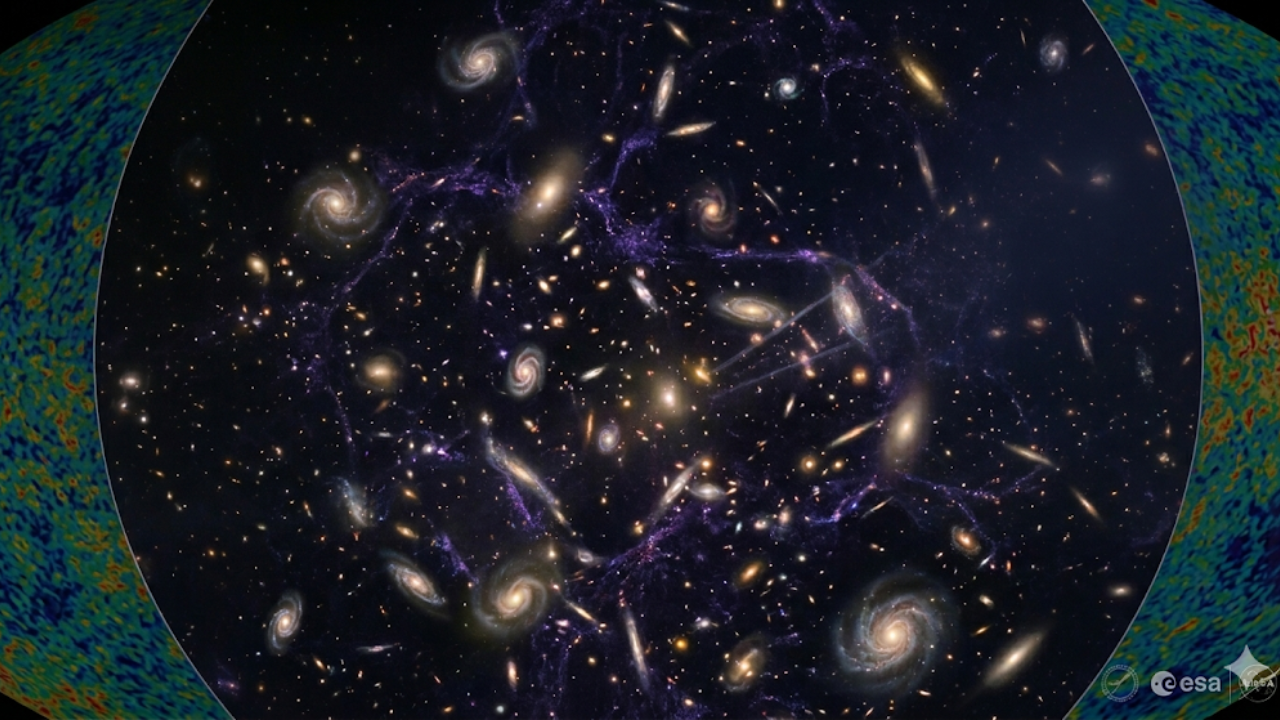
The universe is growing too fast and nobody knows why. If you think physics is a settled field of study where we’ve got most of the big stuff figured out, you’re in for a rude awakening. We are currently staring at a massive, billion-light-year-wide hole in our understanding of reality. Astronomers call it the Hubble Tension. I call it a crisis of confidence.
For decades, we’ve used two main ways to measure how fast the universe expands. One looks at the "fossil" glow from the Big Bang. The other looks at actual stars in the sky today. Here’s the problem. They don't agree. They aren't even close.
The Math Just Does Not Add Up
Let's talk about the Hubble Constant. This number, denoted as $H_0$, tells us how fast galaxies are receding from us. If the universe were a balloon being blown up, the Hubble Constant would be the speed of the expansion.
When scientists look at the Cosmic Microwave Background (CMB)—the afterglow of the Big Bang captured by the Planck satellite—they calculate that the universe should be expanding at about 67 kilometers per second per megaparsec. That sounds fast. But when teams like the SH0ES project, led by Nobel laureate Adam Riess, look at "Standard Candles" like Cepheid variables and Type Ia supernovae in the local universe, they get a different number. They get roughly 73.
That 6 km/s difference might seem small. It isn't. In the world of precision cosmology, that's a cavernous gap. It’s like two different scales telling you that you weigh 150 lbs and 165 lbs. One of them is wrong, or something is fundamentally broken with the way you understand weight.
We Can No Longer Blame the Tools
For years, skeptics argued that this was just a "human error" problem. Maybe the telescopes weren't calibrated right. Maybe we didn't understand the dust blocking our view of distant stars.
The James Webb Space Telescope (JWST) was supposed to settle this. Scientists used the JWST to look at the same stars the Hubble Space Telescope saw, but with much higher precision. The results came back recently and confirmed what we feared. The "error" isn't an error. The measurements are solid. The Hubble Space Telescope wasn't lying to us.
This means the tension is real. We're looking at a discrepancy that has a less than one-in-a-million chance of being a fluke. We've reached a point where we have to admit that our "Standard Model of Cosmology"—the rulebook we’ve used to explain the universe since the 90s—is likely incomplete.
Dark Energy is Getting Weird
The most likely culprit for this cosmic acceleration is Dark Energy. We know it makes up about 68% of the universe, but we don't actually know what it is. In our current models, we treat it as a "Cosmological Constant." This means it’s a property of space itself. As space expands, you get more space, which means more Dark Energy, which leads to more expansion. It’s a runaway loop.
But what if Dark Energy isn't constant?
What if it changes over time? Some theorists suggest "Early Dark Energy"—a burst of energy shortly after the Big Bang that gave the universe an extra push before fading away. This would resolve the math. It would allow the early universe data and the modern universe data to coexist. But it also adds a level of complexity that makes physicists very uncomfortable.
Then there’s the idea of "New Early Dark Energy." This theory posits that a phase transition in the early universe, similar to water freezing into ice, released energy that sped things up. It's wild. It’s speculative. It’s also where the smartest people in the room are looking right now.
The Problem With Dark Matter
We also have to talk about Dark Matter. We know it provides the gravitational "glue" that keeps galaxies from flying apart. But if our understanding of gravity is slightly off at cosmic scales, it could explain the expansion discrepancy without needing new types of energy.
Modified Newtonian Dynamics (MOND) is the black sheep of the physics world. Most mainstream cosmologists hate it because it throws out Einstein’s General Relativity. But as the Hubble Tension persists, even the most stubborn scientists are starting to wonder if Einstein’s equations need a tweak when applied to the entire volume of the observable universe.
Consider the "Local Void" hypothesis. Some researchers argue that we live in a massive, under-dense region of space. If we’re sitting in a cosmic bubble where there’s less matter than average, the local expansion would look faster to us than it actually is on a global scale. It’s a tidy explanation, but most data suggests our neck of the woods isn't that empty.
Why You Should Care About This
You might think this is just nerdy bickering over decimals. It’s not. This is about the fate of everything.
If the expansion continues to accelerate at this rate, we’re heading toward the "Big Freeze" or the "Big Rip." In a Big Rip scenario, the expansion becomes so violent that it eventually overcomes gravity, then electromagnetism, and finally the strong nuclear force. Galaxies will fly apart. Then solar systems. Then atoms. Reality literally shreds itself.
Understanding why the universe is expanding faster than expected isn't just a curiosity. It’s a hunt for the fundamental laws of nature. If our current laws can’t explain why the universe is growing this way, those laws are wrong. Or at least, they’re only half-truths.
What Happens When the Models Break
Physics moves forward in leaps only when the old models fail. When Newton couldn't explain the orbit of Mercury, Einstein gave us General Relativity. When classical physics couldn't explain the behavior of light, we got Quantum Mechanics.
The Hubble Tension is that same kind of "glitch in the matrix." It’s an invitation to find something new. Whether it's a new particle, a fifth force of nature, or a fundamental misunderstanding of gravity, the answer will change how we see the stars.
What to Look for Next
Keep an eye on data from the Dark Energy Spectroscopic Instrument (DESI). They’re currently building the largest 3D map of the universe ever made. Early results from DESI suggest that Dark Energy might indeed be evolving over time, rather than staying constant. If that holds up, the "Constant" in the Cosmological Constant is dead.
Also, watch for results from the Vera C. Rubin Observatory. Once it starts its ten-year survey of the sky, it will track billions of galaxies. This will provide a "high-definition" look at how the expansion has changed over the last 10 billion years.
Don't wait for a press release saying "Science is Solved." That's not how this works. Instead, look for the moments where the numbers don't match. That’s where the real discovery is hiding. We are living through a period where the textbooks are being rewritten in real-time. It’s messy, it’s frustrating for the researchers, and it’s the most exciting time to be looking up at the sky.
If you want to stay ahead of this, stop looking for "answers" and start looking for "discrepancies." The tension isn't a problem to be swept under the rug; it's the thread we need to pull to unspool the next layer of reality. Check the pre-print servers like arXiv for papers on "Evolving Dark Energy" or "Late-time Bulk Viscosity." That’s where the next revolution is starting.


