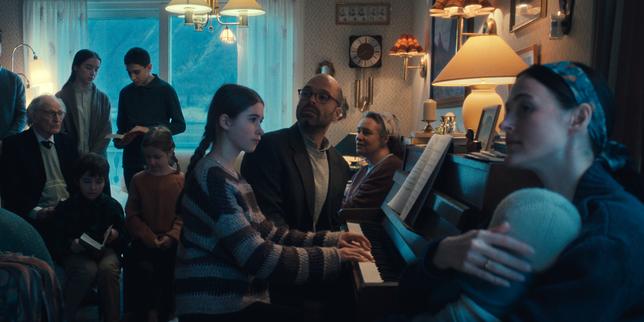
When Cristian Mungiu collected his second Palme d'Or on the Croisette for Fjord, the critical establishment breathed a collective sigh of relief. Here, wrapped in the icy cinematography of a remote Scandinavian coastline, was a film that seemed to address the great sickness of our cultural moment. Polarization. Fundamentalism. The terrifying velocity with which modern institutional bureaucracies swallow individual liberty.
Starring Sebastian Stan and Renate Reinsve, the film follows a conservative, deeply religious Romanian-Norwegian family whose domestic life falls under the microscopic gaze of Norway's child welfare apparatus. It is a narrative engineered to provoke. It takes a progressive sanctuary—a small, orderly Norwegian village where social cohesion is treated almost as a state religion—and rubs it raw against the immovable object of patriarchal, orthodox dogma.
Yet, to praise Fjord merely as a brave interrogation of the culture wars is to fall into the very trap Mungiu has carefully constructed. The film does not challenge the political spectrum. It flattens it into a comfortable morality play for people who prefer their systemic critiques sanitized for festival consumption.
To understand why Fjord resonated so deeply with the jury led by Park Chan-wook, one must examine the mechanics of contemporary prestige cinema. Festivals crave relevance. They want to be seen as grease in the gears of global discourse. Mungiu delivers this by taking a ripped-from-the-headlines anxiety—the real-world friction between immigrant traditions and Western child protection policies—and evacuating it of actual political risk.
By centering the conflict on an extreme religious household, Mungiu creates a safe distance for the audience. We are not asked to ponder the routine, administrative violence visited upon ordinary, un-theatrical families by overzealous state agencies. We are asked to judge whether a father who bans YouTube and enforces daily Bible study deserves to have his kids hauled away by social workers. It is a stacked deck. It invites bourgeois liberals to perform an agonizing internal audit about tolerance while ensuring the ultimate subject remains an exoticized outlier. Look at how far we are willing to stretch our empathy, the film whispers. Look at how civilized we are for enduring these religious conservatives.
This is the central trick of the film. It poses as an anti-fundamentalist tract while weaponizing a deeply reactionary nostalgia for traditional authority against the cold, therapeutic machinery of the modern state. The Norwegian villagers are portrayed as passive-aggressive conformists imprisoned by their own niceness. The patriarch is rendered as a stubborn, bruised defender of paternal prerogative.
Neither archetype bears any resemblance to actual human agency. They are ideological avatars drafted to fight a proxy war that high-brow European cinema has been staging for decades: the sacred, earthy, messy East versus the sterile, bureaucratic, soul-crushing West. It is a tired binary. It flatters Western European guilt by making Eastern European conservatism look like a tragic, misunderstood relic, rather than a living, breathing political force with its own aggressive ambitions.
Mungiu is too smart a filmmaker to offer simple villains, of course. The script labors to show the blind spots on both sides. Yet this structural balance is precisely what dilutes its power. By equating the overreach of a municipal social worker with the systemic ideology of a patriarchal household, the film commits a category error. It suggests that our current societal fracture is merely a failure of interpersonal communication. If only we sat down and talked. If only we applied those lovely words like inclusion and empathy with a bit more sincerity.
This is the language of political exhaustion. It treats systemic power imbalances as if they were bad manners at a dinner party. When societies are fragmenting along genuine economic, racial, and geopolitical fault lines, offering up a parable about mutual misunderstanding in a picturesque fjord feels less like a confrontation with reality and more like an evasion of it.
The film's triumph at Cannes tells us less about the state of the world and more about the state of cinematic validation. It rewards a very specific type of middle-brow triangulation: art house aesthetics deployed in the service of centrist anxiety. It allows everyone in the auditorium to nod knowingly, congratulate themselves on their nuance, and leave the theater entirely undisturbed.
You can watch a discussion of the film and its reception in this Fjord Palme d'Or discussion on YouTube, which breaks down the polarized reactions to its victory on the Croisette.