The diesel exhaust hangs thick in the freezing morning air, a grey shroud over a line of idling semi-trucks that stretches farther than the eye can see. If you walk along the shoulder of the road near Windsor, Ontario, you can hear the low, rhythmic thrum of hundreds of engines. It sounds like a heartbeat. It is the literal heartbeat of North American commerce, trapped in a bottleneck.
For the drivers sitting in those cabs, this is not a statistic about supply chains or bilateral trade agreements. It is a bladder-straining, soul-crushing exercise in patience. A delay here means a missed dinner with family in Ohio, a docked paycheck, or a shipment of auto parts arriving just late enough to shut down an assembly line in Michigan.
Just across the water sits Detroit. It is tantalizingly close. Yet, on days like today, the Ambassador Bridge might as well be a thousand miles wide.
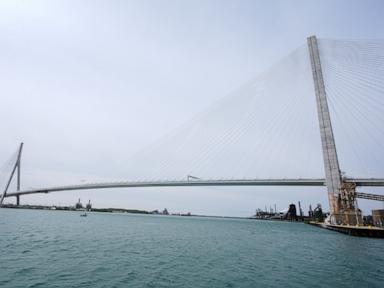
For over a decade, a monument of steel and concrete has been rising from the mud to fix this. The Gordie Howe International Bridge was promised as the ultimate escape valve, a six-lane masterpiece designed to ensure that $400 billion in annual trade would never again be held hostage by a single, privately owned crossing built during the Hoover administration.
But the bridge is quiet. The grand opening has been pushed back. Again.
Unresolved issues, the officials call it. It is a sanitized phrase that masks a messy reality of political theater, bureaucratic paralysis, and the fragile nature of international promises.
The Iron Gatekeepers
To understand why a few more months of waiting matters, you have to understand the sheer absurdity of how America and Canada talk to each other right now.
Consider a hypothetical truck driver. Let's call him Jim. Jim has been hauling steel coils across the border for twenty-five years. He remembers when crossing the border felt like driving through a toll booth. Today, Jim has to navigate a labyrinth of digital manifests, customs brokers, and biometric scans. If one line of code on his manifest is wrong, he sits. If the wind blows too hard on the aging Ambassador Bridge, he sits.
The Ambassador Bridge is a bottleneck by design. It is the only privately owned international crossing of its scale in America, a literal monopoly on the artery of a continent. When Canada and Michigan finally agreed to build a public alternative—the Gordie Howe Bridge—it wasn't just an infrastructure project. It was a declaration of independence from a corporate chokehold.
Then came the politics.
During his first term, Donald Trump openly threatened to block the project. He viewed it through the lens of a zero-sum game, a Canadian encroachment rather than a shared victory. The rhetoric sparked panic through the manufacturing hubs of Ontario and the American Midwest. The message was clear: even a bridge made of steel can be bent by political willpower.
While that specific crisis faded into the background as construction progressed, the ghost of that hostility never truly left the construction site. Every rivet hammered into place felt like a race against the next political mood swing in Washington.
The Invisible Friction
What delays a multi-billion-dollar bridge when the towers are already built and the stay cables are already strung?
The answer is rarely a lack of concrete. It is the invisible friction of two sovereign nations trying to merge their nervous systems.
Imagine trying to build a house where two different families must agree on every single doorknob, outlet, and security camera. Now multiply that by two federal governments, a state government, a provincial government, and dozens of border security agencies.
- The Security Gridlock: A modern international bridge is not just a road; it is a fortress. The Canadian side requires one set of biometric screening tools; the American side demands another. Merging these software systems without creating a massive cyber-security vulnerability has become an engineering nightmare of its own.
- The Tolling War: Who collects the money, in what currency, and through which digital wallet? When millions of dollars flow across a span every single day, a disagreement over a fraction of a percent in transaction fees can halt a project faster than a blizzard.
- The Labor Dispute: Canadian crews and American crews operate under different union rules, safety standards, and wage structures. When the project slows down on one side of the river due to a supply shortage, the delicate balance of labor parity collapses.
The public is told that the delay is merely operational. The reality is that the bridge is caught in a tug-of-war between Canada’s desire for predictable, institutional cooperation and a changing American political landscape that increasingly views international agreements with deep suspicion.
The True Cost of Waiting
We often treat infrastructure delays as an inconvenience, a minor footnote in the business pages. But the friction costs of this delay ripple through communities that will never even see the Detroit River.
When a bridge is delayed, a grocery store in Kentucky pays more for Canadian greenhouse tomatoes. A factory in Toronto pays more for Michigan-made engines. The cost of every single hour a truck sits idling in Windsor is passed down, penny by penny, to the consumer. In an era where inflation has already stretched household budgets to the breaking point, these "unresolved issues" represent a hidden tax on everyday life.
But the human cost is heavier.
The neighborhoods surrounding the existing crossing have some of the highest asthma rates in the region. For decades, residents have breathed in the toxic soup of thousands of idling diesel trucks trapped in stop-and-go traffic on residential streets. The Gordie Howe Bridge was supposed to bypass these neighborhoods, routing the heavy trucks directly onto major highways.
For the parents living in the shadow of the old bridge, the delay isn't about trade volumes or political posturing. It is measured in prescription refills and sleepless nights spent listening to a child wheeze.
A Span Left Stranded
On a quiet night, if you stand on the banks of the Detroit River, the new bridge looks spectacular. Its massive white towers reach toward the sky, illuminated by construction lights, a monument to what human ingenuity can achieve when two nations decide to build something together.
The cables stretch down like the strings of a giant harp, waiting for the music of traffic to begin.
But for now, the deck remains empty. The grand project sits as a beautiful, expensive question mark suspended over the water. It is a reminder that in the modern world, we can conquer the physics of engineering with ease, yet we remain entirely helpless against the friction of our own politics.
The trucks in Windsor will keep idling. The drivers will keep waiting. And the river will keep flowing beneath a bridge that connects two countries in theory, but remains separated by a gulf of unresolved realities.