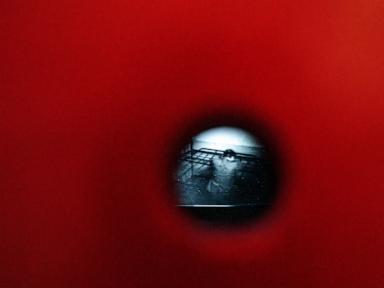
The air inside a surveillance room does not circulate. It sits. It carries the faint, metallic tang of old vacuum tubes, cheap tobacco, and the specific brand of sweat produced only by fear.
In Bucharest, in the deep winter of 1989, that air belonged to the Securitate.
For decades, the Romanian secret police operated as an omnipresent ghost in the machine of daily life. They were the whisper behind the drywall. They were the reason you did not speak your mind to your neighbor, your coworker, or your brother. But history has a way of violently clearing its throat. When the regime of Nicolae Ceaușescu collapsed in a hail of gunfire that December, the ghosts fled, leaving behind mountains of paper, oceans of paranoia, and thousands of hours of magnetic tape.
Today, those tapes are playing in public.
A striking new exhibition in the Romanian capital has done something remarkable. It has bypassed the standard, sterile museum vitrines filled with rusty handcuffs and official decrees. Instead, it places visitors directly across from the glowing monitors of 1989. You sit where the interrogator sat. You look into the eyes of the broken, the defiant, and the terrified.
To watch these videos is to understand that totalitarianism is not merely a political structure. It is a deliberate, systematic assault on the human psyche.
The Architecture of the Stare
Imagine a wooden chair.
It is the only object in a small, windowless room, save for a desk and a camera bolted to a tripod. Suppose a young woman is sitting in that chair. Let us call her Elena, a composite of the countless university students hauled into these rooms for the crime of possessing typed poetry or listening to foreign radio broadcasts.
Elena does not know if she will see her family again. She does not know if the man sitting across from her—a man wearing a well-tailored suit and a neutral expression—has already signed an order for her disappearance.
The camera records everything. But it does not record from a neutral perspective. The Securitate framing was precise, deliberate, and deeply psychological. The lens is almost always positioned slightly above the subject, forcing them to look upward, casting them in a perpetual state of submission. The lighting is harsh, stripping away dignity, highlighting every involuntary twitch of the eyelid, every bead of sweat pooling at the collarbone.
The human brain is wired for connection. When we look at another person, our mirror neurons fire, seeking empathy, reading signals, attempting to establish a baseline of mutual humanity. Totalitarian interrogation weaponizes this evolutionary trait. The interrogator across from Elena does not offer a baseline. He alternates between a terrifying, bureaucratic coldness and a sudden, performative warmth that shatters her internal defenses.
The tapes reveal this rhythm with agonizing clarity. For forty minutes, an officer might badger a suspect about a single name, his voice rising to a calculated crescendo of violence. Then, a click. The tape cuts. When it resumes, the officer is offering the suspect a cigarette, speaking softly about the suspect’s aging mother.
This is not random cruelty. It is behavioral engineering designed to induce learned helplessness. When the rules of survival change every five minutes, the mind stops trying to predict the future. It simply surrenders.
The Technology of Submission
We often view the past through a lens of technological obsolescence. We look at the bulky Video Home System (VHS) tapes, the flickering cathode-ray tube monitors, and the grainy, low-resolution footage of 1989, and we tempt ourselves into believing that those tools were primitive.
They were not primitive. They were highly efficient engines of state control.
The Securitate was one of the most technologically sophisticated secret police forces in the Eastern Bloc. They understood that a photograph could document a crime, but a moving image could document the breaking of a soul. The introduction of video recording allowed superiors to review the techniques of their subordinates, turning the psychological destruction of Romanian citizens into a standardized, optimization-driven corporate pipeline.
Consider the physical reality of the medium. Magnetic tape degrades over time. It stretches. It develops tracking errors—those horizontal bands of static that tear across the screen like digital scars. In the Bucharest exhibition, these imperfections do not obscure the history; they amplify it. The static becomes a physical manifestation of trauma, a visual reminder that these memories have been buried in dark archives for over three decades, warping under the weight of their own secrecy.
The exhibition organizers understood that to truly comprehend this power dynamics, the audience could not remain passive observers. They designed the space to mimic the claustrophobia of the archives. The ceilings are low. The lighting is dim, save for the blue glare of the screens.
When you look at the face of an informant on screen—someone who has agreed to betray their best friend to save their own child from expulsion—you do not feel a sense of historical detachment. You feel a sickening surge of recognition. You realize that under the right combination of pressure, isolation, and psychological leverage, the line between victim and perpetrator becomes vanishingly thin.
The Bureaucracy of the Broken
There is a profound misconception that evil always announces itself with horns and a fury. The reality preserved on these tapes is far more chilling. Evil in 1989 wore a cheap tie and kept meticulous records.
The interrogators in these videos do not look like monsters. They look like mid-level bank managers. They flip through manila folders with a casual, practiced elegance. They check their watches. They step out of the frame to get a cup of coffee while the suspect remains frozen in the chair, staring at the empty space where their tormentor just sat.
This mundane quality is what makes the exhibition so deeply unsettling. It forces us to confront the bureaucratic machinery behind the terror. Every interrogation required a technician to run the recorder. It required a typist to transcribe the audio. It required a clerk to file the tape away in a temperature-controlled room. Dozens of ordinary people went to work every morning, drank their tea, complained about the weather, and spent eight hours contributing to the total erasure of their neighbors' human rights.
The subjects on the other side of the desk vary wildly. Some fight. You can see it in the rigid set of their jaws, the way they refuse to look directly into the camera, their answers clipped and monosyllabic. They are holding onto the last shred of their autonomy.
Others have already crossed the threshold of capitulation. Their shoulders slump forward, creating a protective hollow around their chest. Their voices are flat, drained of all timbre, delivering the exact phrases the state requires of them. They are ghost-walking through their own betrayals.
The exhibition does not offer comfortable answers or easy redemptions. It does not tell you that the good guys won and the bad guys were punished. The reality of post-communist Romania is far more complicated. Many of the men who sat behind those desks, directing those cameras, simply transitioned into the new corporate and political structures of the 1990s. They traded their Securitate badges for corporate business cards, their power remaining intact, merely rebranded.
The Weight of the Unseen
Walking out of the exhibition into the modern, bustling streets of Bucharest is an exercise in psychological decompression. The city today is vibrant, loud, and thoroughly European. Young people sit at sidewalk cafes, typing on iPhones, arguing about politics, completely unbothered by the specter of the state.
But if you look closely at the architecture, the scars are still there. The massive, concrete monolith of the Palace of the Parliament still dominates the skyline—a physical manifestation of Ceaușescu’s megalomania that required the destruction of historic neighborhoods and the forced labor of thousands.
The tapes inside the exhibition act as a psychological blueprint for those concrete structures. They show us how a state builds a prison inside the minds of its people before it ever builds one out of stone.
The true value of preserving and displaying these videos lies in their ability to strip away the romanticism of historical memory. It is easy to look back at the revolutions of 1989 as triumphant, cinematic moments of liberation. We remember the crowds in the streets, the flags with the communist symbols cut out of the center, the collective roar of a people reclaiming their destiny.
We forget the silence that preceded it.
We forget the decades of quiet, agonizing choices made in small, windowless rooms. We forget the exact cost of a whispered confession, the price of a signed informant agreement, the precise shade of blue that a CRT monitor casts over the face of a person who has just lost everything.
The exhibition closes not with a grand statement, but with a return to the physical archive itself. A wall of unlabelled tape boxes, stacked high into the darkness, stretching out toward the ceiling. Thousands of hours of human suffering, captured on plastic ribbon, waiting for someone to sit down, press play, and bear witness to the silence.