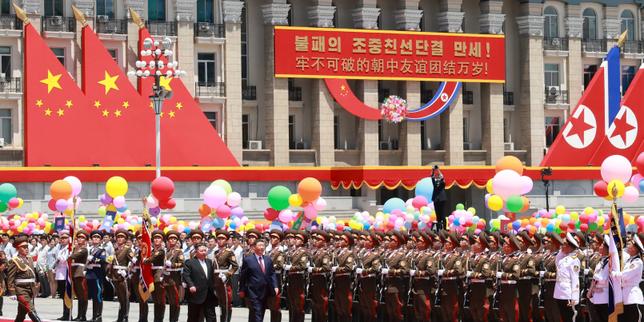
Beijing is quietly tightening its embrace of Pyongyang, but it isn't out of affection. Chinese leader Xi Jinping recently issued a public call to elevate ties between China and North Korea to new heights, demanding a surge in bilateral exchanges. On the surface, official communiqués paint this as a renewal of socialist solidarity. The reality is far more transactional. Xi is anchoring China to an erratic, nuclear-armed neighbor to build a strategic buffer against a tightening web of American-led military alliances in Asia. For Beijing, a stable, dependent North Korea is an indispensable shield against Western encirclement.
Behind the grand declarations of eternal friendship lies a relationship defined by deep mutual suspicion and stark geopolitical necessity. Pyongyang wants economic survival and recognition as a nuclear state. Beijing wants regional stability and a compliance partner to frustrate Washington's regional strategy.
The Illusion of Socialist Brotherhood
The state media reports out of Beijing and Pyongyang always follow a predictable script. They reference a history forged in blood during the Korean War. They talk of a shared ideological destiny.
This rhetoric obscures a historically volatile relationship. Kim Jong Un spent the early years of his rule purging pro-Beijing factions within his own government, most notably executing his uncle Jang Song-thaek. For years, Xi showed his displeasure by enforcing strict United Nations sanctions against Pyongyang's nuclear program.
The shift we are seeing now is driven by shifting global dynamics. The collapse of US-North Korea diplomacy after the 2019 Hanoi summit forced Kim to abandon his hopes of sanctions relief from the West. Simultaneously, Beijing watched Washington successfully pull Japan and South Korea into a unified security front. The strategic calculus changed overnight. Beijing realized that pushing North Korea too hard could trigger a regime collapse on its border, a scenario that would likely bring US troops stationed in the South right up to the Yalu River.
Pyongyangs Newfound Leverage
North Korea is no longer just a diplomatic liability for China. It has gained significant leverage due to its deepening military cooperation with Russia.
By supplying artillery shells and ballistic missiles for Moscow's campaign in Ukraine, Kim Jong Un secured vital grain shipments, oil supplies, and potentially advanced military technology from Russia. This newfound alliance with Moscow gave Pyongyang an alternative economic lifeline, briefly reducing its absolute dependence on Beijing.
The Balancing Act
Beijing viewed this Moscow-Pyongyang axis with immense anxiety. China operates as a global economic powerhouse that requires access to Western markets; it cannot afford to be lumped into a hardline, anti-Western triad with Russia and North Korea. If Kim grows too bold under Vladimir Putin's backing, he might provoke a major military response from the US and its allies, destabilizing the entire region.
Xi's sudden push to reinforce bilateral exchanges is a direct move to reassert Chinese dominance. Beijing is signaling to Kim that Russia is a temporary partner of convenience, whereas China remains North Korea's economic gravity well.
[China's Strategic Trilemma]
   /                        \
  /                          \
v                             v
Prevent Regime Collapse   <--->   Contain Nuclear Provocation
  \                          /
   \                        /
    v                      v
Keep US Forces Away From Border
Sanctions Evasion Under the Table
While Beijing officially claims to uphold UN Security Council resolutions, enforcement on the ground has quietly evaporated. Investigative radar and satellite imagery show an ongoing game of cat-and-mouse along the Chinese coastline and the Yalu River.
- Ship-to-Ship Transfers: North Korean tankers routinely disable their transponders in the Yellow Sea, pulling alongside Chinese vessels to transfer refined petroleum products.
- The Border Trade Network: Dandong, the primary Chinese border hub, has seen a resurgence in illicit trucking networks moving machinery, industrial components, and luxury goods into the North.
- Labor Export Schemes: Thousands of North Korean IT workers and laborers continue to operate inside China under front companies, funneling hard currency directly back to Pyongyang's state coffers.
Beijing tolerates this grey-market economy because it acts as an economic ventilator. It keeps the North Korean population from starving and keeps the regime stable, without giving Kim enough economic freedom to completely ignore Beijing's dictates.
The True Cost of Containment
This relationship comes at a steep price for China's broader diplomatic goals. By shielding a nuclear rogue state, Beijing actively undermines its own efforts to present itself as a responsible global mediator.
South Korea and Japan are using the growing North Korean threat to justify massive increases in defense spending and deeper integration with the US military apparatus. This includes the deployment of advanced American missile defense systems and regular joint naval drills right off the Chinese coast. Beijing's policy is backfiring in real time. The very buffer zone Xi is trying to maintain is accelerating the militarization of his own backyard.
Xi Jinping is playing a dangerous game of containment. He cannot reform North Korea, nor can he abandon it. Every diplomatic overture, every shipment of oil, and every call for increased exchanges is a calculated premium paid on a geopolitical insurance policy. The objective is not to build a prosperous alliance, but to prevent an explosion that could tear through Beijing's own house.