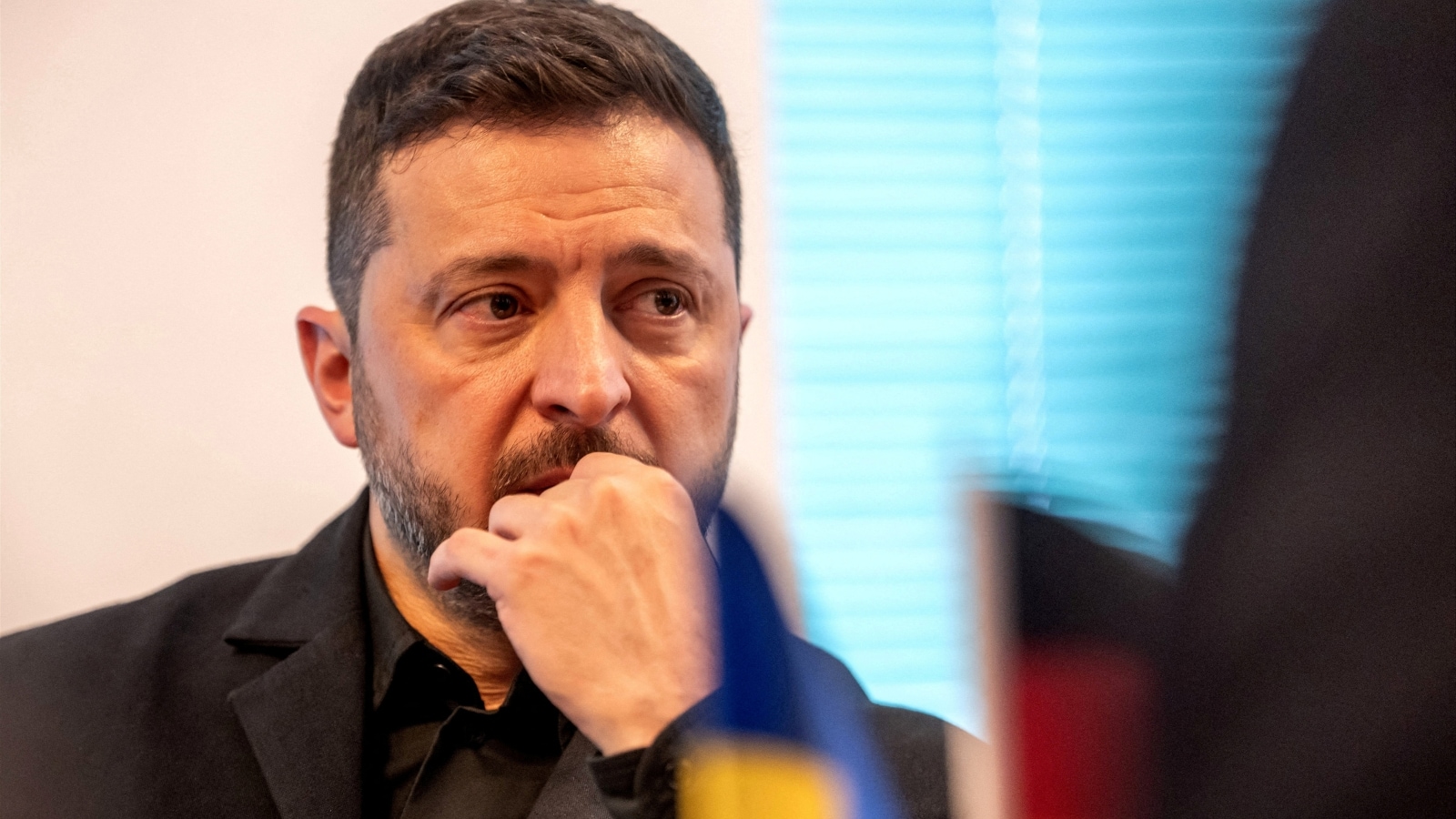
He stood before the microphones in his signature uniform: a plain black T-shirt and worn blue jeans. Behind him, a massive digital screen flickered with telemetry data, drone flight paths, and video feeds of Russian supply lines being blown to pieces.
Mykhailo Fedorov, the 35-year-old digital prodigy who had spent six months trying to drag a post-Soviet military machine into the twenty-first century, was no longer Ukraine’s defense minister. He had just been ousted in a sweeping government reshuffle.
But he was not going quietly.
With the raw, unfiltered anger of a tech founder whose startup had just been hostilely overtaken by corporate suits, Fedorov pointed his finger directly at the man he blamed for his exit: General Oleksandr Syrskyi, the 60-year-old commander-in-chief of Ukraine's armed forces.
"Instead of working out how to asymmetrically defeat Russia," Fedorov said, his voice tight, "he has worked out how to split the country."
It was an astonishing public execution of military protocol. In a nation fighting for its survival, where public unity is treated as a sacred shield, the armor had cracked wide open.
This was not a simple political disagreement. It was a fundamental clash between two entirely different eras of human conflict.
The Calculus of Mud and Math
To understand the rift, you have to look at the backgrounds of the two men standing at the center of the divide.
General Syrskyi is a product of deep military heritage. Born in 1965, he was educated at the Moscow Higher Military Command School in the 1980s. He learned the art of war through Soviet doctrine: massive artillery barrages, deep defensive lines, and the grueling, slow-moving physics of infantry maneuvering. He is the strategist who successfully organized the defense of Kyiv in the terrifying opening weeks of 2022, and later masterminded the brilliant Kharkiv counteroffensive. To Syrskyi, war is won by holding the dirt, placing the boots, and enforcing absolute, unyielding hierarchy.
Then there is Fedorov.
Before the war, he was Ukraine’s minister of digital transformation, a millennial tech enthusiast who wanted to turn the state’s bureaucracy into an app. When the rockets started falling, he realized that a country outnumbered and outgunned could not win a war of attrition against a massive neighbor. Ukraine could not match Russia soldier for soldier, shell for shell.
It had to use math.
Under Fedorov's influence, Ukraine’s defense strategy leaned heavily into asymmetrical warfare. He championed cheap, agile, first-person-view (FPV) drones. He helped build an ecosystem of private tech developers, bypassing slow bureaucratic channels to put lethal, low-cost aerial tools directly into the hands of frontline units. His long-range strike drones bended the narrative of the war, bypassing front lines altogether to strike deep into Russia's industrial heart, knocking out oil refineries and starving the Kremlin's war machine of fuel.
Consider the contrast. On one side is the general who views the battlefield through maps and troop movements. On the other is the reformer who views the battlefield as a series of networks, software updates, and manufacturing supply chains.
The Audit that Sparked the Fire
When Fedorov took over the Defense Ministry in January, he didn’t just focus on gadgets. He brought a startup's obsession with efficiency and transparency to a ministry notorious for Soviet-style bloat.
He ordered a sweeping audit of the military’s procurement processes and army brigades. The results were staggering. The audit uncovered 300 billion hryvnias—roughly 6.7 billion dollars—in overspending and waste.
Fedorov began shaking up the old guard. He instituted polygraph tests for ministry employees, moved major procurement contracts to open digital bidding, and aggressively renegotiated artillery shell purchases. He claimed these moves cut the cost of critical 155mm artillery ammunition by 16 percent. He raised soldier salaries and worked on plans to allow long-serving infantrymen to finally go home on demobilization.
But in doing so, he stepped on the toes of the generals.
Traditionalists in the military hierarchy saw Fedorov’s reforms not as modernization, but as a hostile takeover. They whispered to journalists that the young minister was out of his depth. They argued that his obsession with technology was a "PR repackaging" of efforts that were already underway. They accused him of "gamifying" a brutal war, focusing on flashy drone strikes while ignoring the deeply unglamorous, agonizing reality of a severe infantry shortage.
The tension build-up was quiet at first, occurring behind closed doors in high-stakes meetings with President Volodymyr Zelenskyy. Fedorov tried to get Zelenskyy to replace Syrskyi. When that failed, he tried to make the partnership work. But behind the scenes, Fedorov claimed, his initiatives were systematically stalled, buried under paperwork, and ignored.
The system, as it often does, resisted the foreign body.
"We hit a situation where all the initiatives we proposed were blocked," Fedorov lamented at his press conference. "And Syrskyi... is not ready to look me in the eye and talk openly about the problems."
A Splintered Nation in the Streets
Ultimately, Zelenskyy chose the general over the disrupter. Faced with a choice between the commander who holds the front lines and the minister who optimizes the budget, the president backed Syrskyi.
The backlash was instant, violent, and deeply emotional.
For many Ukrainians, particularly the generation under thirty, Fedorov represented the future. He was the proof that Ukraine could be modern, transparent, and clever. Within hours of his dismissal, thousands of citizens took to the streets of Kyiv, singing the national anthem and waving flags. It was a rare, highly sensitive display of wartime dissent.
The military itself began to show fractures. Pavlo Yelizarov, a deputy commander of Ukraine's air force, resigned in protest. Joint Forces Commander Mykhailo Drapaty publicly defended Fedorov, pointedly stating that the military desperately "needs change" and "new rules."
Syrskyi responded with a brief, chilly statement. He thanked Fedorov for his service, ignored the specific accusations of sabotage and lies, and simply urged the country to focus on the war.
But the damage to the facade of absolute unity is done.
The tragic irony of Ukraine’s current crisis is that both Syrskyi and Fedorov are right. You cannot win a modern war without the gritty, terrifying, mud-soaked holding of trenches that Syrskyi commands. Yet you also cannot win a war of attrition against a vastly larger empire without the rapid, ruthless technological evolution that Fedorov championed.
By pushing out the innovator, Ukraine has preserved its traditional chain of command at the cost of its most creative engine.
As the protest chants faded into the Kyiv evening, the digital screen behind Fedorov’s empty podium remained dark. The country is left to face an unrelenting adversary with its old-school generals firmly in control, leaving millions of Ukrainians to wonder if a military that refuses to change its internal culture can ever truly change the course of the war.