The dust in Barcelona doesn't just settle. It waits.
In 2008, the city looked at its reflection in empty reservoirs and saw a ghost. The Sau reservoir, usually a vast expanse of sapphire, had shriveled so severely that a submerged 11th-century church tower began to poke through the surface like a skeletal finger pointing toward a dry sky. People stood on the banks and looked at the mud. They realized that the Mediterranean dream—the salt air, the Gaudí curves, the late-night tapas—was built on a liquid foundation that was vanishing.
Emergency ships began pulling into the harbor, carrying millions of liters of water from Marseille and Tarragona. It was a humiliating spectacle for a global metropolis. It was also a warning.
When the taps almost ran dry, the conversation changed from "how do we find more water" to "how do we stop throwing away the water we already have." Today, Barcelona isn't just surviving. It has become a laboratory for the rest of a scorching world.
The Loop
Think about the water you used this morning. You brushed your teeth, showered, and flushed. In most cities, that water follows a linear path: from a river or a well, through a pipe, into your home, and then out to a treatment plant before being dumped into the ocean. It is a one-way trip. We treat water like a disposable battery. We use its energy and then discard the casing.
Barcelona decided to build a circle.
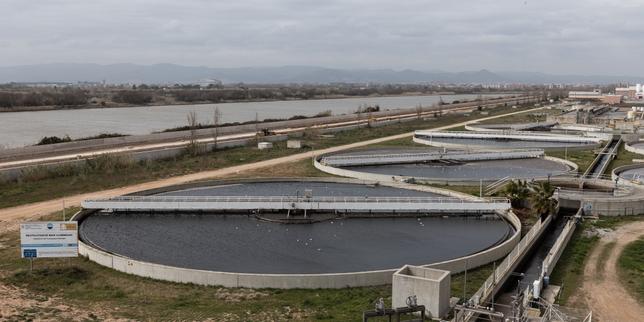
To understand how this works, you have to look at the Llobregat delta. This is where the city’s waste meets its future. Instead of letting treated wastewater flow into the Mediterranean, engineers began pumping it back upstream. They treat it to a high standard and then inject it into the subsoil or discharge it into the river several kilometers above the city’s intake valves.
It is a feedback loop. The water travels from the sink to the plant, from the plant to the river, and from the river back to the sink. It is the same molecule, performing an endless encore.
The Invisible Barrier
Consider a hypothetical gardener named Mateo. Mateo lives in the Baix Llobregat, where the salt from the sea has been creeping into the groundwater for decades. As the freshwater levels dropped, the heavy, briny Atlantic pushed inland, poisoning the wells and turning fertile soil into a salty crust.
If you are a farmer, salt is the enemy. It is a slow, silent invasion.
To fight this, Barcelona’s water authorities created an invisible wall. By injecting reclaimed water into the aquifer at high pressure, they created a hydraulic barrier. This wall of recycled water pushes back against the sea. It keeps the salt in the ocean and the fresh water in the ground. Mateo doesn't see the complex array of pumps and sensors, but he sees his tomatoes growing. He sees the green.
This isn't just a technical fix. It is a territorial defense. Without this reclaimed "shield," the city’s secondary water sources would be lost to the Mediterranean within a generation.
The Chemistry of Trust
The biggest obstacle to water reuse isn't engineering. It’s the "yuck factor."
There is a deep-seated, primal resistance to the idea of drinking something that was once in a sewer. Engineers call this "potable reuse," but for the public, it feels like a violation of a natural law. We want our water to come from mountain springs and pristine glaciers, even if those glaciers are melting and those springs are tapped out.
Barcelona bypassed this psychological barrier through clever integration.
The reclaimed water isn't piped directly into homes. Instead, it is used for irrigation, street cleaning, and industrial cooling. Most importantly, it is used to "recharge" the river. By the time that water reaches a resident’s glass, it has been filtered by the earth, mixed with rainwater, and treated again at a traditional drinking water plant.
It has been laundered by nature.
In the Sant Feliu de Llobregat plant, the process is a masterpiece of micro-management. They use ultrafiltration and reverse osmosis—forcing water through membranes so fine that even viruses cannot pass. It is cleaner than the water in many mountain streams. Yet, the city knows that logic rarely wins an argument against instinct. They have spent years proving the safety of the loop through transparency and constant testing.
The data is cold. The water is clear. The fear is what remains to be dissolved.
A Continental Pressure Cooker
The rest of Europe is watching. While Barcelona was the first to feel the heat, the "drought map" is expanding north. Berlin, London, and Milan are starting to see the same erratic rainfall patterns that forced Catalonia’s hand.
The statistics are sobering. In some parts of the region, the reuse of water has reached nearly 20% of the total supply. During the most recent droughts, that number climbed even higher. Without the recycled flow, the city would have had to implement draconian rationing years ago.
But there is a cost.
Desalination and advanced recycling are energy hogs. To pull the salt out of seawater or the impurities out of waste, you need massive amounts of electricity. This creates a feedback loop of its own: to fight the effects of climate change (drought), we use processes that can contribute to climate change (carbon emissions).
Barcelona’s answer is to tie the water works to renewable energy. Solar arrays and biogas recovery—harvesting the methane produced by the waste itself—are being used to offset the footprint. They are trying to make the circle not just wet, but green.
The Memory of the Tower
The church tower at Sau still appears from time to time. It is a barometer of anxiety. When the tip of the steeple emerges, the headlines in Barcelona grow frantic. When the bell tower is fully visible, people start to panic.
But the panic is different now. It is no longer the frantic, helpless fear of 2008. It is a focused, industrial resolve. The city has realized that the climate of the past is a foreign country, and we no longer have a passport to go back there.
Walking through the Gothic Quarter, you see the fountains. You see the tourists washing their hands. You see the life of a city that refuses to stop. Below the cobblestones, the recycled pulse of the Llobregat is moving through a hidden anatomy of pipes and membranes, a silent miracle of persistence.
We used to think of water as a gift from the clouds. In Barcelona, they have learned to treat it as a precious, borrowed tool—one that is too valuable to ever truly let go.
The sea sits just a few meters away, vast and blue and undrinkable. The city turns its back on the salt and looks inward, toward the pipes, toward the filters, and toward the next time someone turns on a tap, expecting the miracle to just happen.
The miracle is no longer in the rain. It is in the reuse.
Would you like me to analyze the specific energy trade-offs between desalination and wastewater reclamation in Mediterranean climates?