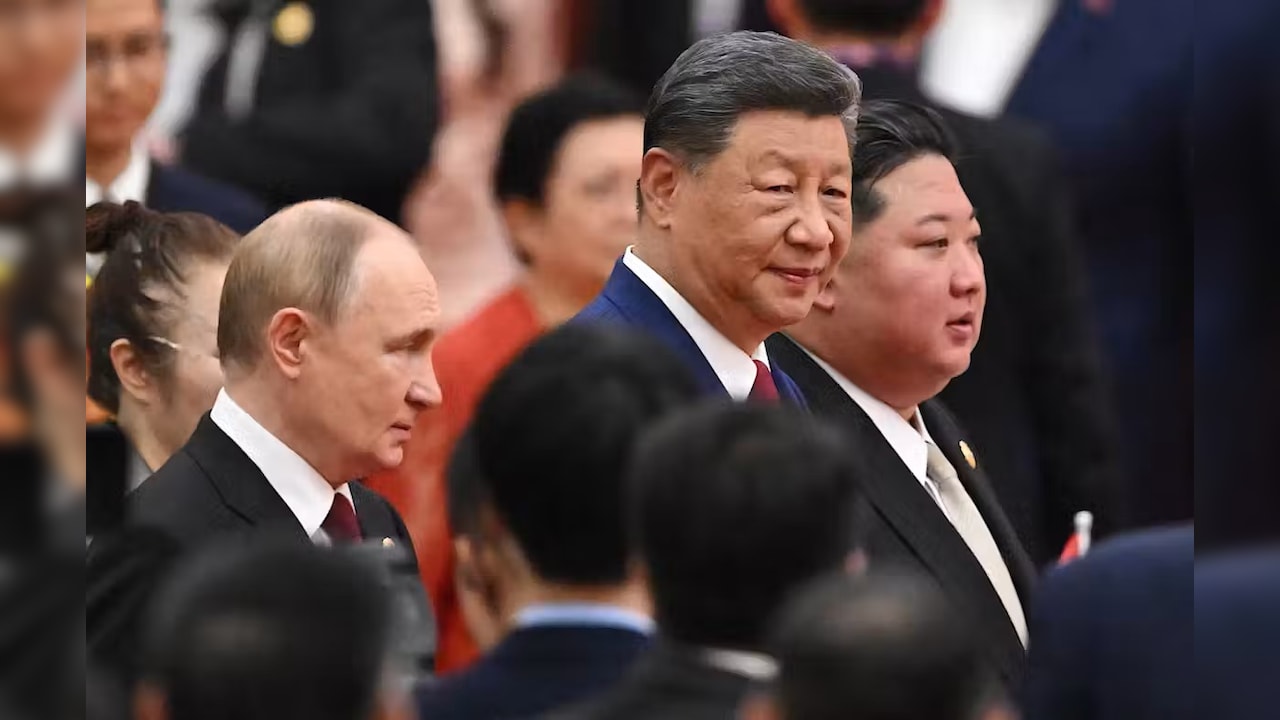
You have probably seen the photos. World leaders standing shoulder to shoulder in Beijing, smiling for the cameras, putting on a grand show of solidarity. It looks like a formidable, unified front against the West. A tight trilateral axis consisting of Beijing, Moscow, and Pyongyang, ready to rewrite the rules of global geopolitics.
But if you look closer, the cracks are glaring.
What looks like a rock-solid alliance is actually a marriage of convenience. It is packed with deep-seated paranoia, conflicting long-term goals, and asymmetric dependencies. China is playing a high-stakes game. By wrapping its arms around a warmongering Russia and a nuclear-armed, highly unpredictable North Korea, Beijing is dangerously close to burning its bridges with its most vital economic partners in the West. It is a balancing act that simply cannot hold.
The Axis of Unease
Let's look at what is happening under the surface. China remains North Korea’s historical ally and economic lifeline, accounting for the vast majority of its trade. But North Korean leader Kim Jong Un recently made a hard pivot toward Moscow. The mutual defense treaty signed between Russia and North Korea completely flipped the script on regional security dynamics.
North Korea has shipped millions of artillery shells to fuel Vladimir Putin’s campaign in Ukraine. In return, Pyongyang gets something it desperately craves: cold hard cash, Russian oil, and space-age military technology. Thousands of North Korean troops have deployed to fight alongside Russian forces, giving Pyongyang real-world combat experience its military has not seen in decades.
This deep bond between Moscow and Pyongyang infuriates Beijing.
For decades, China viewed North Korea as its exclusive strategic backyard. Now, Putin is barging in, handing Kim Jong Un a license to be reckless. A more confident, nuclear-capable North Korea means increased military escalation right on China's doorstep. It gives the United States, Japan, and South Korea the perfect justification to build up their own missile defense systems and deepen their trilateral military cooperation in East Asia. That is China's absolute worst nightmare.
The Economic Reality Check
Beijing’s biggest headache is its own economic vulnerability. Unlike Russia, which has been largely cut off from global financial networks, or North Korea, which thrives in international isolation, China relies heavily on global markets.
Consider the raw economic numbers from recent trade data. China's trade with its democratic neighbors dwarfs its trade with the United States. In 2025, China's trade with South Korea topped $331 billion, and its trade with Japan reached $322 billion. These massive numbers represent real wealth, employment, and economic stability. If China gets sucked into a formal, adversarial military bloc with Russia and North Korea, these critical economic channels will suffer devastating damage.
European and American leaders have made it clear that they are closely watching Beijing's actions. While Chinese President Xi Jinping wants to signal to the West that North Korea remains firmly within China's strategic orbit, he cannot afford to look like the leader of an anti-Western triumvirate. This explains why China's official rhetoric regarding the Russia-North Korea defense pact remains noticeably muted. Beijing is terrified of secondary sanctions that could crippled its automotive, electronics, and tech manufacturing sectors.
Tactical Wins vs Strategic Losses
Is China completely powerless here? Not at all. Beijing still extracts significant short-term benefits from this messy alignment.
The loose coordination between China, Russia, and North Korea acts as a highly effective counterweight to American influence in the Indo-Pacific region. By coordinating diplomatic moves at the United Nations, China and Russia have systematically eroded the effectiveness of international sanctions against Pyongyang. They are effectively working together to end North Korea’s isolation, giving Beijing a powerful diplomatic lever to pull whenever it wants to pressure Washington.
On the economic front, bilateral trade between China and Russia surged past $227 billion. Russian hydrocarbons and commodities are flowing into China at discounted rates, while Chinese manufactured goods, cars, and machinery fill the void left by Western brands in the Russian market.
But these tactical wins come at a steep strategic price. By refusing to condemn Russian aggression and failing to rein in North Korea's nuclear provocations, China is destroying whatever trust it had left with the European Union. Europe used to view China primarily as a commercial partner. Now, it increasingly views Beijing as a systemic security threat.
Breaking the Illusion of Unity
The idea of a seamless, integrated trilateral axis is a myth. The history of these three nations is defined by mutual distrust, shifting loyalties, and transactional relationships. During the Cold War, North Korea masterfully played China and the Soviet Union against each other to secure maximum aid while giving up zero sovereignty. Kim Jong Un is running the exact same playbook today.
China wants regional stability so it can focus on its long-term goal of domestic high-quality economic development. Russia wants global chaos to distract the West and fragment the international order. North Korea wants survival, cash, and nuclear legitimacy, regardless of the regional collateral damage.
These goals are fundamentally incompatible. China is finding out that the closer it hitches its wagon to Moscow and Pyongyang, the less control it has over either of them. Instead of projecting immense strength, Beijing's show of unity is exposing its strategic isolation.
Navigating the Fallout
For global businesses, investors, and policymakers, this shifting geopolitical landscape requires immediate tactical adjustments. You cannot afford to rely on the assumption that China will easily de-escalate regional tensions.
- Accelerate supply chain decoupling. If your business relies heavily on Chinese manufacturing, look closely at diversifying your operations into Southeast Asia, India, or Mexico. The risk of sudden secondary sanctions or export controls triggered by China's geopolitical alignments is at an all-time high.
- Monitor dual-use technology compliance. Ensure your compliance teams aggressively vet all international trade partners. The line between commercial tech and military-grade components is blurring fast, and Western regulators are cracking down hard on any entity feeding the Russia-North Korea-China trade loop.
- Hedge against East Asian currency volatility. The deepening military coordination between the US, Japan, and South Korea, coupled with North Korea's rising belligerence, will trigger sharp fluctuations in the South Korean Won and the Japanese Yen. Position your financial portfolios to weather sudden regional security shocks.
The grand show of unity in Beijing makes for a striking photograph, but it is a terrible long-term strategy for China. By coddling its volatile neighbors, Beijing is trading its lucrative global integration for a fragile, dangerous partnership that offers very little real security.
Russia-China-North Korea Relations: Obstacles to a Trilateral Axis
This presentation from the Foreign Policy Research Institute offers an excellent, objective breakdown of why a formalized military axis between these three nations faces significant historical and political hurdles.