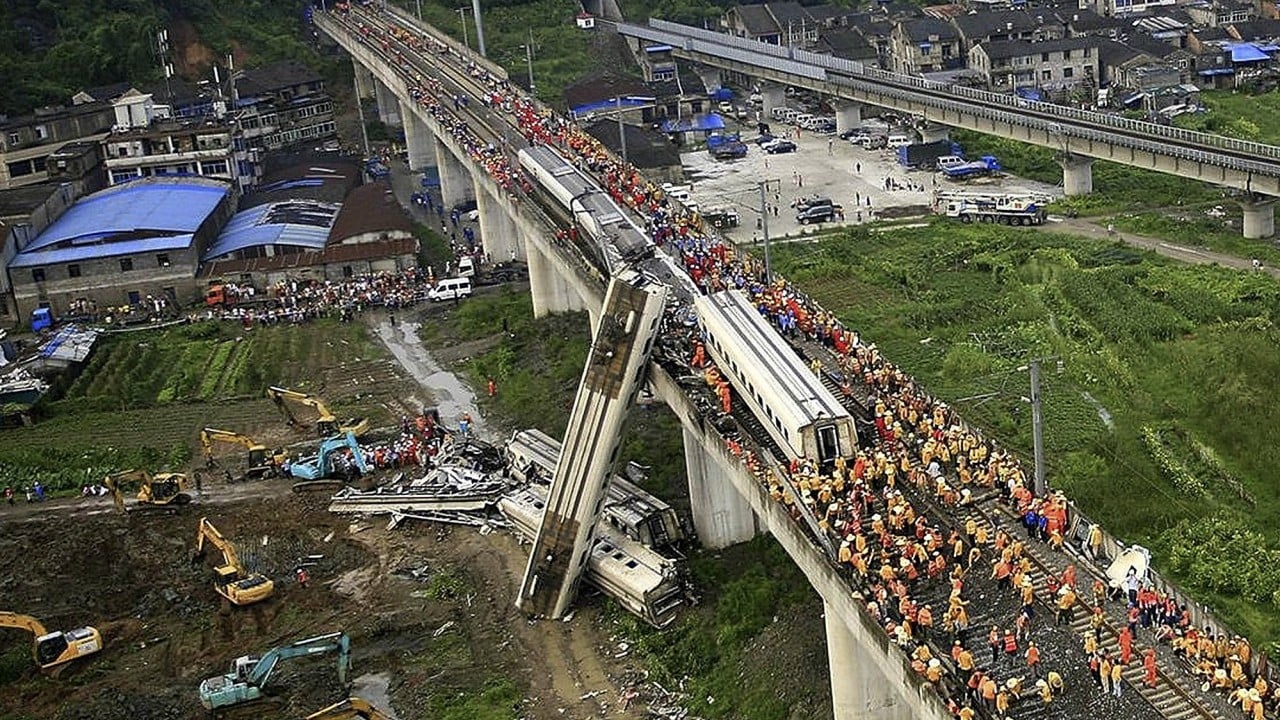
The mainstream media is losing its mind over China’s proposal to sync its massive high-speed rail network with low-Earth orbit satellites. The instant, lazy consensus from Western defense blogs and tech pundits boils down to a single, panicked question: But what if it gets hacked? They paint a cinematic picture of rogue cyber operators intercepting satellite signals, overriding ground control, and sending trains flying off the tracks at 350 kilometers per hour.
It is a terrifying narrative. It is also completely wrong.
The obsession with "space hacking" exposes a fundamental ignorance of how modern railway signaling works. The real risk of a space-based control system is not a cyberattack that causes a spectacular crash. The real risk is a mundane, brutal architectural failure: atmospheric interference, signal attenuation, and the sheer mathematical impossibility of maintaining zero-latency positioning for thousands of speeding multi-ton vehicles beneath heavy cloud cover and concrete tunnels.
We are asking the wrong questions because we are seduced by Hollywood cyber-thrillers. If you want to understand why China is pursuing this technology—and where the actual danger lies—you have to look past the hacking scare tactics.
The Flawed Premise of the Space Hack
Let us dismantle the security panic immediately. I have spent years reviewing critical infrastructure architecture, and if there is one universal truth, it is that terrestrial systems are already highly vulnerable, but not in the ways the public thinks.
Mainstream articles imply that linking a train to a Beidou or low-Earth orbit (LEO) satellite constellation suddenly opens a backdoor for a teenager in a basement to steer a train. This ignores the bedrock principles of railway engineering:
- The Fail-Safe Mandate: High-speed rail operates on a philosophy of absolute passivity in the event of failure. If a signaling system loses its data feed, it does not default to "keep driving blindly." It defaults to an immediate, automated emergency brake application.
- Decoupled Control and Positioning: Satellites do not drive the train. In any proposed space-based architecture, satellites provide highly accurate positioning and synchronization data. The actual execution of speed restrictions and braking curves happens locally, on the train’s onboard computer, cross-referenced with terrestrial sensors.
- Cryptographic Reality: Military-grade encryption on satellite downlinks means a bad actor cannot simply spoof a signal to inject malicious steering commands. To cause a catastrophic failure via spoofing, an attacker would need to replicate a highly complex, authenticated data stream across multiple moving targets simultaneously.
If a state-sponsored actor wants to disrupt a rail network, they do not need to hijack a satellite. They will use a cheap, localized radio jammer to flood the frequency. The result? The train safely grinds to a halt because it lost its signal. The economy slows down, passengers get angry, but nobody dies. The hacking narrative sells clicks, but it misunderstands the physics of the system.
The Real Crisis Is Physics, Not Cyber Warfare
The true vulnerability of China’s space-based rail ambitions is the brutal reality of signal degradation. High-speed rail lines do not run across flat, empty deserts. They cut through mountain ranges via tunnels, slice through dense urban concrete jungles, and operate under torrential downpours.
Consider the European Train Control System (ETCS) Level 3 or China’s equivalent CTCS-4. These systems aim to eliminate traditional trackside physical blocks in favor of "moving blocks" calculated by the train's precise position.
When you shift the primary positioning mechanism from physical track circuits and transponders (balises) beneath the train to a satellite constellation 500 kilometers above the earth, you introduce severe architectural liabilities.
The Tunnel Problem
Imagine a train traveling at 97 meters per second. It enters a three-kilometer-long mountain tunnel. The satellite line-of-sight is instantly severed. To compensate, the train must rely on inertial navigation systems (INS) or terrestrial wheel sensors. The moment the train exits the tunnel, it must re-acquire the satellite signal instantly.
If there is even a two-second delay in re-establishing a high-precision carrier-phase lock, the system’s positional uncertainty expands exponentially. In high-speed rail, an uncertainty of just a few meters is the difference between a safe stopping distance and a catastrophic failure of the moving block interval.
Atmospheric and Multipath Interference
Satellites operating in the Ka or Ku-band frequencies suffer from rain fade. Heavy storms attenuate the signal. Furthermore, in deep rock cuttings or urban areas, the signal reflects off walls before hitting the train's antenna—a phenomenon known as multipath propagation. This creates ghost positioning data.
If the onboard system receives conflicting data between its internal sensors and a degraded satellite signal, it must reject the satellite data. If it rejects the data, it triggers a penalty brake. The result of a space-dependent network is not a series of explosions; it is a system plagued by constant, unpredictable, system-wide delays that render high-speed transit economically unviable.
Why China Is Gambling on Space Infrastructure
If the technical hurdles are this severe, why is Beijing pushing for it? The answer is not about superior tech; it is about infrastructure economics and geopolitical dominance.
| Factor | Terrestrial Systems (CTCS-3) | Space-Based Systems (Proposed) |
|---|---|---|
| Capital Expenditure | Massive cost for trackside equipment (balises, radio towers). | High initial launch cost, low incremental line cost. |
| Maintenance | Continuous manual inspection of thousands of miles of trackside hardware. | Software-driven updates; hardware maintenance localized to satellites/depots. |
| Geographic Reach | Limited to built-out rail corridors. | Globally deployable across entire continents. |
| Geopolitical Value | Non-exportable physical assets. | Exportable standard for the entire Belt and Road Initiative. |
China has built the largest high-speed rail network on earth, but maintaining hundreds of thousands of physical transponders and specialized trackside radio towers across varying terrain is an astronomical financial burden. By shifting the heavy lifting of positioning to space, they can theoretically slash the maintenance costs of future lines.
More importantly, this is a play for technological export. If China can standardize a space-based rail control system linked directly to its Beidou satellite constellation, it can export cheap, end-to-end transportation infrastructure to developing nations across Central Asia, Africa, and Southeast Asia. The purchasing nation becomes permanently dependent on Chinese space assets to keep their domestic trains running. It is geopolitical leverage disguised as engineering innovation.
The Dangerous Trade-off of Centralization
The downside to this approach is something I have seen repeatedly in massive industrial automation projects: the illusion of the magic bullet. Engineers fall in love with the elegance of a centralized, cloud-or-space-based architecture, forgetting that decentralization is what keeps systems alive during black swan events.
By shifting the foundational layer of rail safety from local, physical track infrastructure to a centralized orbital constellation, you create a single point of failure. Not for a hacker, but for a systemic software glitch or a solar storm.
During a severe geomagnetic storm, the ionosphere becomes highly charged, disrupting satellite signals globally. A localized terrestrial rail system can ignore a solar flare. A space-reliant rail system would be forced to ground or slow down its entire national fleet simultaneously.
Stop Worrying About Cybercriminals, Start Worrying About Complexity
The premise of the competitor’s article—and the broader public discourse—is flawed because it treats security as a firewall problem. It asks if a hacker can break into the system.
The real question we should be asking is: Does the addition of a space layer introduce more failure modes than it eliminates?
The answer is yes. The pursuit of space-based rail control is an aggressive bet that software complexity and orbital engineering can overcome the laws of terrestrial physics. It is an audacious experiment driven by economic desperation to cut maintenance costs and a geopolitical drive to export a closed-loop technology ecosystem.
If China’s space-based rail system fails, it will not be because a shadowy figure in a hoodie typed code into a terminal and caused a collision. It will be because a train exiting a tunnel in a torrential downpour lost its carrier-phase lock for four seconds too long, forcing a system-wide emergency shutdown that the network’s fragile economics simply could not survive.
Stop looking for hackers in the sky. Look at the mud, the rain, and the tunnels on the ground. That is where the project will succeed or die.