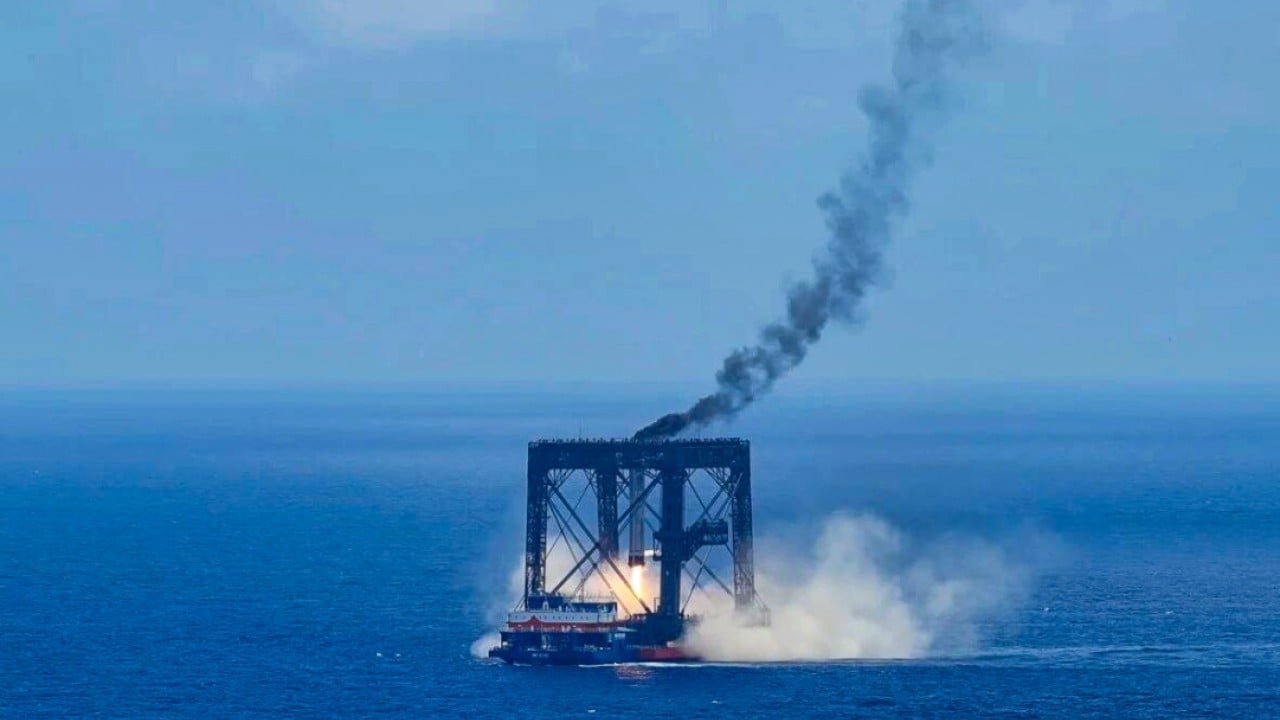
China is rewriting the orbital playbook by trying to catch returning rockets with a giant, flexible net. In late 2024, Chinese commercial aerospace company CAS Space successfully demonstrated this concept using a scale prototype, signaling a sharp departure from SpaceX's rigid launchpad "chopsticks" or traditional landing legs. By shifting the mechanical burden of landing from the flight vehicle to ground infrastructure, Chinese firms aim to slash rocket dry mass, maximize payload capacity, and drastically lower the cost per kilogram to orbit.
It is a radical engineering gamble. If it succeeds, it bypasses the massive weight penalties that have historically limited the efficiency of reusable launch vehicles.
The Mass Penalty of Coming Home
To understand why a giant net is even on the table, you have to look at the brutal physics of the rocket equation. Every gram of structure added to a rocket stage degrades its ultimate performance.
When a vehicle like SpaceX's Falcon 9 lands, it carries a heavy burden. It requires deployable carbon-fiber landing legs, hydraulic actuators, cold-gas thrusters for orientation, and a substantial reserve of propellant dedicated solely to the terminal burn. This hardware is dead weight during the ascent phase. It eats directly into the maximum payload the rocket can deliver to orbit.
By contrast, the catch-net architecture aims to strip the rocket bare.
If a ground-based system absorbs the kinetic energy of the descending stage, the vehicle no longer needs heavy landing gear. It requires less reserve fuel because the ground infrastructure handles the final deceleration and stabilization. The engineering philosophy here is simple: move the complexity, the mass, and the risk to the ground, where weight does not matter.
How to Catch a Falling Missile
The mechanism tested by CAS Space relies on a tensioned network of high-strength cables suspended by specialized cranes. This is not a simple cargo net draped over a frame. It is an active, dampening recovery apparatus.
The Physics of Mechanical Dampening
As the rocket stage hovers and descends into the recovery zone, it targets a centralized grid. The net must accomplish three distinct engineering feats simultaneously:
- Load Distribution: It must distribute the impact forces across the structural hardpoints of the rocket airframe rather than crushing the thin-walled fuel tanks.
- Kinetic Absorption: The winch and cable systems must yield dynamically, converting the vehicle’s downward momentum into controlled mechanical friction.
- Thermal Management: The system must withstand the residual heat from the rocket's engine plume, which remains active until the exact moment of capture.
This approach contrasts sharply with the "Mechazilla" system developed for Starship. SpaceX uses massive, rigid steel arms that close around precise pins on the side of a massive booster. That requires millimeter-level guidance accuracy and an incredibly rigid airframe to withstand the sudden metal-on-metal impact. The net approach is far more forgiving in terms of initial alignment, using compliance and flexibility to cradle the vehicle.
The Untested Realities of Scale
The prototype tests conducted so far have used small-scale testbeds. Scaling this infrastructure to handle a full-sized orbital booster introduces terrifying structural challenges.
A standard first-stage booster returning from the edge of space weighs dozens of tons, even when nearly empty of fuel. It descends at high speed, buffeted by unpredictable low-altitude wind shears.
[Hovering Booster] -> [Initial Contact with Cord Grid] -> [Dynamic Winch Yielding] -> [Secured Stage]
If the booster enters the net at a slight angle, the lateral forces could cause the thin aluminum-lithium tanks to buckle. Rockets are incredibly strong along their vertical axis to withstand the immense g-forces of launch, but their side walls are remarkably delicate. A net that squeezes too hard, or unevenly, will simply unzip the hull, resulting in an immediate catastrophic fireball.
Furthermore, the operational lifespan of these high-strength fibers under repeated exposure to superheated rocket exhaust remains a massive question mark. Synthetic materials like Kevlar or ultra-high-molecular-weight polyethylene lose their tensile strength rapidly when exposed to extreme thermal stress. Replacing the core cabling after every few flights would quickly erase the economic benefits of reusability.
China Corporate Space Race
The pursuit of net-based recovery is not happening in a vacuum. It is fueled by a fiercely competitive ecosystem of Chinese state-backed enterprises and private startups, all racing to deploy megaconstellations that rival Western satellite networks.
Companies like CAS Space, LandSpace, and iSpace are under immense pressure from Beijing to achieve rapid, low-cost flight cadence. The country’s planned national internet networks, such as the G60 Starlink and the China Satellite Network Group (SatNet) initiatives, require thousands of operational satellites in low Earth orbit over the coming decade.
The current global supply of launch vehicles is entirely inadequate to meet this demand. Traditional expendable rockets are too slow to manufacture and too expensive to sustain such an effort. Because Western options are off-limits due to geopolitical barriers, domestic commercial entities must innovate rapidly. They cannot afford to spend a decade replicating SpaceX’s developmental path step-by-step; they need to leapfrog the established methodologies.
Logistics Beyond the Launchpad
A major, often overlooked advantage of the net recovery system is its mobility. Rigid recovery towers require massive concrete foundations, deep piles, and years of fixed site construction. They are permanent monuments tied to a single coordinate.
A cable-and-net system can theoretically be deployed on a modified sea barge or a rapidly assembled mobile ground station. For a nation looking to expand its launch geography, sea-based recovery is highly strategic.
Landing a rocket on an ocean platform removes the risk of spent stages falling near populated inland areas—a persistent issue for China’s older, land-locked launch sites like Xichang. A flexible net system on a pitching deck at sea could prove more forgiving than a rigid platform, absorbing both the movement of the ship and the descent of the rocket simultaneously.
The true test of this technology will not be found in controlled, low-altitude hover tests. It will happen when a full-scale first stage, fresh from the upper atmosphere, attempts to find its cradle amidst the chaotic winds of the South China Sea.