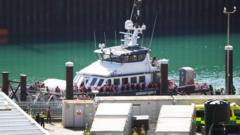
A sudden spike in summer temperatures over the late-May bank holiday weekend triggered a predictable surge in English Channel small-boat crossings, with nearly 1,000 migrants arriving on British shores in just four days. Between Friday and Monday, precisely 989 people were intercepted by UK Border Force cutters and brought to the Dover quayside.
The spike is not a failure of intelligence or a statistical anomaly. It is the direct consequence of unseasonably hot weather and flat seas, combined with a highly adaptable people-smuggling industry that has outmanoeuvred joint British and French enforcement strategies.
The Mirage of Border Control
The British public is frequently told that increased funding for French beach patrols and high-tech drone surveillance will stem the flow of small boats. The data tells a different story. When the weather clears, the boats launch. Smuggling networks have shifted from an amateur logistical headache into a highly professionalised multi-million-pound industry.
When French authorities intensify patrols on the beaches of Calais and Dunkirk, the gangs do not pack up and go home. They simply move their launch sites. Evidence from small-boats command indicates that dinghies are now being launched along a sprawling 100-mile stretch of northern European coastline.
Smugglers are moving operations as far north as Nieuwpoort on the Belgian coast and as far south as Le Tréport in Normandy. This geographic expansion stretches French and Belgian policing resources to a breaking point. It turns the English Channel into an unpoliced sieve where the perimeter is too vast to monitor effectively.
The Supply Chain Illusion
There is a persistent myth that seizing inflatable dinghies or arresting low-level drivers at the French border will break the business model. This misunderstanding ignores how global supply chains operate.
The vessels used in these crossings are not standard commercial dinghies. They are custom-ordered, sub-standard inflatables manufactured in factories outside of Europe, often shipped in pieces through complex transit routes across the Balkans and Germany. They are treated by smuggling networks as entirely disposable infrastructure.
- Low Capital Cost: A single inflatable boat, structurally weak and dangerous, costs the gang a few thousand pounds to source.
- High Profit Margins: With up to 60 or 70 people crammed onto a single vessel, each paying thousands of Euros, a single successful launch generates massive revenue.
- Disposable Assets: Losing a boat to French police on a beach is merely a minor cost of doing business.
The financial incentives are too high for simple beach interceptions to work. By the time a boat touches the water, the financial transaction is already complete. The smugglers have made their profit, and the risk has been entirely transferred to the passengers and the British coastguard.
The Geopolitical Standoff
The British government has pinned its hopes on various returns policies and international agreements to act as a deterrent. The reality on the ground is far less cooperative.
While the UK and France have extended a pilot returns scheme designed to exchange a limited number of arrivals, the wider geopolitical reality makes mass deportations unfeasible. A significant portion of those arriving via small boats originate from countries like Afghanistan, Sudan, Eritrea, and Syria.
Nationality Share of Small Boat Arrivals (Recent Trends)
--------------------------------------------------------
Eritrean     | ███████████████ 18%
Afghan       | █████████ 11%
Iranian      | █████████ 11%
Sudanese     | █████████ 11%
Somali       | ████████ 9%
Others       | ███████████████████████████████ 40%
Returns to nations like Afghanistan and Sudan are effectively frozen due to ongoing conflict and a lack of diplomatic relations. You cannot easily deport an asylum seeker to a war zone or a state run by a regime the British government does not officially recognize. This leaves thousands of individuals in a state of legal limbo within the UK asylum infrastructure, driving up the domestic cost of accommodation and processing.
The Port Infrastructure Choke Point
The impact of the small-boats crisis is not confined to the humanitarian and legal realms. It is actively colliding with legitimate cross-Channel trade and travel.
Over the same bank holiday weekend, holidaymakers and freight drivers faced six-hour delays at the Port of Dover. While the sheer volume of holiday traffic contributed, the parallel deployment of Border Force assets to manage migrant arrivals placed an unprecedented strain on port infrastructure.
The introduction of new biometric checks at the border has exacerbated this friction. When the system faces a simultaneous influx of legal travelers and irregular arrivals, the entire logistical corridor between Kent and northern France risks grinding to a halt.
The Policy Dead End
The debate around the English Channel crossings remains stuck in a political loop. One side demands harsher enforcement and immediate deportations, while the other focuses on expanding safe and legal routes. Neither perspective addresses the immediate, structural reality of the crisis.
Enforcement alone cannot police a 100-mile coastline against an adversary that views its equipment as disposable and its customers as an infinite resource. Conversely, offering administrative alternatives does little to dismantle the sophisticated criminal networks currently operating with impunity across western Europe.
The bank holiday influx proved that the small-boats phenomenon is no longer an emergency; it is an established, resilient trans-national supply chain. Treating it as a series of isolated, weather-dependent events ensures that the system will keep operating, one calm sea at a time.