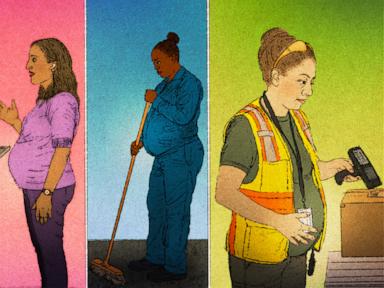
The fluorescent lights of the third-floor conference room hummed a low, synthetic drone that felt, to Elena, like a dentist's drill pressed directly against her temporal lobe.
She was fourteen weeks pregnant. Nobody knew yet.
In the glow of the dual monitors, her quarterly projections blinked mockingly at her. A spreadsheet of numbers—costs, revenue projections, client acquisition targets—that cared nothing for the microscopic heartbeat fluttering inside her ribs like a trapped moth. Elena pressed a cold can of sparkling water against the back of her neck, trying to beat back the rising tide of nausea that arrived with clockwork precision every afternoon at two-thirty.
"Elena," her manager’s voice crackled through the speakerphone, smooth and relentlessly upbeat. "Can we circle back on those supply chain metrics? The client wants assurance we won't hit any bottlenecks."
Elena swallowed hard, her mouth tasting of copper and stale mint. "Estamos en ello," she caught herself, correcting instantly, "We're on top of it. I'll have the updated brief on your desk by morning."
She clicked mute. She closed her eyes. She breathed.
This is the invisible architecture of modern work: a system built on the unspoken assumption that the human body is a static, reliable machine. It does not bleed. It does not swell. It does not produce milk, or grow organs, or require twelve separate medical evaluations before a child takes their first breath. For millions of women, pregnancy and the postpartum return are not just milestones; they are high-wire acts performed without a safety net, suspended over a canyon of institutional indifference.
The Secret Logistics of the Prenatal Calendar
To be pregnant at work is to become an intelligence operative in your own life.
Consider the sheer administrative burden of growing a human while maintaining fifty billable hours a week. Every prenatal appointment requires a tactical maneuver. You cannot simply tell your boss, “I need to spend Tuesday morning watching a technician smear cold gel across my abdomen to ensure my child’s kidneys are developing correctly.”
Instead, you lie.
You invent a vague "dental procedure." You schedule appointments for eight in the morning or four-thirty in the afternoon, hoping against hope that traffic will cooperate, that the clinic running forty minutes behind schedule won't blow your alibi, and that your manager won't notice the faint smell of antiseptic clinging to your sweater when you rush back to your desk.
The psychological toll of this deception is staggering. Women spend precious cognitive bandwidth—energy that should be directed toward analysis, creativity, and leadership—navigating the optics of vulnerability. In corporate culture, pregnancy is often treated as a temporary inconvenience at best, and a liability at worst. To show weakness is to invite doubt. To ask for flexibility is to raise a quiet flag that marks you as less committed to the grind.
The data underscores this quiet panic. Studies consistently show that a significant percentage of working mothers experience pregnancy discrimination, whether overt or coded in the passive-aggressive language of "cultural fit" and "availability." They find themselves passed over for promotions not because their output dropped, but because decision-makers have already written the script for them: She’s going to have a baby soon; she won’t want the travel.
Nobody asks Elena what she wants. They assume. And in that assumption, the architecture of her career begins to quietly fracture.
When the Baby Arrives, the Desert Begins
If pregnancy is a test of endurance, the postpartum return is a trial by fire.
Imagine walking back through those glass office doors twelve weeks after major abdominal surgery or vaginal tearing. Your pelvic floor is still recovering. Your sleep has been shattered into jagged, ninety-minute shards for nearly three months. Your brain is swimming through the dense, fog-like haze of postpartum neurogenesis.
And then, your milk comes in.
For a nursing mother, the human body does not care about quarterly earnings calls, board meetings, or open-plan office layouts. Every three hours, the biological imperative sounds an alarm. Breasts swell, engorge, and ache with a physical intensity that makes sitting upright at a desk feel like an act of medieval torture. If milk is not expressed, ducts clog, mastitis sets in, and the agonizing heat of infection takes hold.
Now, look around the modern corporate office. Where is the room for this?
In theory, federal and state laws require employers to provide a functional space—other than a bathroom—that is shielded from view and free from intrusion for employees to express milk.
In practice, reality looks vastly different.
Ask women across industries where they pump, and the answers read like a dark comedy about institutional neglect. They pump in supply closets, sitting on upturned plastic milk crates surrounded by spare toner cartridges and brooms. They pump in locked server rooms, listening to the deafening roar of industrial cooling fans while staring at blinking green status lights. They pump in their cars parked in freezing winter parking garages, running the engine to keep warm while juggling battery-powered pumps against a steering wheel.
Some have had to put sticky notes on office door handles begging colleagues not to barge in during a twenty-minute pumping window. Others have been told by facilities managers that the only available room is a windowless storage room where discarded filing cabinets go to die.
Dignity is the first casualty. When a new mother is forced to express the nourishment for her child sitting next to a mop bucket, the message from the organization is loud and clear: You are tolerated here, but you are not accommodated.
The Cost of Looking Away
Why does this persist?
Because corporations are run on legacy assumptions designed by people who never had to carry a child or feed one while closing a sale. The traditional workplace was engineered around a nineteenth-century model: the worker with a wife at home whose sole job was to manage biology out of sight.
When organizations fail to build genuine infrastructure for pregnancy and postpartum needs, they pay a price they rarely calculate on their balance sheets. It is called turnover.
Talented, experienced women reach their breaking point during these transition years. They look at the absurdity of pumping in a freezing car or fighting for five minutes of calendar space to see an obstetrician, and they quietly calculate their exit. They step off the ladder. They take lower-paying consulting gigs, or they leave the workforce entirely.
Companies wring their hands over the "leaky pipeline" of female leadership, wondering why senior management remains stubbornly homogenous. They commission diversity reports and host unconscious bias seminars. Yet they ignore the physical, material reality that drives mothers out the door: you cannot demand peak performance from people while denying them the basic biological conditions required to sustain human life.
Rewriting the Code
Fixing this is not a matter of charity. It is a matter of operational intelligence.
Forward-thinking organizations are beginning to realize that supporting reproduction is just as fundamental as maintaining high-speed internet or ergonomic desk chairs. A true lactation room is not a converted broom closet with a folding chair and an extension cord. It is a clean, private, climate-controlled space equipped with comfortable seating, sanitizing stations, hospital-grade equipment access, and—most importantly—absolute cultural permission to use it without penalty.
Similarly, prenatal care must be reframed. When a company normalizes time off for medical monitoring during pregnancy without requiring employees to invent elaborate healthcare fiction, trust deepens. When managers understand that a postpartum employee returning to work is navigating a profound neuro-hormonal transition, they stop treating accommodations as special favors and start treating them as standard operating procedure.
The stakes go far beyond retention. They touch the core of what kind of society we are building. Every time a workplace forces a mother to choose between her professional standing and her biological health, it sends a chilling signal to the next generation about how much we value the continuity of human life.
The Final Shift
Back on the third floor, the clock ticks past four o'clock.
Elena rubs her eyes, feeling the familiar, dull ache in her lower back. She looks at the spreadsheet, then at the calendar invite for tomorrow morning's strategy review, right in the middle of when she would need to pump if she were maintaining her schedule.
For a brief, exhausted second, she considers giving up. She considers the quiet whisper that tells her it would be easier to step back, to dim her ambitions, to accept that the system was never meant to hold someone like her.
Then she remembers the small heartbeat. The future she is working toward, spanning two distinct worlds—the one inside her home and the one on these glowing screens.
She closes the spreadsheet. She stands up, straightens her shoulders, and opens her laptop bag. She has a meeting to prep for, a team to lead, and a body that refuses to apologize for keeping the world alive.