The air at the Minnesota State Fair always tastes like a specific geometry of ambition: frying oil, damp sawdust, hot horsehair, and the metallic tang of ozone rolling off the Tilt-A-Whirl just before dusk. Ten days of compressed humanity. Two million pairs of boots grinding against the asphalt of Falcon Heights. Every square inch of the fairgrounds becomes a contested territory of sight and sound, where blue-ribbon squash sit fifty feet away from politicians pressing flesh and corn-dog vendors working tongs like surgeons.
Into this sensory carnival walked an artist with a wooden board and a brush.
They thought it was just another sign. They were wrong.
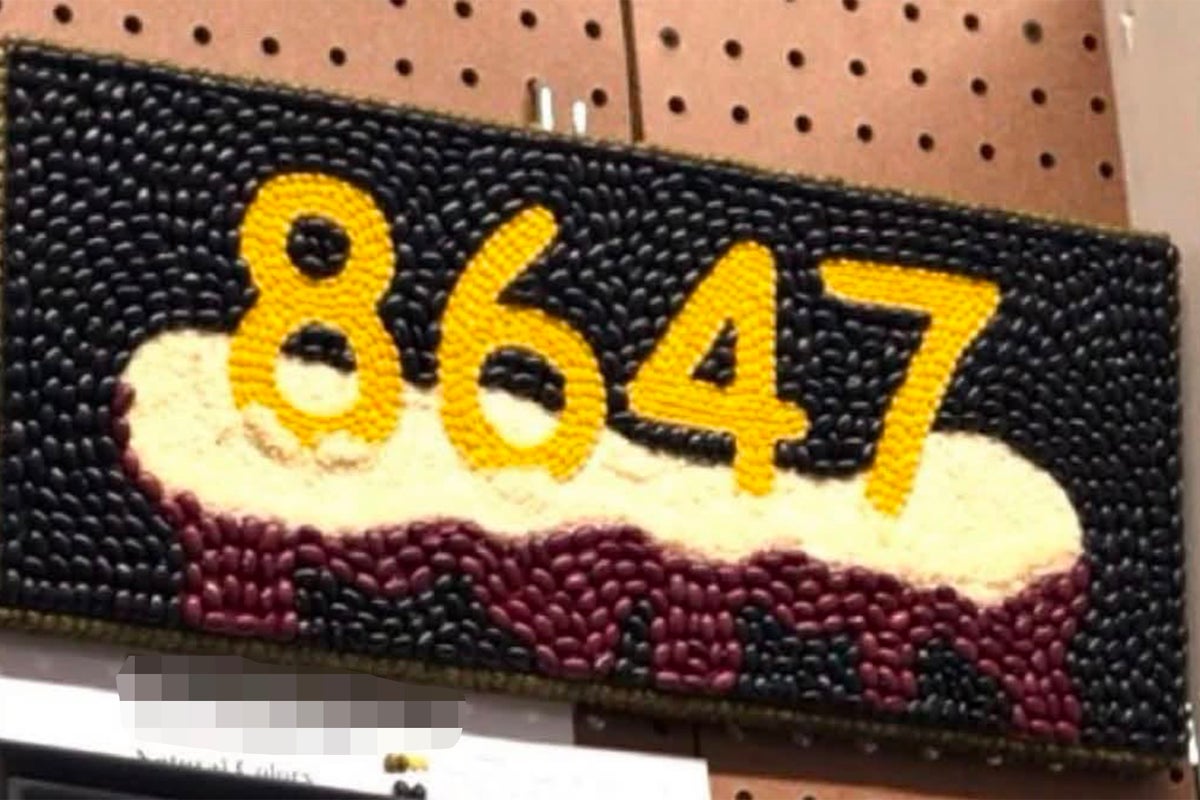
Let us be entirely clear about what happened, stripping away the noise of the headlines. A piece of artwork entered the juried exhibition spaces of the fairgrounds, bearing the alphanumeric string 8647. To the casual passerby, it looked like abstract geometry or a cryptic serial number. To anyone steeped in the lexicon of modern political theater, the meaning was instantly legible. In the vernacular of kitchen-table arguments and late-night cable broadcasts, "86" means to throw out, to get rid of, to terminate. Pair it with the number 47, and you have a shorthand reference to the forty-seventh president of the United States.
Remove. Expel. Silence.
It hung there among the watercolors of barnyards and the charcoal sketches of North Woods pines, a piece of political shrapnel embedded quietly in the cultural loaf. And then, the temperature changed.
Security guards began to notice the lingering crowds. Not the usual pack of art students squinting through greaseproof paper from their cheese-curd cartons, but people with fixed jaws and phones held high, filming. Then came the phone calls. Then came the emails. Then came the kind of threats that turn a state fairgrounds—usually defined by the harmless absurdity of the Giant Slide—into a place where law enforcement personnel check the radios on their hips twice before walking past the Ferris wheel.
By the time the fair organizers pulled the piece down, the canvas had already achieved a strange kind of immortality. It had crossed the invisible boundary between provocative speech and tangible peril.
We live in a culture that treats every surface as a billboard and every disagreement as a zero-sum death match. We want our art to be safe until it is provocative, and we want our provocation to be cost-free until it isn't. But art at a state fair has always occupied a peculiar, sacredly mundane space. It is where the local taxidermist hangs their prize pike next to a nine-year-old’s papier-mâché cow. It is an index of the community's actual texture—not the polished feed of an algorithm, but the stubborn, eccentric reality of neighbors who cannot stand each other's bumper stickers yet still share a bench while eating deep-fried Snickers bars.
When a piece of political friction is introduced into that space, it acts like a drop of heavy dye in a shallow puddle.
Consider what happens when public safety and creative expression collide in a crowded public square. The fair is not a museum with whisper-quiet galleries and velvet ropes designed to keep the rabble at arm's length. It is porous. It breathes. A mother pushing a stroller can find herself six inches away from a statement advocating for the political elimination of a national leader. There is no advisory warning at the turnstile. There is no trigger warning on the ticket stub. You buy your admission, you smell the onions, and you are suddenly face-to-face with the raw, jagged edges of national polarization.
The artists will tell you that censorship is a creeping rot. They will argue, with historical justification, that once you start taking down art because someone found it offensive or threatening, you have set foot on a staircase with no bottom landing. Today it's a cryptic number board protesting a politician; tomorrow it's a photograph of a controversial agricultural practice; next week it's a sculpture that challenges local religious sensibilities. The logic of removal is an insatiable engine. It always demands more fuel.
The administrators will tell you something entirely different, spoken in the low, exhausted register of people who just want to get through a ten-day shift without a mass casualty event. They are not thinking about the philosophical niceties of free expression when the threat matrix spikes. They are thinking about the teenager working the cotton candy machine down the row. They are thinking about the elderly couples sitting on the aluminum bleachers to watch the rabbit-judging competition. Their mandate is not to protect the First Amendment; their mandate is to keep the peace between the butter sculptures and the Midway.
Both sides are entirely, agonizingly right.
And that is where the real ache of this story lives. Not in the numbers, not in the administrative press releases, but in the contraction of our shared spaces.
We are running out of rooms where we can look at each other without filtering our gazes through the prism of national animosity. The county fair was supposed to be one of the last bastions of that shared reality. You could disagree with the man running the tractor exhibit about tax policy, but you could still nod respectfully at his restored 1948 John Deere. You could roll your eyes at your neighbor’s yard sign, but you could still buy a ticket for the giant boar competition together.
When the 8647 artwork was hoisted down from its wire and carried away into the administrative bowels of the fairgrounds, it wasn't just a win for security or a loss for free speech. It was a symptom of a deeper fracture. It was proof that the partisan voltage has become too high for our local transformers to handle. We are overloading the circuits. Every public institution, from the United States Capitol down to the county-fair poultry barn, is now expected to act as an ideological fortress.
We have forgotten how to inhabit the same room without demanding total ideological submission from everyone else in it.
The empty spot on the exhibition wall remains there now, metaphorically if not literally. A blank rectangle of painted drywall, waiting for someone to hang another landscape or another still life of apples in a bowl. But the apples look different now. The landscape feels a little thinner. We walk past the spot and we feel the ghost of the argument lingering in the sawdust, a faint, acrid smell that doesn't quite clear away, no matter how many grease-laden breezes blow in off the food stands.
The crowds will return next August. The butter will be carved. The giant bull will be weighed. But the canvas is gone, and the space it occupied has been reclaimed by a quiet, watchful silence that is heavier than any protest ever was.