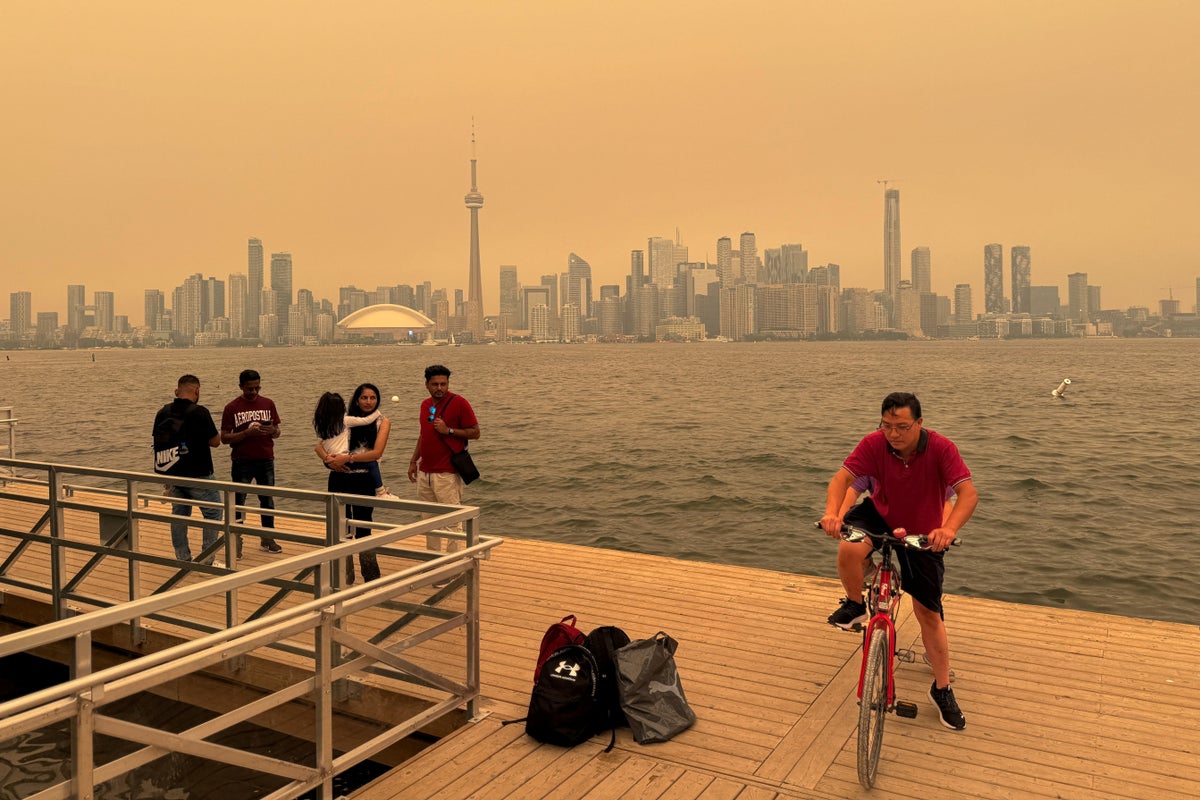
The Atmospheric Convergence Turning Day Into Night
Midwestern and East Coast residents looked up to find their cities bathed in an eerie, apocalyptic amber light. The immediate cause was smoke drifting south from hundreds of active wildfires burning in the Canadian boreal forest. What changed was not just the sheer acreage of trees burning north of the border, but a rare alignment of atmospheric physics, extreme fire behavior, and jet stream mechanics.
Historically, smoke from northern blazes dispersed across vast northern distances, diluting before reaching major population centers. Today, a combination of pyrocumulonimbus cloud formation, jet stream stagnation, and record-breaking fuel dryness forces massive concentrations of fine particulate matter directly into urban air corridors. Understanding why the sky turns orange requires examining how light interacts with airborne soot, how fire mechanics have changed, and how high-altitude weather patterns act as high-speed conveyor belts. For a deeper dive into similar topics, we suggest: this related article.
The Physics of the Amber Glow
Sky coloration depends entirely on how light particles interact with atmospheric molecules. Under normal conditions, gas molecules in the atmosphere scatter short wavelengths of light—such as blue and violet—far more efficiently than longer wavelengths. This phenomenon, known as Rayleigh scattering, is why clear skies appear blue to the human eye during the day.
When wildfire smoke fills the air, the rules of light scattering shift dramatically. For broader context on this development, extensive coverage is available on Al Jazeera.
Wildfire plumes contain trillions of micro-particles known as PM2.5, fine particulate matter measuring 2.5 microns or smaller in diameter. These particles are significantly larger than gas molecules. When light encounters particles of this size, it undergoes Mie scattering, a process that is much less dependent on wavelength. However, dense concentrations of soot and organic carbon absorb short blue and green wavelengths entirely.
Only the longer, red and orange wavelengths pass through the thick haze unhindered. When sunlight hits a dense layer of smoke hovering over a city, the shorter wavelengths filter out completely before reaching the ground. What remains is a narrow spectrum of deep orange and dull red light cast across the ground below.
Firestorms That Build Their Own Weather
The orange skies seen across American cities are not produced by routine forest fires. They are the product of megafires capable of generating their own violent atmospheric systems.
When an intense fire burns across thousands of contiguous acres of boreal forest, it creates an enormous amount of thermal energy. Warm air rises rapidly from the flame front, creating a powerful updraft. This updraft pulls in massive amounts of oxygen from surrounding areas, feeding the fire and accelerating its growth.
As the superheated column of air and combustion byproducts shoots upward, it carries smoke deep into the atmosphere. Under extreme conditions, these thermal plumes create towering thunderheads called pyrocumulonimbus clouds.
- Elevated Injection: Standard forest fires release smoke into the lower atmosphere, where local winds disperse it across short distances. Pyrocumulonimbus clouds act like giant industrial chimneys, blasting smoke 5 to 10 miles up into the upper troposphere and lower stratosphere.
- Protection from Rainout: Smoke trapped in the lower atmosphere often gets washed out by local rainfall within days. Smoke injected into the stratosphere sits above traditional weather systems, allowing it to travel across continents completely undisturbed by rain.
- Particle Coagulation: High up in the calm upper troposphere, smoke particles collide and clump together. Atmospheric scientists sampling high-altitude smoke plumes discovered that these clumped particles grow larger than standard weather models predict, altering how they absorb sunlight and prolonging their lifespan in the air.
Once smoke reaches these high altitudes, it encounters high-velocity air currents that act as expressways to distant regions.
How Jet Stream Wobbles Trap Smoke Overhead
Extremely intense fires account for the production of smoke, but atmospheric blocking patterns determine where that smoke goes.
The jet stream is a high-altitude band of strong wind flowing from west to east across the Northern Hemisphere. Historically, the jet stream moved in relatively fast, straight paths, sweeping weather systems along efficiently. In recent years, scientists have observed a distinct shift in jet stream behavior. The wind current has become wavier, bending into deep northward loops and southward dips.
The Mechanism of Atmospheric Stagnation
When the jet stream forms a deep, southward-dipping trough over the central or eastern United States, it creates a atmospheric funnel. Smoke rising from fires in Ontario, Quebec, or western provinces gets caught in the southward flow on the western side of the trough.
Simultaneously, weather patterns can become locked in place by what meteorologists call an Omega block. Named for its resemblance to the Greek letter $\Omega$, this pattern features a high-pressure ridge sandwiched between two low-pressure systems.
Under an Omega block, high pressure forces air to sink toward the Earth's surface. As the jet stream channels Canadian smoke southward, the sinking air beneath the high-pressure system compresses and pushes that smoke downward toward ground level.
Instead of drifting overhead unnoticed at 30,000 feet, the smoke gets trapped near the surface. Millions of people suddenly find themselves breathing air filled with microscopic ash, while the sun overhead is transformed into a dull orange disc.
Overlooked Factors Fueling Boreal Megafires
To understand why these fires burn with such unprecedented intensity, one must look at the physical state of the northern boreal forest itself. Boreal ecosystems cover vast stretches of Canada, Russia, and Scandinavia, holding massive reserves of terrestrial carbon locked in trees, moss, and deep peat soils.
Several factors have aligned to convert these cold, damp northern ecosystems into explosive fuel sources.
Earlier Snowmelt and Prolonged Dryness
Boreal forests rely on winter snowpack to maintain soil moisture well into the summer season. When winter snowpack melts weeks earlier than historical averages, the forest floor loses its moisture reserve prematurely.
By the time mid-summer arrives, tree canopy foliage, fallen pine needles, and deep layers of peat beneath the soil become dry. A single lightning strike in a remote region can ignite a fire that burns not just across the surface, but deep underground into the peat layer. Deep peat fires are notoriously difficult to extinguish and can burn quietly for weeks before erupting across thousands of hectares during high-wind events.
Decades of Strict Suppression
For nearly a century, forestry management across North America prioritized immediate fire suppression. Every fire was treated as an emergency to be extinguished as quickly as possible.
While this policy protected timber assets and remote settlements, it interrupted the natural fire cycle. Historically, low-intensity wild fires naturally cleared out dead wood, underbrush, and dense thickets every few decades. Without these regular natural clearings, dead plant material accumulated on forest floors uninterrupted.
Today, vast regions of northern forests hold historic quantities of combustible fuel. When a fire starts during a prolonged heatwave, it does not burn as a manageable surface fire. It climbs into the canopy, consuming decades of accumulated wood and releasing energy on a scale that overwhelms standard firefighting resources.
Comparing Historical and Modern Wildfire Dynamics
The difference between past wildfire events and current conditions comes down to scale, altitude, and weather persistence.
| Feature | Historical Boreal Fires | Modern Boreal Megafires |
|---|---|---|
| Plume Altitude | Primarily lower atmosphere (1–3 km) | Reaches upper troposphere and stratosphere (8–15 km) via pyrocumulonimbus clouds |
| Transport Distance | Local to regional (100–500 miles) | Intercontinental (1,000–5,000+ miles) |
| Dominant Scattering | Light haze; mild sunset reddening | Mie scattering dominance; total blue light extinction causing deep orange skies |
| Atmospheric Driver | Fast-moving cold fronts sweeping smoke away | Stationary Omega blocks and wavy jet stream troughs trapping smoke |
| Fuel Condition | Periodic surface fuel loads | Heavy fuel accumulation combined with dried peat soils |
Health and Infrastructure Consequences
When high-altitude smoke is pushed down to ground level by high-pressure air masses, air quality indices plummet into hazardous territory.
Fine particulate matter ($PM_{2.5}$) is small enough to bypass the human respiratory system's natural filtration mechanisms. When inhaled, these micro-particles travel deep into the alveoli of the lungs, where they can cross directly into the bloodstream. Exposure to high levels of wildfire smoke triggers immediate respiratory irritation, aggravates asthma, and increases the risk of cardiovascular events.
The economic impacts extend far beyond public health.
- Aviation Disruptions: Heavy smoke degrades visibility near major airport hubs, forcing flight delays and rerouting.
- Solar Power Reduction: Orange skies dramatically cut the amount of usable sunlight reaching solar panels, reducing renewable power generation across affected regions by significant margins precisely when grid demand peaks.
- Agriculture Strain: Prolonged light suppression alters photosynthesis rates in crops, affecting agricultural yields during critical summer growing periods.
The Feedback Loop Reshaping Future Skies
The orange skies seen across American cities are not isolated anomalies. They signal a fundamental shift in how northern forest ecosystems interact with global atmospheric patterns.
When massive boreal fires burn, they release stored carbon into the air. Boreal forests store more carbon per acre than tropical rainforests, mostly within their thick soil layers. As intense fires burn through these peat beds, carbon stored over centuries enters the atmosphere in a matter of hours.
This release fuels further warming, which accelerates snowmelt, dries out timber, and creates the ideal dry conditions for future megafires. The resulting pyrocumulonimbus clouds continue to lift smoke into the upper atmosphere, where persistent jet stream loops wait to carry it south.
The orange hue that blankets urban skylines is the visual proof of an atmospheric chain reaction. As long as fuel loads remain high and jet stream patterns continue to stall, the conditions that produce these eerie, darkened days will remain a recurring feature of North American summers.