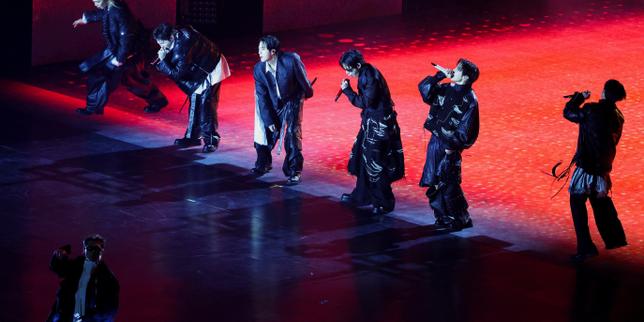
The headlines are all the same. They gush about the "magic" of the return. They use words like "historic" and "emotional" to describe a group of men standing on a stage after a mandatory government-mandated hiatus. The mainstream media is selling you a fairy tale about a triumphant return to form, but they are missing the cold, hard mechanics of the most sophisticated entertainment machine ever built.
The standard narrative suggests that BTS is "returning" to save K-pop or to reclaim a throne they never actually left. This is a fundamental misunderstanding of how global stardom works in the digital age. They aren't returning; they are being redeployed.
The Scarcity Engine
Most critics looked at the South Korean military enlistment as a threat to the brand. I’ve seen labels panic over six-month gaps in a release schedule, convinced that the "attention economy" will move on to the next shiny object. They are wrong.
The hiatus wasn't a hurdle; it was a masterclass in synthetic scarcity. By removing the product from the shelf, HYBE (the parent company) didn't lose relevance—they manufactured a desperate, global demand that no amount of traditional marketing could buy. This "return" is the payoff of a years-long short squeeze on the fans' emotions.
When you see those "emotional" images of the group back together, you aren't looking at a spontaneous moment of brotherhood. You are looking at a perfectly timed product relaunch. The "four-year absence" being touted by the press is a mathematical sleight of hand. Solo projects, documentaries, and pre-recorded content ensured the brand stayed at a fever pitch. The "absence" was a ghost.
The Trap of the Legacy Act
The danger no one wants to talk about is the "Legacy Trap." Right now, the industry is celebrating the return of the BTS we knew in 2020. But the music industry moves in dog years.
A "return to stage" that relies on the same choreography, the same aesthetic, and the same parasocial triggers is a move toward becoming a heritage act. Think of the Rolling Stones or U2—bands that people pay hundreds of dollars to see not for what they are doing now, but for how they made them feel fifteen years ago.
If BTS returns as a nostalgia trip, the "King of K-pop" title becomes a gilded cage. To stay relevant, they have to break the very image that the fans are currently crying over in those concert photos. Most fans say they want "the old BTS back." If the group gives them exactly that, they are dead in the water within twenty-four months.
Precision Engineering vs. Artistic Soul
There is a persistent myth that K-pop is "manufactured" while Western pop is "authentic." This is a lazy, borderline xenophobic take that misses the point entirely. All global pop is manufactured. The difference is that BTS is manufactured with higher tolerances and better quality control.
The "return" concert isn't a show; it's a stress test of a global logistics network.
- Light sticks (ARMY Bombs): These aren't just toys; they are a synchronized, Bluetooth-controlled data-collection and immersion tool.
- Weverse: This isn't a fan club; it's a vertical integration play that bypasses traditional social media giants to own the customer data.
- The Setlist: This is a data-driven sequence designed to maximize social media "clip-ability."
When a journalist writes about the "palpable energy in the room," they are describing the result of billions of dollars in infrastructure. I’ve seen artists try to replicate this with "vibes" and "raw talent." It fails every time. You don't beat the BTS machine with soul; you beat it with better systems, and right now, no one has them.
The Parasocial Debt
We need to address the elephant in the stadium: the parasocial debt. The relationship between BTS and their fanbase (ARMY) is often described as a beautiful partnership. In reality, it’s a high-interest loan.
The fans have invested years of their lives, millions of dollars, and a massive amount of emotional labor into "protecting" and "promoting" the group. The return to the stage is the moment the bill comes due. The pressure on these seven men to fulfill the collective fantasies of tens of millions of people is unsustainable.
The "images of their return" show smiling faces, but the industry insider sees the weight of a multi-billion dollar IPO resting on a few pairs of shoulders. If one member pivots too hard away from the established brand, or if the music evolves in a way that doesn't serve the "fandom's" specific needs, the backlash will be proportional to the devotion.
Stop Asking if They Are Back
People keep asking: "Are they still the biggest band in the world?"
That is the wrong question.
The real question is: "Can the industry survive without them?"
The "return" is being treated as a victory for the group, but it’s actually a desperate sigh of relief for the entire music economy. Streaming numbers, physical sales, and even South Korean GDP figures are tied to this one entity. That kind of centralization is dangerous. It creates a "too big to fail" scenario in culture.
When the media focuses on the "tears of joy" at a concert, they ignore the systemic fragility of an industry that has put all its eggs in one purple basket. We shouldn't be celebrating the return of a monopoly; we should be questioning why the gap they left was so impossible for anyone else to fill.
The Blueprint for the Next Phase
If you are looking at those concert photos and seeing a "reunion," you’re a consumer. If you’re looking at them and seeing a "rebranding," you’re a competitor.
The next phase of global entertainment won't be about finding the "next BTS." It will be about using their blueprint—the scarcity, the vertical integration, and the controlled hiatus—to build something that doesn't rely on the physical presence of humans at all.
The military hiatus proved that the BTS brand can grow even when the members are invisible. That is the real disruption. The "return to stage" is just the victory lap for a ghost that never stopped haunting the charts.
Stop looking for the "magic." Start looking at the ledger.
The concert wasn't a comeback. It was a collection on a debt that the world was finally ready to pay.
Go look at the photos again. Notice the precision of every light, the timing of every firework, and the curated "imperfection" of every emotional speech. This isn't art. It's an atmospheric re-entry of a high-value asset.
Treat it as anything less, and you’ve already been sold the ticket.