While the rest of Hollywood spent Sunday night navigating a sea of champagne and tailored tuxedos, Sean Penn was stepping off a train in Kyiv with a cigarette in his mouth and a familiar, weary scowl. He did not just skip the 98th Academy Awards. He effectively discarded them. Despite winning Best Supporting Actor for his role in One Battle After Another, Penn was nowhere near the Dolby Theatre. He was instead reenacting a script he wrote years ago: one that trades the validation of the American film industry for a front-row seat to an actual war.
This was not a sudden change of heart or a scheduling conflict. It was a calculated political statement aimed directly at the Academy of Motion Picture Arts and Sciences. Penn’s absence on March 15, 2026, was the culmination of a four-year grudge that began when the Oscars refused to let Ukrainian President Volodymyr Zelenskyy address the telecast in 2022. For Penn, the industry’s refusal to "get political" while a sovereign nation burned was an unforgivable act of cowardice.
The Statuette as a Weapon
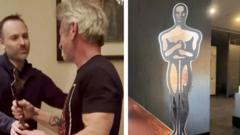
The image of an Oscar sitting on a bookshelf in a Malibu mansion is the ultimate symbol of Hollywood success. The image of that same gold-plated man sitting on a desk in a wartime bunker in Kyiv is something else entirely. It is a piece of propaganda, a psychological anchor, and, according to Penn, a potential source of scrap metal.
When Penn first handed over his statuette to Zelenskyy in November 2022, he did not do it for the cameras. He did it because he was deeply embarrassed by his own industry. At the time, Penn famously suggested he would "smelt" his Oscars in public if the Academy continued to ignore the Ukrainian struggle. By leaving the physical award in Zelenskyy’s possession—telling him, "When you win, bring it back to Malibu"—Penn essentially turned his highest professional achievement into a security deposit for a victory he believes is certain.
This 2026 trip reinforces that the gesture was never a one-off publicity stunt. By winning a third Oscar and refusing to show up to claim it, Penn has created a vacuum where a "thank you" speech should have been. Kieran Culkin, who accepted the award on Penn's behalf, could only offer a brief, awkward acknowledgement of the actor's absence. The silence in the room spoke louder than any prepared statement could have.
The Zelenskyy Connection and the Documentary Lens
To understand why a 65-year-old actor would rather be in a trench than a ballroom, you have to look back to February 24, 2022. Penn was in Kyiv that day, filming his documentary Superpower. He was there when the first missiles hit. He sat with Zelenskyy in the initial hours of the invasion, witnessing the transition of a former comedian into a commander-in-chief.
Superpower, released in 2023, was widely criticized by some for being "hagiographic"—a fancy way of saying Penn was too in love with his subject. Critics argued that the film focused more on Penn’s own grit and cigarette consumption than on the complex geopolitical realities of Eastern Europe. But for Penn, objectivity was never the point. He has openly admitted to being a "propagandist" for the Ukrainian cause.
In his view, the war is not a nuance-heavy diplomatic puzzle; it is a clear-cut battle between good and evil. This moral absolutism is what drives him back to Kyiv time and again. It is also what makes him so exhausting to the Hollywood establishment, which prefers its activism to be neatly packaged in 30-second segments between commercial breaks.
A History of Calculated Defiance
Penn has always been the industry’s resident contrarian. He skipped the Oscars in 1996, 2000, and 2002. He only showed up to win for Mystic River in 2004 because he felt "embarrassed" after Clint Eastwood had to pick up his Golden Globe. His activism has frequently veered into the controversial, from his 2005 trek through the floodwaters of Hurricane Katrina to his infamous 2015 interview with drug lord "El Chapo" Guzmán.
However, his involvement in Ukraine feels different. It is more sustained, more personal, and far more costly to his reputation within the "A-list" bubble. By choosing to meet with Zelenskyy on the very night his peers were celebrating, Penn is signaling that he no longer considers himself a part of that world. He is a man who has replaced the "tapestry" of Hollywood social life with the cold, hard reality of a state under siege.
The Real Impact of Celebrity Diplomacy
Does it actually matter that a movie star gives a trophy to a president? To a soldier in the Donbas, probably not. But to the international media cycle, it is fuel. Zelenskyy, a man who understands the power of the image better than perhaps any world leader in history, knows exactly how to use Sean Penn.
Every time Penn visits, he brings a fresh wave of Western attention to a war that many are beginning to treat as "background noise." The Ukrainian government has recognized this by awarding Penn the Order of Merit. They don't care if his documentary is "self-indulgent." They care that he has 20 million people listening when he calls for more long-range missiles.
The Academy remains a soft target for Penn’s ire. By ignoring him during the 2026 broadcast, they hoped to avoid the drama. Instead, they ensured that the headline of the morning wasn't about the films—it was about the empty chair in the front row and the man who was thousands of miles away, standing in the mud of a sovereign nation, waiting for a war to end so he can get his trophy back.
One thing is certain. Penn won't be mailing a thank-you note.