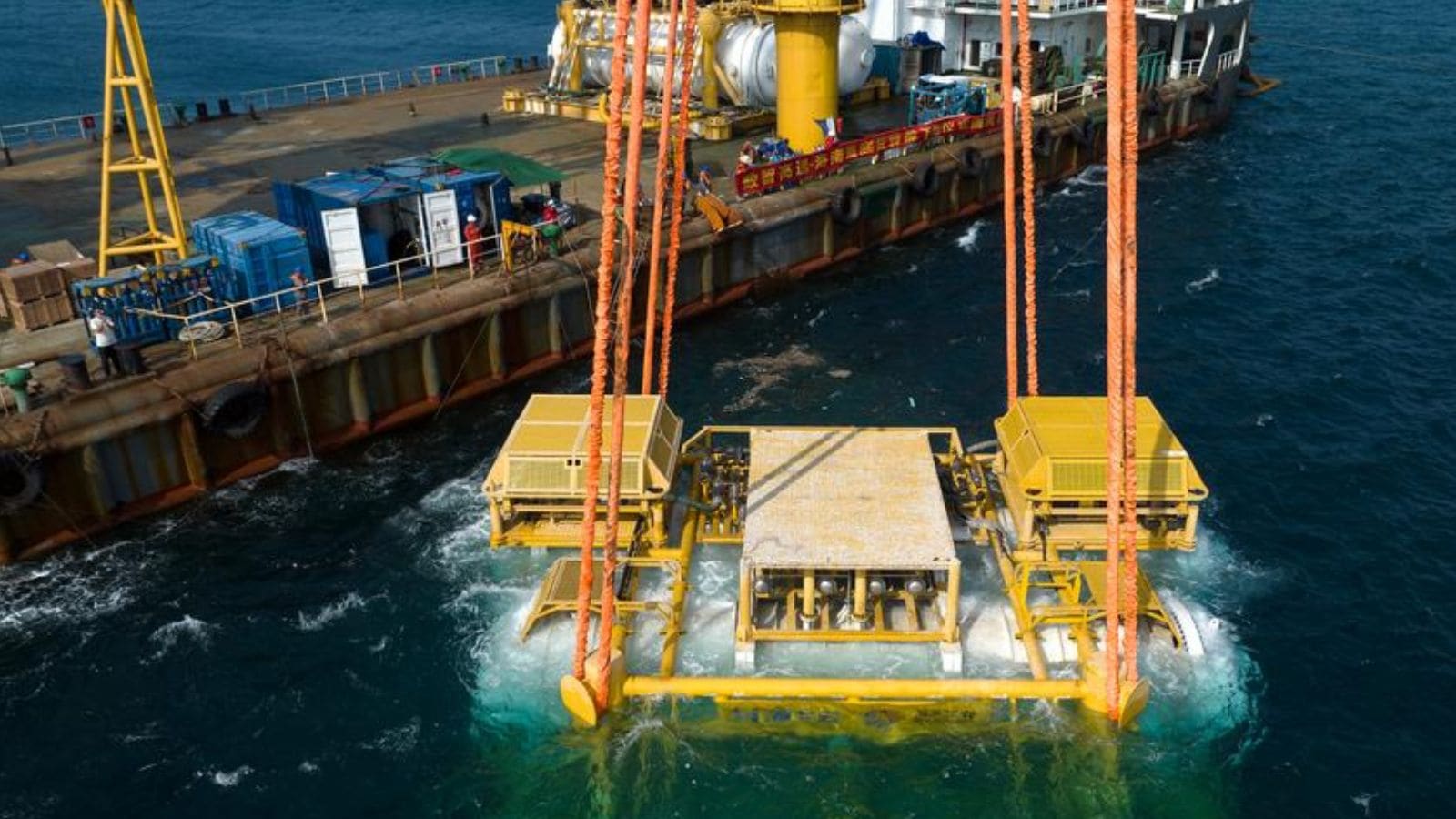
China has successfully submerged its first commercial underwater data center in the waters off Shanghai, linking it directly to an offshore wind farm to achieve what state media hails as zero-emission computing. By placing heavy-duty server racks inside sealed, pressurized vessels on the seabed, the project utilizes ambient seawater to eliminate the massive electrical load typically required for air conditioning. It is a technical milestone. Yet the state-backed narrative frames this purely as a green victory, conveniently obscuring the brutal geopolitical, military, and economic calculations driving Beijing into the deep ocean.
Subsea computing is not just about saving energy. It is an aggressive play for resource dominance, coastal real estate preservation, and data survivability in a region increasingly defined by industrial vulnerability and military tension.
The Physical Reality of Seabed Processing
Conventional data centers are resource monsters. They consume millions of gallons of fresh water daily for evaporative cooling and demand vast tracts of expensive coastal land near major metropolitan hubs like Shanghai. By moving the infrastructure to the seafloor, engineers exploit a natural, infinite heat sink.
The physics are straightforward. Seawater passes through external heat exchangers, drawing warmth away from the sealed internal atmosphere of the capsule without ever coming into direct contact with the electronics. Inside these cylinders, an inert gas like nitrogen replaces oxygen to prevent corrosion and eliminate fire hazards.
The immediate benefit shows up in Power Usage Effectiveness (PUE), the metric used to judge data center efficiency. A perfect score is 1.0, meaning every watt of power goes directly to computation rather than cooling. Standard terrestrial facilities struggle to average 1.5. The Shanghai subsea deployment reportedly operates below 1.1.
Connecting these units directly to offshore wind turbines solves the transmission loss problem that plagues remote green energy grids. Instead of sending raw electricity across hundreds of miles of high-voltage lines to mainland server farms, the energy is consumed right at the source of generation. Power flows down the turbine tower, through a localized marine grid, and straight into the undersea modules. The data then travels back to land via fiber-optic submarine cables.
The Economic Friction of the Deep
The engineering is elegant, but the balance sheet is terrifying. Capital expenditure for marine deployment is astronomically high compared to pouring concrete on land.
Building a pressure vessel capable of resisting constant marine corrosion and tidal forces for a projected 20-year lifespan requires specialized metallurgy and precision manufacturing. Every component must be redundant. If a terrestrial server fails, a technician walks down an aisle and swaps out a blade in ninety seconds. If a subsea server fails, you do not send a technician down in a scuba suit. The unit stays dead until the entire multi-ton capsule is winched to the surface by a specialized maritime salvage vessel.
Because of this maintenance barrier, operators must under-provision their hardware or accept a steady degradation of computing power over the capsule’s five-year deployment cycle. Industry data indicates that the cost of marine deployment currently outpaces land-based construction by a factor of three.
- Pressure Resistance: Marine vessels must withstand immense hydrostatic pressure, requiring thick, specialized steel or composite hulls.
- Corrosion Mitigation: Constant exposure to saltwater requires expensive sacrificial anodes and anti-fouling coatings to prevent marine life buildup.
- Logistical Dependence: Deployments and retrievals require specialized crane ships, favorable weather windows, and highly paid marine engineering crews.
Beijing handles these financial realities through state-directed capitalism. Chinese tech firms do not operate under the same short-term quarterly profit pressures as Western cloud providers. State-owned enterprises and local government funds absorb the staggering upfront costs, treating the infrastructure as a long-term strategic asset rather than a venture seeking immediate return on investment.
The Sovereignty Safeguard and Land Scarcity
Shanghai is running out of space. The Yangtze River Delta is the industrial heartbeat of the country, crammed with factories, residential high-rises, and critical infrastructure. Local governments face strict agricultural land redlines dictated by Beijing to ensure food security. They cannot afford to convert scarce acreage into massive server warehouses.
The ocean offers a loophole. By shifting the physical footprint of the digital economy into territorial waters, coastal provinces free up premium land for high-value manufacturing and urban expansion.
There is a deeper structural motivation. China's domestic data strategy, known as the "East Data, West Computing" initiative, aims to build massive data hubs in impoverished western provinces like Guizhou and Gansu where land and renewable energy are plentiful. This works perfectly for cold storage, data archiving, and non-time-sensitive processing.
It fails completely for the real-time needs of mega-cities like Shanghai.
High-frequency trading, autonomous vehicle networks, and real-time AI inference require ultra-low latency. A millisecond of delay caused by routing data thousands of miles across the mainland translates to millions of dollars in lost economic efficiency. The underwater data center solves this geographic crisis by keeping the processing power within a few dozen miles of the urban core, tucked safely beneath the waves.
The Shadow of Military Survivability
An overlooked aspect of this maritime push is the concept of hard asset survivability. Terrestrial data centers are large, easily identifiable targets visible to commercial satellite imagery. In any sustained regional conflict, traditional server farms are highly vulnerable to kinetic strikes or sabotage against their external cooling towers and substations.
Submerging the infrastructure alters the defensive equation.
A sealed capsule sitting on the mud of the continental shelf is exceptionally difficult to detect, track, and target. It leaves no thermal footprint on the surface. It emits no smoke. It is shielded by dozens of meters of water that absorb kinetic impacts and shrapnel. Furthermore, these data nodes are situated within highly monitored coastal defense zones, heavily patrolled by the People's Liberation Army Navy.
This is not to say these installations are invincible. They remain dependent on vulnerable umbilical cables linking them to offshore wind turbines and mainland fiber networks. Severing a submarine cable is a well-established gray-zone warfare tactic. However, by decoupling the processing units from vulnerable surface structures and spreading them across a decentralized underwater network, Beijing creates a highly resilient data topology that can operate through localized disruptions.
The Ecological Gamble
The narrative of the zero-emission data center ignores the thermodynamic reality of dumping heat into local marine ecosystems.
While a single underwater data center might have a negligible impact on the vast volume of the ocean, scaling this technology to thousands of pods creates localized thermal plumes. Water goes in cold and comes out warm. In shallow coastal waters like those around Shanghai, even a slight increase in ambient water temperature alters the local micro-environment.
Thermal Pollution Risks
- Hypoxia: Warmer water holds less dissolved oxygen, creating localized dead zones for marine organisms.
- Algal Blooms: Elevated temperatures accelerate the growth of toxic algae, disrupting local fishing industries.
- Migration Shifts: Stationary thermal barriers can disrupt the migration routes of commercially vital fish and crustacean species.
The regulatory framework governing undersea thermal discharge is practically non-existent. Environmental impact assessments issued by municipal agencies remain tightly controlled and rarely public, meaning the true ecological toll will only be understood after years of continuous operation.
The Global Subsea Race
The Shanghai deployment forces a critical reassessment of global cloud infrastructure. Western tech companies pioneered this concept. Microsoft famously proved the technical viability of subsea computing with Project Natick, submerging a data center off the coast of Scotland's Orkney Islands back in 2018.
The project was a technical success, showing that servers inside the nitrogen-filled capsule were eight times more reliable than their land-based counterparts due to the absence of human interference, oxygen, and humidity. Yet, despite the successful proof of concept, Western hyperscalers did not immediately pivot to commercialization. They chose instead to focus on scaling massive, standardized terrestrial campuses where supply chains are predictable and maintenance is simple.
China took the Western blueprint and industrialized it.
Where Western companies saw an interesting engineering experiment with uncertain immediate returns, Chinese planners saw a strategic imperative. The Shanghai project demonstrates an ability to execute complex marine engineering projects at a speed and scale that Western regulatory environments and market forces slow down.
The Integration Bottleneck
The true test of the Shanghai underwater data center lies in its long-term operational viability over the next decade.
Marrying data processing directly to intermittent energy sources like wind requires sophisticated power management. When the wind drops, the data center must seamlessly pull power from the terrestrial grid via subsea cables without interrupting active computations. When the wind gusts, the system must dump excess energy or throttle up non-urgent computational workloads, such as training large AI models, to maximize the free electricity.
This requires software-defined power allocation operating at a level of complexity few facilities have ever attempted. If the software fails, power fluctuations can fry millions of dollars of enterprise hardware sealed inside an inaccessible steel tube under the sea.
The Shanghai deployment is a display of engineering prowess, but it is primarily a symptom of a nation forced to innovate by the constraints of its own geography and geopolitical position. China is building into the ocean because it has run out of easy choices on land.