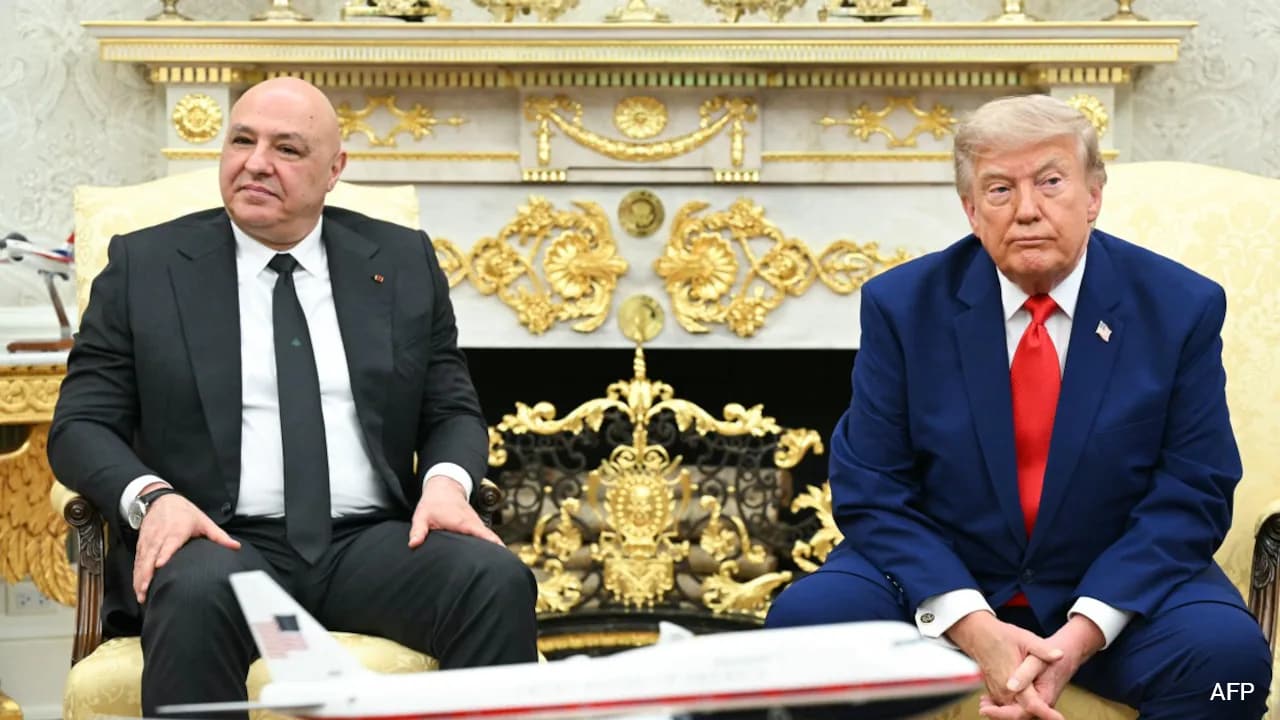
Washington pledges to help Lebanon secure peace with Israel and lift decades-old aviation bans sound like a historic breakthrough, but the underlying arithmetic tells a far more complicated story. During recent White House meetings, President Donald Trump pledged direct support to newly elected Lebanese President Joseph Aoun, offering political backing and promising to authorize the resumption of direct commercial flights by U.S. airlines to Beirut for the first time in over forty years. Yet behind the grand declarations lies a high-wire geopolitical gamble where Lebanon must attempt to disarm Hezbollah across its entire territory while standing under the shadow of persistent Israeli border strikes and deep domestic factional divisions.
Diplomatic promises often collapse under the weight of structural reality. For Beirut, receiving a public nod from Washington is an essential political lifeline. For Washington, framing the region through the lens of transaction-based diplomacy is standard procedure. But converting optimistic promises into a stable border requires resolving fundamental power imbalances that have paralyzed the Levant for half a century.
The Illusions of a Quick Diplomatic Victory
The political sales pitch delivered in Washington centers on a simple narrative. If the Lebanese Armed Forces assume exclusive control over security in the south and disarm non-state actors, international economic aid will flow, direct flights will resume, and Israel will pull back its forces.
It is an appealing formula on paper. It is completely detached from the balance of power inside Lebanon.
The Lebanese Armed Forces are tasked with disarming Hezbollah, a political and military organization that spent four decades constructing a deeply entrenched state-within-a-state with extensive missile arsenals, subterranean infrastructure, and tens of thousands of trained fighters. Expecting a cash-strapped national military—whose soldiers have seen their salaries eroded by years of hyperinflation—to forcibly strip an armed militia of its arsenal is not merely optimistic. It risks igniting a domestic security catastrophe that could shatter the fragile confessional peace holding the nation together.
Lebanon Security Equation

[US Diplomatic Support] ---> [Demands for Total Hezbollah Disarmament]
                                     |
                                     v
                        [Lebanese Armed Forces (LAF)]
                                     |
                  +------------------+------------------+
                  |                                     |
                  v                                     v
   [Risk of Internal Civil Conflict]     [Risk of Israeli Border Escalation]
When military deployments in pilot zones along the southern border are greeted by warning shots from across the frontier, the pretense of a smoothly executed transition quickly vanishes. The national military finds itself squeezed between international demands to act as a regional security buffer and the reality that any misstep could provoke an internal confrontation.
The Unspoken Economics of the Direct Flight Promise
Among the headline announcements emerging from the summit was the authorization to resume direct U.S. carrier flights to Beirut. Suspended following the 1985 hijacking of TWA Flight 847, the flight ban became a permanent symbol of Lebanon’s isolation from Western aviation corridors.
Lifting the restriction provides an unquestionable psychological and symbolic boost. Economically, however, its immediate impact is vastly overstated.
Aviation connectivity does not automatically generate financial stability. Commercial airlines calculate route viability based on strict criteria: operational security, airport infrastructure, insurance premiums, and passenger volume. Beirut’s Rafic Hariri International Airport continues to suffer from chronic infrastructure decay, fuel supply instabilities, and persistent security concerns stemming from political friction over airport management.
| Political Promise | Operational Barrier | Economic Reality |
|---|---|---|
| Resumption of U.S. Direct Flights | War-risk insurance premiums remain prohibitively high for international carriers. | Airline operational costs will delay actual route launches indefinitely. |
| Lebanese Army Deployment | Severe funding shortages and equipment deficits within the national armed forces. | Heavy reliance on foreign donor funds just to cover basic soldier payrolls. |
| Normalisation of Border Trade | Lack of formal peace treaties and unresolved territorial disputes. | Economic exchanges remain legally prohibited and politically unviable. |
Without massive capital investments in security protocols and physical infrastructure, Western airlines will be slow to schedule non-stop flights to Beirut regardless of executive orders signed in Washington. The announcement serves as a useful political talking point for the government in Beirut, but it does not address the banking crisis, currency collapse, or capital flight that have wiped out middle-class savings across the country.
Senior Advisors and the Shift Toward Deal Making
To understand Washington’s current approach to the region, one must look at the key intermediaries shaping the policy behind closed doors. The appointment of figures like Massad Boulos—a Lebanese-born businessman with deep familial and financial ties to both U.S. political inner circles and regional business networks—signals a distinct operational shift.
The traditional diplomatic apparatus, with its reliance on career bureaucrats and institutional channels, has been bypassed in favor of direct, personalistic deal-making.
"We are looking forward to peace, and we are aiming for peace, and by the grace of God, this will be achieved soon," senior advisor Massad Boulos declared during meetings with regional stakeholders, framing the path forward as an imminent business and political resolution.
This personalist approach operates on a fundamental assumption: every political conflict, no matter how deeply rooted in religious identity, territorial dispute, or historical trauma, can be converted into an economic transaction if the financial incentives are structured correctly.
The flaw in this logic lies in underestimating ideological persistence. Hezbollah does not exist merely as an armed force that can be bought off or reasoned out of existence through commercial development schemes. It is a socio-political institution with deep ideological alignment with Tehran and a deeply entrenched constituent base that views its armed status as an essential existential defense. Stripping away that armed architecture requires changing the regional security architecture, not simply promising commercial development packages.
The Dangerous Gap Between Enforcement and Reality
The United States insists that any lasting peace agreement must mandate full disarmament across all of Lebanon, rejecting initial interpretations that restricted military disengagement strictly to the zone south of the Litani River. This position aligns with Israeli demands for complete security along its northern border.
It also creates a dangerous enforcement gap.
Who actually enforces total disarmament when the party possessing the weapons refuses to hand them over?
The United States will not deploy ground troops to enforce compliance. Israel, despite conducting extensive cross-border strikes and maintaining a military footprint in border areas, cannot eliminate underground networks across the entirety of Lebanon without an endless, high-cost military occupation. That leaves the Lebanese Army.
If the government in Beirut attempts to use military force against Hezbollah, it risks triggering a sectarian civil war. If it refuses to act, Washington threatens to cut off diplomatic backing and economic assistance, while Israel continues to launch targeted strikes across Lebanese airspace.
The Enforcement Paradox

                         [Washington & Jerusalem]
                        Demands Total Disarmament
                                    |
                                    v
                        [Lebanese Government]
                                    |
            +-----------------------+-----------------------+
            |                                               |
            v                                               v
   [Option A: Execute Demands]                     [Option B: Refuse Demands]
   - Military clashes with Hezbollah               - Loss of US economic support
   - High risk of sectarian civil war              - Unchecked foreign air strikes
This structural bind leaves the state in an impossible position. It is being ordered to enforce terms that its political institutions lack the coercive capacity to implement.
The Fallacy of the Abraham Accords Template
Washington policy circles frequently operate under the assumption that the Abraham Accords provide a usable blueprint for Lebanon. The logic suggests that as regional dynamics shift, normalization between Israel and its Arab neighbors can be systematically expanded to encompass the entire Levant.
Applying this template to Lebanon fundamentally misreads the structure of the state.
The Gulf states that signed normalisation agreements possessed strong, centralized governments capable of enforcing policy decisions top-down without facing armed internal resistance. They did not host powerful non-state militias embedded in their national legislative assemblies, nor did they share direct, contested land borders with Israel marked by decades of direct military conflict.
In Lebanon, public opinion and constitutional law remain strictly opposed to formal normalisation with Israel. Lebanese political figures across the spectrum—including those openly critical of Hezbollah—repeatedly emphasize that any agreement must be framed strictly around armistice terms, border demarcation, and security enforcement, rather than political or economic normalisation.
Key Strategic Distinctions
- Centralized Monarchy vs. Fractured State: Gulf nations implemented normalisation through centralized authority; Lebanon operates via a fragile confessional balance where no single faction holds absolute power.
- Territorial Disputes: Lebanon shares direct land borders with unresolved territorial claims, including the Shebaa Farms and border demarcation points, whereas signing Gulf states had zero shared physical borders with Israel.
- Internal Armed Groups: No other nation that signed peace agreements hosted a heavily armed, non-state military force capable of challenging the national army's monopoly on force.
Treating Lebanon as merely another candidate for a transactional peace deal ignores these structural distinctions. Pushing for formal diplomatic normalisation rather than focusing on manageable, incremental armistice enforcement risks shattering the very political process Washington claims to support.
What Must Change for Real Stability
If Washington wants to prevent Lebanon from collapsing into deeper chaos, it must abandon political symbolism and confront the structural mechanics on the ground.
First, military aid to the Lebanese Armed Forces must be structured around realistic operational goals rather than maximalist political demands. Expecting the army to fight an internal battle against its own citizenry is a recipe for institutional collapse. Funding must focus on border containment, logistical support, and direct financial subsidies for soldiers to prevent mass desertion.
Second, diplomatic efforts must prioritize enforcing the terms of UN Security Council resolutions strictly as a security and armistice mechanism, rather than attempting to force a broader political peace deal that the country's constitution and population cannot absorb.
Third, international backing must be tied directly to internal economic reforms—specifically restructuring the banking sector, restoring judicial independence, and stabilizing essential public utilities. A nation without electricity, functional banks, or basic state institutions cannot serve as a reliable guarantor of regional security, regardless of how many promises are made in the Oval Office.
Until Washington aligns its diplomatic ambitions with the stark realities on the ground in Beirut, grand vows of peace will remain little more than rhetoric designed for domestic consumption while the Levant continues to burn.