Beneath the shifting floors of the Arctic and Southern Oceans, the planet’s thermostat is breaking. Scientists are now forced to undergo elite, military-grade dive training to reach these sub-zero environments, because satellite data and surface sensors cannot capture the full story of thermal decay. These researchers are not just observers. They are high-stakes technicians operating in a "crush zone" where the margin for error is measured in seconds and the equipment is pushed far beyond its designed limits.
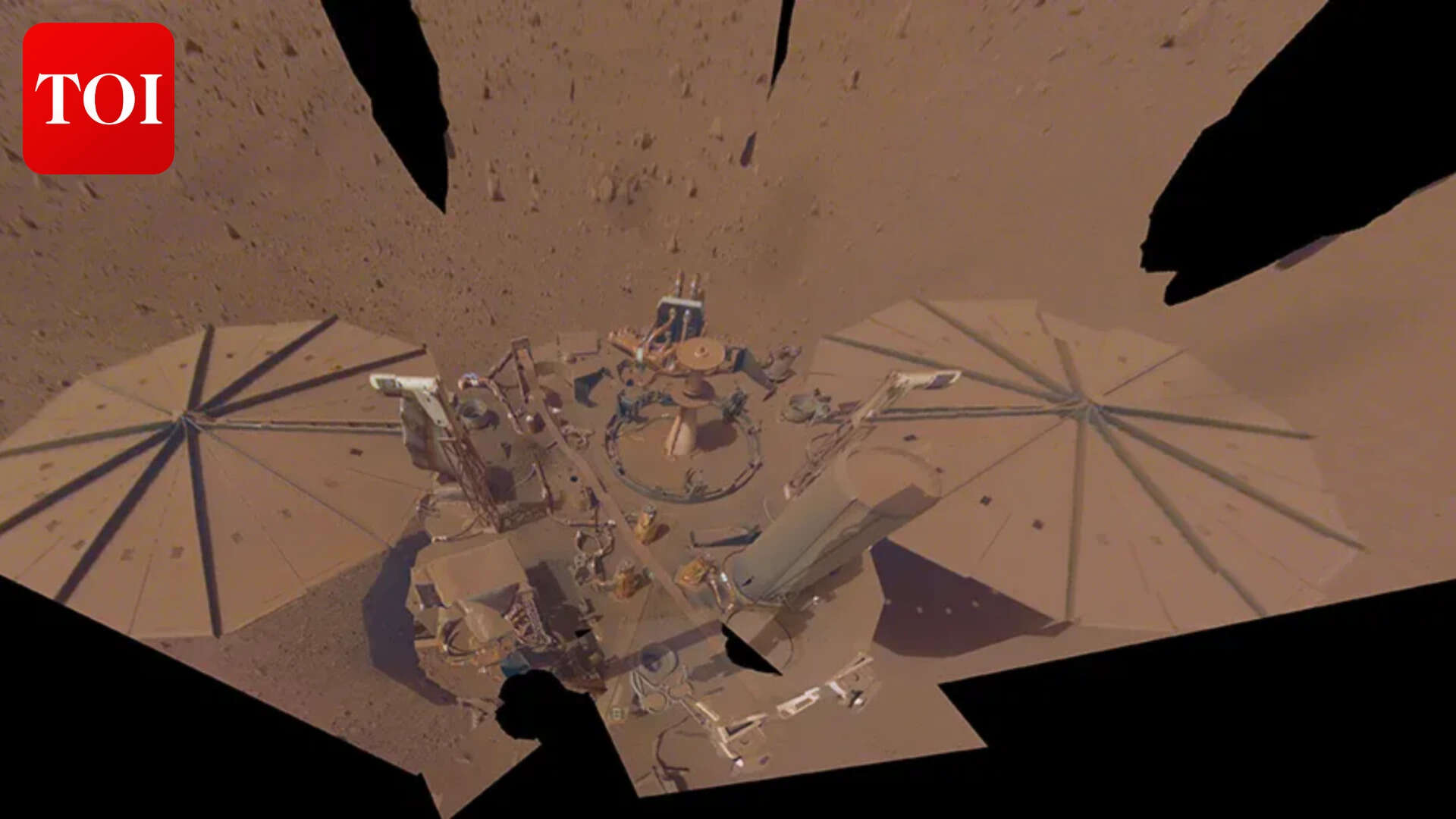
While the public consumes high-level data about rising sea levels, the ground truth is being gathered by a handful of specialists willing to slip through holes in the ice. This is not a hobby. It is a grueling, expensive, and dangerous necessity born from a gap in our current technological capabilities. We can map the surface of Mars with precision, but we still struggle to understand the fluid dynamics of an ice shelf from the bottom up.
The Engineering Nightmare of Negative Temperatures
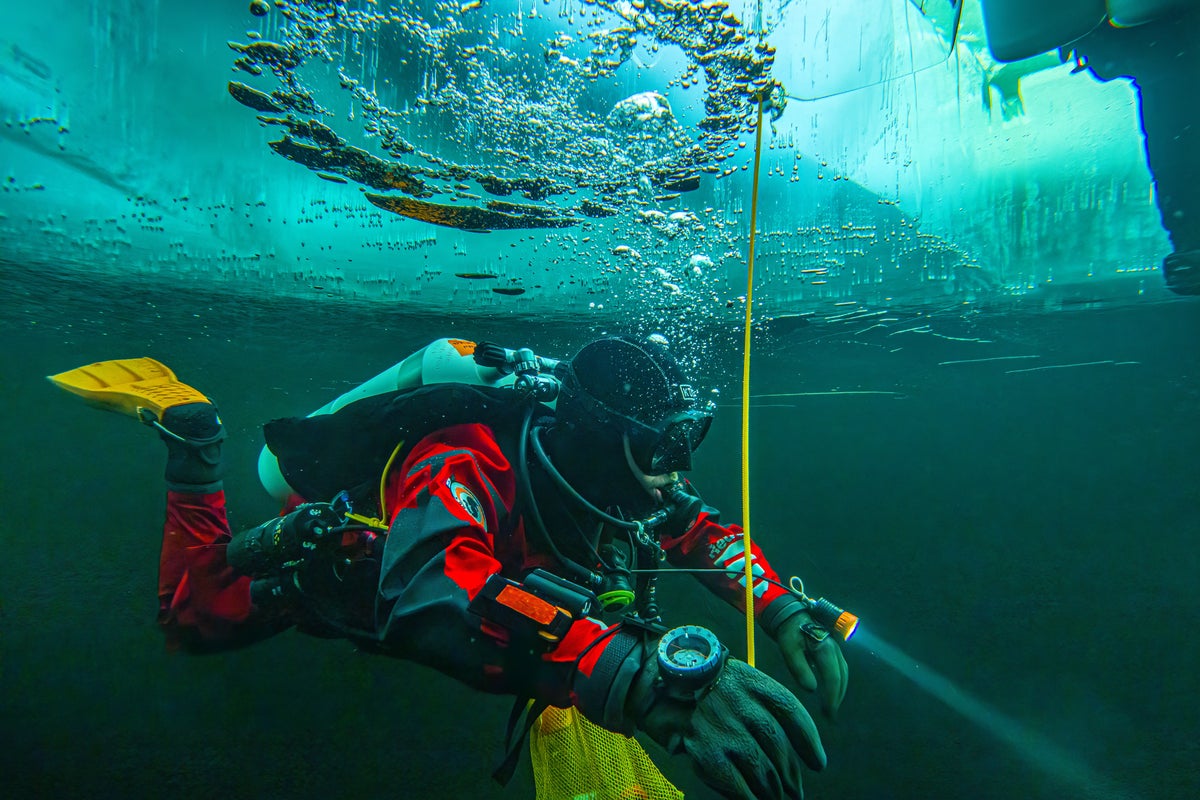
Standard SCUBA gear is a death trap in polar waters. At temperatures hovering around -1.8 degrees Celsius—the freezing point of saltwater—freshwater-based regulators will freeze open almost instantly. This causes a "free flow," where the entire air supply screams out of the tank in a roar of bubbles, leaving a diver breathless in a lightless, overhead environment.
To survive, these research teams use specialized environmentally sealed regulators filled with silicone oil or dry chambers to isolate moving parts from the water. Even with these safeguards, the failure rate remains high. Divers often carry two entirely independent air systems, a redundant weight that adds to the physical exhaustion of working in a 7mm compressed neoprene drysuit.
The suit itself is a paradox. It must be thick enough to prevent hypothermia, which can set in within minutes, yet flexible enough to allow a scientist to operate delicate sensors or extract core samples. Most researchers wear electrically heated undergarments powered by lithium-ion battery packs. If the battery fails, the "cold shock" isn't just uncomfortable; it’s a cognitive hazard. Your brain slows down. Your fingers lose the dexterity required to manage your buoyancy or signal your surface tender.
Why Robots Cannot Replace the Human Hand Yet
There is a persistent argument in the tech sector that Remotely Operated Vehicles (ROVs) and Autonomous Underwater Vehicles (AUVs) should be doing this work. On paper, it makes sense. A robot doesn't need to breathe, and it doesn't care if the water is freezing.
The reality on the ice is different.
Current ROV technology struggles with the "tangle factor" of jagged under-ice formations. Tethered drones get caught on ice keels—massive ridges of ice that can protrude thirty feet below the surface. AUVs, while tether-less, often lack the situational awareness to navigate the chaotic, shifting underside of a melting floe. They are excellent at broad-path sonar mapping but miserable at the surgical precision required for biological sampling or instrument calibration.
A human diver can feel the texture of the ice. They can see the microscopic "marine snow" and the delicate brine channels where life begins. They can troubleshoot a jammed sensor with a flick of a wrist—a task that might take an ROV pilot three hours and five thousand dollars' worth of thruster burn to attempt. Until haptic feedback and AI-driven navigation can match the spatial reasoning of a veteran diver, the human element remains the only way to get high-fidelity data.
The Physiological Toll of Polar Science
Training for these missions takes months, often occurring in high-altitude lakes or specialized refrigerated tanks. The goal is to build muscle memory for "catastrophic management." Divers practice mask-clearing and regulator-swapping until the actions are subconscious. They have to. In the dark under the ice, panic is the primary killer.
When you drop through a "man-hole" cut into six feet of solid ice, you are entering a literal bottleneck. There is only one way out. If a diver loses their guideline or the surface hole freezes over—a real possibility in extreme wind chills—they are trapped in a tomb of white and blue. This psychological pressure is why the pool of qualified polar research divers is so small. It requires a specific temperament: the analytical mind of a PhD and the cold-blooded composure of a deep-sea salvage diver.
The long-term health effects are also coming into focus. Frequent exposure to extreme cold and the repeated decompression cycles required for deep-ice dives put immense strain on the cardiovascular system. We are seeing cases of "bone necrosis" and long-term nerve damage in the hands of veteran researchers. They are quite literally giving their bodies to the data.
The Geographic Shift in Research Funding
The "Ice Race" is no longer just about environmentalism; it is about infrastructure. Nations like China, Russia, and the United States are pouring money into polar diving programs because they need to know how stable the ice will be for future shipping lanes and subsea cables.
Research stations like McMurdo in Antarctica or the various outposts in Svalbard have become hubs for this "extreme science." The logistics of getting a dive team to these locations are staggering. It involves C-130 transport planes, tracked snow vehicles, and tons of life-support equipment. A single twenty-minute dive can cost a university or government agency upwards of $20,000 when the logistical overhead is factored in.
Critics argue that this money would be better spent on satellite arrays. However, satellites see the "skin" of the planet. They cannot see the "blood" (the currents) or the "bones" (the deep ice structure). To understand why an ice shelf the size of Rhode Island is suddenly disintegrating, you have to look at the interface where the warming water meets the frozen ceiling. You have to be there.
Hidden Variables in the Water Column
One of the most significant discoveries made by these diving teams is the role of "meltwater plumes." These are streams of fresh water that flow off the glaciers and into the sea. Because fresh water is less dense than salt water, it rises, creating a turbulent mixing zone that accelerates melting from below.
This process was largely underestimated in early climate models. Without divers physically placing thermistors and flow meters directly into these plumes, our projections for sea-level rise would be off by decades. The data being pulled from these freezing depths is the "ground truth" that calibrates every global climate model currently in use by the UN and major world governments.
The Equipment Bottleneck
We are currently seeing a stagnation in diving technology. The industry is small, and the "extreme cold" niche is even smaller. Most of the gear used today is a refined version of 1990s technology. There is a desperate need for:
- Solid-state heating systems that don't rely on bulky wires.
- Head-up displays (HUDs) integrated into masks to show oxygen levels and depth without the diver needing to look at a wrist gauge in the dark.
- Low-profile rebreathers that don't emit bubbles, which can disturb the very ice structures being studied.
The lack of innovation here is a direct result of market size. There isn't enough profit in polar research to drive the R&D that the military or commercial oil sectors enjoy. Scientists are essentially "hacking" existing gear to make it work in conditions it was never meant to endure.
The Reality of the "Last Frontier"
It is a common trope to call the ocean the final frontier. For the polar diver, that frontier is shrinking. They are witnessing the disappearance of the very environments they are trained to study. There is a profound irony in spending years mastering the art of ice diving only to find that the ice is no longer thick enough to support the weight of the support vehicles.
In some parts of the Arctic, researchers are finding that "fast ice"—ice attached to the shoreline—is becoming so unpredictable that diving operations are being canceled for safety reasons. The window of opportunity to gather this data is closing. We are losing the library before we have finished reading the books.
Stop looking at the pretty pictures of blue ice and start looking at the logistics of the people beneath it. Every data point on a graph of "Global Mean Temperature" represents a human being who risked their life in a dark, freezing hole. The technology is failing to keep pace with the rate of change, leaving the "human sensor" as our most reliable, yet most vulnerable, tool in the field.
Equip the teams properly or prepare for the consequences of blind forecasting.