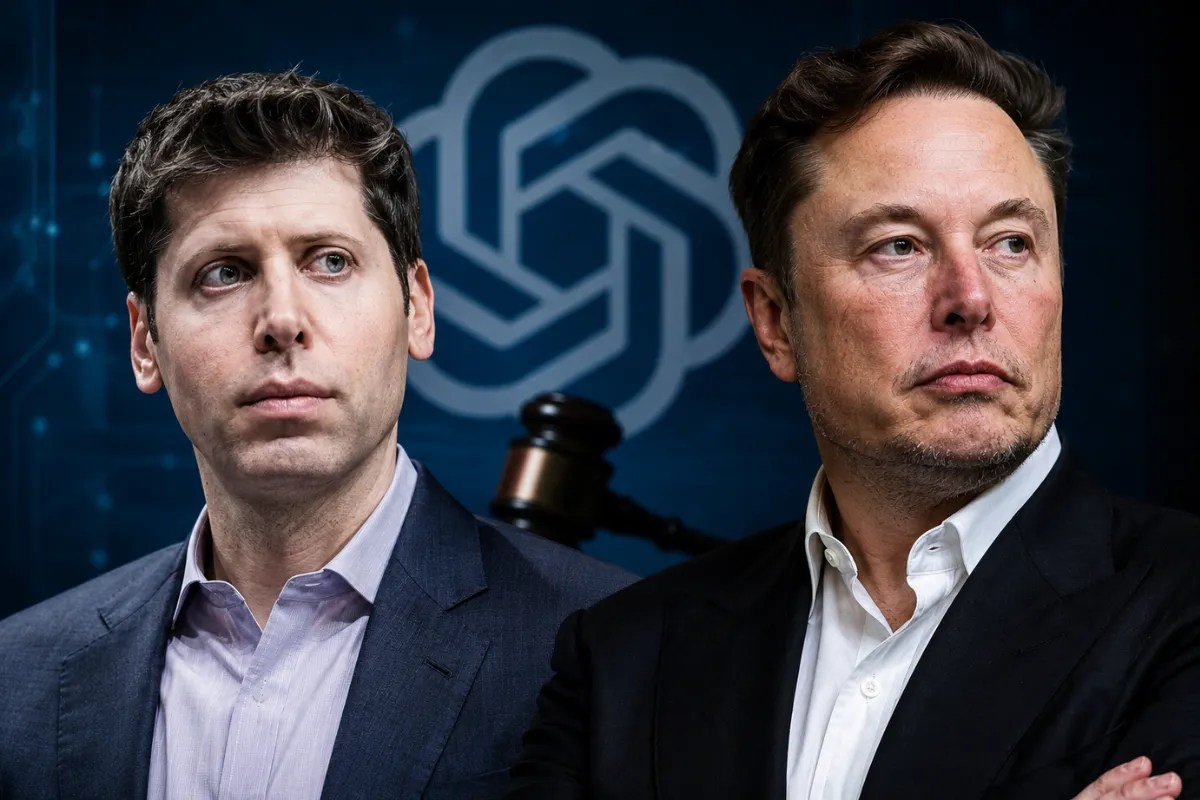
The courtroom was quiet, but the silence carried the weight of a multi-billion-dollar schism.
When Elon Musk walked away from the early, fragile incarnation of OpenAI years ago, he left behind more than just a massive financial commitment. He left behind a vision. It was a dream of a squeaky-clean, open-source fortress built to protect humanity from its own digital creations.
Now, an American judge has decisively thrown out Musk’s high-profile lawsuit against the company he helped birth. The legal framework crumbled. The lofty rhetoric about broken promises and compromised missions evaporated under the cold, analytical gaze of contract law.
This isn’t just a corporate dispute over intellectual property or board seats. It is the definitive closing of an era. The idealistic romance of Silicon Valley has finally collided with the brutal realities of global capitalism.
The Friction of Genesis
To understand how we arrived at a dismissed lawsuit in a federal court, we have to look at the human friction that started it all.
Think back to 2015. Artificial intelligence was largely a playground for tech giants with deep pockets and massive server farms. The fear among a small group of idealists was that a single corporation might achieve a monopoly on superintelligence. That kind of centralized power felt dangerous.
Sam Altman and Elon Musk sat across from each other, bound by a shared anxiety. They wanted to create a counterweight. They promised the world that their laboratory would be different. It would be a non-profit. It would give its research away.
But agreements made over late-night dinners and frantic email chains rarely survive the pressure cookers of exponential growth.
Consider what happens next: a technology emerges that is so computationally expensive, it burns through hundreds of millions of dollars just to train a single iteration. The non-profit model, designed for academic purity, suddenly looked like a bicycle trying to compete in a Formula 1 race. OpenAI needed capital. To get capital, it needed a corporate structure that could offer investors a return.
Musk watched from the sidelines as the company transformed. The open-source champion began locking its doors. It partnered with Microsoft. It became, in Musk’s eyes, a de facto subsidiary of the very corporate world they had set out to bypass.
He sued. He claimed a breach of a "founding agreement."
But the law does not trade in vibes. It trades in binding signatures.
The Anatomy of a Dismissal
The judge’s decision to dismiss the lawsuit boils down to a stark legal reality that many observers missed in the media circus. You cannot breach a contract that does not legally exist.
Musk’s legal team painted a picture of a profound moral betrayal. They argued that OpenAI’s shift toward a for-profit structure violated a foundational pact. The problem lies elsewhere, specifically in the fine print. The "founding agreement" Musk referenced wasn’t a formal, ironclad contract. It was a collection of emails, shared aspirations, and philosophical alignments.
In a court of law, enthusiasm is not a substitute for a contract.
The court found that Musk lacked the standing to sue over the governance of a non-profit he was no longer a part of. Furthermore, the vague promises of keeping things "open" were too indefinite to be enforced as a matter of law.
It was a total rout.
The dismissal sends a chilling message to anyone who believes that ethical mandates can be enforced through nostalgia. The legal system cares about corporate charters, bylaws, and explicit fiduciary duties. It does not enforce gentleman's agreements made before a company becomes the hottest commodity on earth.
The Illusion of the Non-Profit Savior
We often desperately want to believe in the myth of the benevolent tech savior. We want to believe that genius-level engineers can operate entirely outside the gravity of the market.
It is confusing and deeply uncomfortable to realize that the tools shaping the next century of human progress are being built behind closed doors by entities that must answer to shareholders. Musk’s lawsuit was an expression of that collective discomfort. It was a messy, public manifestation of the anxiety we all feel when something meant for the public good turns into a proprietary goldmine.
But let's look at the mechanics of the situation clearly.
OpenAI's Historical Trajectory:
[2015: Pure Non-Profit] -> [2019: Capped-Profit Transition] -> [Present: Commercial Titan]
Without that transition to a commercial structure, the ChatGPT we know today simply would not exist. The computing power required to train large language models requires a financial engine that non-profits cannot sustain.
Musk’s legal team argued that this transition was a bait-and-switch. OpenAI countered that it was the only way to keep the lights on and stay competitive against massive monopolies. The court ultimately decided that OpenAI’s internal restructuring was its own business, shielding it from the interference of a disgruntled co-founder.
What Remains in the Dust
The lawsuit is over, but the debate it ignited will outlive the legal filings.
The dismissal cements OpenAI's position. It frees the company from a massive legal distraction and validates its corporate trajectory, at least in the eyes of the American legal system. Sam Altman’s vision of a commercially aggressive, heavily funded sprint toward artificial general intelligence has won this round completely.
Musk is left to build his own counterweight with xAI, running the exact same race but from a different starting line.
We are left with a landscape where the word "Open" in OpenAI feels more like a historical artifact than a description of current operations. It stands as a monument to an ideal that could not withstand the reality of its own success.
The courtroom doors have closed, the filings are archived, and the billionaires will continue their proxy wars in the markets instead of the legal dockets. The dream of a purely altruistic, universally shared superintelligence didn't die in that courtroom. It had already died years ago, the moment the world realized just how valuable this technology would become. All the judge did was sign the death certificate.