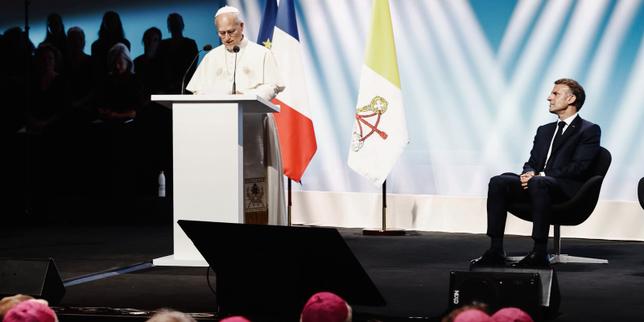
The cathedral bells of Metz did not ring out in celebration this week; they tolled for an continent sleepwalking into an abyss. When Pope Leo XIV touched down in the historic French city, the diplomatic corps expected standard ecumenical pleasantries. Instead, the pontiff delivered a lacerating rebuke of modern European complacency, condemning the normalization of continental conflict as a "useless massacre" that devours civilian lives behind abstract geopolitical statistics.
For months, the halls of power in Brussels, Berlin, and Paris have normalized a war footing. Defense budgets swell while social compacts fray, and the rhetoric of perpetual deterrence has replaced the language of reconciliation. The papal intervention in Metz punctures that carefully constructed illusion. By focusing his pilgrimage on the return of mechanized slaughter to Europe's eastern marches, the pontiff forced a historical reckoning that political leaders have desperately tried to avoid. This is not merely a spiritual lamentation. It is a diagnosis of institutional failure by an establishment that forgot the cost of its own peace.
The Architecture of Amnesia
To understand why the papal warning in Metz strikes such a raw nerve, one must examine how quickly the post-Cold War architecture corroded. For three decades, European integration was sold as an irreversible historical triumph. The European project claimed a monopoly on peace, suggesting that economic interdependence rendered large-scale artillery duels obsolete. That narrative survived minor regional skirmishes in the Balkans because they were cordoned off as peripheral tragedies.
When armor rolled across international borders on the eastern flank, the ideological shockwave destroyed the foundational myth of perpetual immunity. European capitals reacted not with profound diplomatic re-engagement, but with a rush toward remilitarization. Factories that once produced green technologies and medical supplies pivot toward ammunition lines. Public broadcasters broadcast troop movements with the detached excitement of sports commentators.
Pope Leo XIV's visit to Metz cuts through this conditioning. Metz is a city scarred by the Franco-Prussian war, World War I, and World War II—a living monument to the cyclical nature of continental bloodletting. When the pontiff stood before the stained glass windows of Saint-Étienne, he was looking at a populace that has buried generations to satisfy the ambitions of sovereign states.
The political class treats the current security paradigm as a tragic necessity. The Vatican treats it as a systemic moral collapse. When deterrence becomes the sole ideology, diplomacy is reduced to a secondary nuisance. Every euro funneled into ordnance is a euro stripped from the social fabric that actually keeps fractured societies stable. That trade-off is rarely debated in parliaments, but it is felt acutely in working-class suburbs from the Moselle to the Vistula.
The Economics of Permanent Confrontation
Behind the high-minded rhetoric of defending democratic values lies a harsh economic reality. Defense contractors see record valuations. Stock markets in Frankfurt and Paris respond to geopolitical escalation with steady gains. War has become an asset class.
This financial alignment creates a perverse incentive structure. When peace ceases to be profitable for the industrial-military complex, the political incentives for de-escalation wither. Negotiated settlements are dismissed as appeasement by pundits who face no personal risk from protracted attrition. The civilian population bears the brunt, not just through the direct trauma of bombardment for those closest to the front lines, but through runaway inflation, energy insecurity, and the gradual erosion of public services across the wider continent.
The papal address in Metz targeted this sanitized indifference. When thousands of non-combatants die in apartment blocks and municipal squares, they are too often sanitized into "collateral damage" or "strategic overhead." The Vatican's intelligence networks—informed by local clergy operating in conflict zones—provide a grimmer ledger. They report pulverized infrastructure, traumatized children, and a generation of young conscripts fed into meat-grinders for territorial gains measured in meters.
The Quiet Erosion of Moral Authority
Europe's leadership fancies itself the moral compass of the globe, lecturing other regions on human rights while quietly looking away from the devastating humanitarian consequences of prolonged warfare on its own doorstep. This hypocrisy is corrosive. When European politicians demand unconditional alignment with a military strategy that lacks a clear diplomatic exit ramp, they forfeit the moral high ground in the Global South.
Nations in Africa, Asia, and Latin America watch the endless funding of European arsenals while famine, climate displacement, and economic instability ravage their own regions. They see a double standard. The pontiff's speech in Metz resonated globally precisely because it named this contradiction. If Europe cannot protect its own neighborhood without resorting to industrial-scale destruction, its appeals to universal values ring hollow.
The tragedy of Metz is that it serves as a mirror. It reflects a continent that outsourced its conscience to technocrats and generals. The revival of trench warfare in the twenty-first century is not an alien invasion from the dark ages; it is the logical outcome of a diplomatic failure that began years before the first shot was fired.
As the papal motorcade departed Metz under heavy security, the flags fluttered against a gray sky. The leaders who shook the Pope's hand will return to their command bunkers, draft their next defense white papers, and continue the march toward an unpredictable horizon. They may ignore the bishop of Rome, but they cannot forever outrun the history written in the soil beneath their feet.