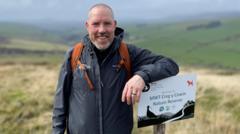
The Isle of Man is currently the staging ground for an aggressive environmental experiment: building a rainforest from scratch. Backed by a multi-million-pound corporate funding package, conservationists are transforming hundreds of acres of low-grade upland into native wet woodland. The geographical logic is sound. Swept by relentless Atlantic sea-fogs, high rainfall, and a hyper-oceanic microclimate, the island possesses the exact bioclimatic envelope required to support temperate rainforests. Yet, while the premise sounds like a triumph of ecological restoration, the reality of manufacturing a highly complex, ancient ecosystem on depleted agricultural land reveals deep financial contradictions and monumental biological hurdles.
We are not talking about tropical jungles filled with parrots and canopy vines. Temperate rainforests are a distinct, globally rare habitat characterized by open glades of oak, birch, hazel, and willow, where every trunk, boulder, and ravine is choked with a thick blanket of mosses, lichens, liverworts, and ferns. Historically, these hyper-humid woods blanketed a fifth of the British Isles. Centuries of timber harvesting, agricultural clearing, and sheep grazing systematically erased them, leaving behind a barren landscape of heather and gorse. Today, native rainforest fragments occupy a meager one percent of the region, mostly clinging to steep, inaccessible river gorges where the plow could never reach.
The Corporate Calculus of Corporate Environmentalism
The sudden rush to plant trees on the Isle of Man is powered by a £38 million partnership between the UK-wide Wildlife Trusts and the insurance giant Aviva. On paper, the scale is historic. The newest acquisition at Glen Auldyn spans 1,124 acres, with 750 acres dedicated entirely to rainforest restoration, making it the largest single site in the national recovery program. Along with smaller island projects at Creg y Cowin and Glion Darragh, the ambition is to establish a contiguous, landscape-scale ecological network.
Corporate money does not move without a strict calculation of return. For years, massive corporations offset their environmental footprints through cheap, overseas forest preservation credits. Many of those legacy schemes lacked what experts call additionality—they paid to protect forests that were never actually at risk of being logged, generating phantom carbon savings. Under intense scrutiny from financial regulators and greenwashing watchdogs, multinational firms have shifted their strategy toward tangible, domestic habitat creation.
The Isle of Man offers an attractive proposition for corporate balance sheets. Because these wet woodlands are incredibly dense with epiphytes—the mosses and lichens covering the branches—their carbon sequestration capacity is exponentially higher than standard commercial pine plantations. The Atlantic Rainforest Restoration Programme estimates that the overarching project will lock away 222,000 tonnes of carbon by 2050, doubling that figure by 2060.
But carbon accounting is notoriously fragile. A sapling planted today does not securely sequester meaningful carbon for decades. In the interim, those young trees face severe threats from disease, changing rainfall patterns, and shifting political will. By funding a centurylong initiative, corporate backers purchase immediate reputational value based on ecological projections that will not mature until long after the current executive board has retired.
The Biological Bottleneck
You cannot simply plant an ancient forest. You have to wait for it.
The primary hurdle facing the Manx Wildlife Trust is the sheer lack of biological material. Because native trees adapted to this unique microclimate are scarce, conservationists cannot buy saplings from mass-market commercial nurseries. Instead, field workers must abseil into the steep, treacherous national glens to hand-gather seeds from the surviving fragments of ancient Manx oak, downy birch, mountain ash, and hazel.
These seeds are transported to a dedicated tree nursery at Milntown, grown under controlled conditions, and then painstakingly replanted into the exposed hillsides of Glen Auldyn. It is a slow, manual bottleneck.
Furthermore, a true temperate rainforest is defined not by its trees, but by the ancient lower plants that live upon them. Lichens and liverworts require centuries of stable, humid conditions to colonize a woodland. Replanting trees creates a plantation; it does not instantly recreate a rainforest. Without close proximity to existing ancient fragments, the complex web of spores, fungi, and rare bryophytes may take generations to migrate into the new zones, if they manage to do so at all.
The Friction on the Ground
Ecological idealism frequently collides with rural realities. The uplands of the Isle of Man are not empty wilderness; they are historical farming assets. The conversion of large tracts of hill country into nature reserves inevitably reduces the available landmass for traditional livestock farming, creating systemic friction with an agricultural community already squeezed by shifting subsidies and rising operational costs.
To mitigate local backlash, the Manx Wildlife Trust is attempting a delicate compromise. They are avoiding a total exclusion policy. Instead, livestock grazing will continue across appropriate areas of the reserve during an initial two-year ecological baseline survey period. Over the long term, the trust plans to introduce low-impact, sustainable grazing models designed to mimic the natural disturbance patterns of extinct wild herbivores.
The strategy aims to maintain a woodland-pasture mosaic rather than a dense, monocultural wall of timber. Whether this hybrid approach can successfully appease traditional hill farmers while simultaneously allowing fragile, slow-growing native saplings to escape the jaws of hungry livestock remains an unproven gamble.
The Downstream Payoff
If the project succeeds, the immediate benefits will not be felt in global carbon markets, but in the immediate topography of the island. The town of Ramsey, situated directly at the base of the Glen Auldyn watershed, faces a severe, structural risk of flooding during intense Atlantic storm events. Degraded, overgrazed hillsides act like concrete slopes, channeling rainwater rapidly down into the river channels.
A thriving, mature wet woodland acts as a massive natural sponge. The complex root systems loosen compacted soils, allowing heavy rainfall to infiltrate deep into the subterranean aquifers rather than rushing overland. The thick moss layers coating the forest floor can hold several times their weight in water, drastically slowing the peak flow of rivers during a deluge.
The ultimate metric of success for the Isle of Man experiment will not be found in corporate sustainability brochures or carbon ledger sheets. It will be measured by the depth of the topsoil, the return of lost avian species like the wood warbler, and the dryness of the streets in the valleys below when the autumn gales hit.


)