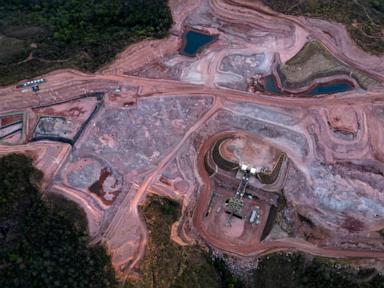
The United States and its industrial allies are turning to Brazil to break Beijing's chokehold on rare earth elements, but this geopolitical scramble is fast-tracking a localized environmental crisis that few Western policymakers want to address. As global demand for permanent magnets accelerates, the rush to extract critical minerals in South America’s largest nation is colliding with fragile ecosystems, deeply rooted land conflicts, and regulatory frameworks designed more for speed than safety.
For decades, the global supply chain for neodymium, praseodymium, dysprosium, and terbium ran almost exclusively through China. That monopoly gave Beijing unmatched leverage over advanced manufacturing, consumer electronics, and defense systems. Western capitals responded by opening checkbooks. Multi-billion-dollar buyouts, such as USA Rare Earth’s acquisition of the Serra Verde mining group, signal a desperate bid to secure non-Chinese raw materials. Yet pinning supply chain security on Brazilian soil introduces a volatile set of trade-offs that extend far beyond corporate balance sheets.
The structural flaw in the current Western strategy lies in treating geography as a proxy for sustainability. While Brazil offers vast geological wealth and a renewable energy grid that theoretically lowers extraction carbon footprints, the physical reality on the ground tells a much harsher story. The mining frontier is expanding into vulnerable biomes and rural settlements where regulatory oversight is thin and historical land disputes are already boiling over.
The Pela Ema Paradigm and the Cost of Extraction
Consider the operations at Serra Verde's Pela Ema mine in Minaçu, Goiás. Long defined by its legacy as an asbestos-producing hub, the region has pivoted aggressively toward the periodic table's most coveted transition metals. Pela Ema is one of the rare scaled producers outside Asia capable of yielding all four critical magnetic rare earths alongside yttrium.
The financial architecture backing these operations is immense. Washington-backed financing packages and long-term offtake agreements guarantee a steady pipeline of capital designed to insulate Western supply chains from geopolitical shocks. But money does not neutralize chemistry. Rare earth extraction involves mobilizing weathered clay deposits, moving massive volumes of earth, and managing complex tailings. Even when projects avoid the catastrophic structural failures seen in historic iron ore disasters, the day-to-day footprint of clearing native vegetation and managing chemical reagents leaves deep ecological scars.
Regulatory shortcuts compound these risks. Pending legislative pushes in Brasília to fast-track critical minerals have systematically prioritized speed of licensing over exhaustive environmental impact assessments. When speed becomes the primary metric of bureaucratic success, baseline protections for water tables and local biodiversity are the first casualties.
Land Conflicts and the Rural Fallout
The expansion frontier does not exist in a vacuum. Across multiple Brazilian states, prospective rare earth claims overlap directly with rural settlements, indigenous buffer zones, and fragile forest remnants.
In Bahia, mining applications threaten dry forest ecosystems and land traditionally managed by rural communities. Local labor and land rights organizations report a measurable uptick in social friction as speculative capital enters these regions. Land grabbing, psychological harassment, and threats against community leaders are creeping upward in areas marked for mineral exploration.
These dynamics expose a profound contradiction in the green transition narrative. Industrialized democracies are demanding ethically sourced inputs to power electric vehicles and wind turbines. Yet the foundational extraction process frequently tramples local land rights and disrupts traditional livelihoods. When a rural community is displaced or its water source is compromised for the sake of a wind turbine component, the definition of sustainability collapses under its own weight.
The Infrastructure Bottleneck
Geology is not destiny. Finding an ore body is only the initial hurdle; processing, separating, and metallizing those elements require a sophisticated industrial ecosystem that Brazil is only beginning to construct.
Refining rare earths is notoriously toxic and energy-intensive. While Brazil possesses the clean energy capacity to power these plants, building the physical and regulatory infrastructure to handle chemical separation domestically requires years of sustained investment. Without that domestic processing capacity, the country risks falling into a historical trap. It could remain a raw material quarry for foreign entities, exporting unrefined dirt while absorbing the totality of the environmental degradation at home.
Western corporations celebrating multi-billion-dollar cross-border deals rarely account for these friction points. They project smooth operational curves and uninterrupted cash flows, assuming that government backing will sweep away local resistance. That assumption underestimates the resilience of grassroots movements and the growing sophistication of Brazil's public prosecutors, who are increasingly willing to challenge environmental licenses that bypass constitutional protections.
The race for critical minerals is reshaping international relations, but it is also forcing a reckoning within resource-rich nations. If the transition to clean technology simply replicates the predatory extraction models of the past under a different banner, the true cost will be paid by the ecosystems and communities standing in the path of the bulldozer.