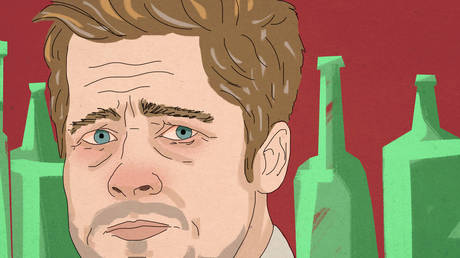
Brad Pitt recently shattered seven years of public sobriety by casually announcing that he has returned to alcohol, describing his new relationship with wine as a measured practice where he must act "professional about it." This admission, dropped during a widely read profile, instantly triggered a polarized cultural friction loop. Mainstream entertainment outlets rushed to frame the relapse as a benign lifestyle adjustment, leaning on casual expert quotes suggesting that rigid abstinence is not mandatory for every single person on earth. Down in the trenches of addiction medicine and long-term recovery communities, however, the reaction was not nuanced curiosity. It was alarm.
To understand why a movie star pouring a glass of wine sparks a fierce ideological war, you have to look past the glitz of Hollywood profiles and examine the rigid mechanics of chemical dependency. True addiction is not a bad habit that responds to willpower training or professional discipline. It is a chronic neurobiological condition characterized by the erosion of executive control over substance use. When someone with a severe history of chemical dependency steps away from total abstinence and tries to manage intake like an executive balancing a spreadsheet, they are playing a high-stakes psychological game against a rewiring brain.
The phrase "drinking like a professional" sounds clever in a magazine feature, but it flies in the face of clinical reality. Clinical social workers and addiction researchers spend decades documenting how the brain's reward pathways reactivate upon the reintroduction of a primary trigger. Once the neural pathways associated with heavy coping mechanisms are lit back up, the brain does not care about professional boundaries or movie star discipline. It remembers the precise route to total oblivion.
The Anatomy of the Seven-Year Itch
Seven years is a massive milestone in the recovery world. During that window, the brain undergoes significant neuroplastic healing, rebuilding dopamine receptors and reshaping behavioral responses to stress. Yet, recovery veterans know that time alone does not grant permanent immunity. Relapse rarely happens overnight out of nowhere. It is the final destination of a long, quiet mental drift.
Pitt himself admitted to moments of overconfidence before falling off the wagon. That overconfidence is the smoking gun of late-stage emotional drift. In recovery circles, the descent back into a substance usually begins months before the first drink touches the lips. It starts with isolation, the dropping of support structures like peer groups or accountability meetings, and the gradual belief that the individual has somehow conquered the underlying vulnerability.
When a person reaches a level of fame and insulation like Pitt's, the surrounding ecosystem often lacks friction. Nobody in a movie trailer or on a private film set is going to slap a glass of wine out of an A-list actor's hand and demand to see his chip count. Fame creates a distorted reality distortion field where boundaries bend to accommodate the individual. That insulation is lethal for recovery, which thrives on radical transparency, brutal honesty, and peer accountability.
The Dangerous Cultural Message of Controlled Relapse
The real danger of high-profile figures normalizing controlled drinking after severe addiction is the ripple effect it creates among everyday people struggling in silence. Millions of individuals watch these interviews from their living rooms, fighting severe alcohol use disorder, looking for any excuse to convince themselves that they, too, can moderate.
They hear a beloved actor say he can handle a few glasses, and their addiction-driven brain instantly locks onto that permission slip. It whispers that maybe the past interventions were an overreaction, maybe the rock-bottom moments weren't that bad, and maybe—just maybe—they can drink normally now.
This is where celebrity transparency becomes hazardous. Addiction does not scale according to net worth, charm, or professional success. A Hollywood star with an army of private support systems, nutritionists, and personal assistants has a vastly different safety net than an ordinary person battling isolation and financial stress. Pretending that a return to drinking is simply a matter of applying professional management ignores the systemic devastation alcohol inflicts on millions of families who cannot afford private rehabilitation resets.
Why the Addiction Community Reacts with Despair
The split between clinical theorists and front-line recovery advocates is stark. While university researchers often look at population statistics and note that controlled drinking outcomes occur in specific, mild subsets of the population, sponsors and long-term survivors look at human wreckage. They have seen this exact narrative play out thousands of times across ordinary lives.
The script is almost always identical. Phase one involves cautious moderation and celebratory toasts about how well things are going. Phase two involves shifting the goalposts, where a few glasses turn into a bottle, and the management strategy begins to fray at the edges. Phase three brings back the original chaos, often heavier and more destructive than before because the psychological toll of a failed moderation experiment crushes whatever hope was left.
To frame this as a personal triumph of maturity is a profound misreading of psychological pathology. Maturity does not allow an alcoholic to safely ingest their primary poison any more than willpower allows a diabetic to safely ignore insulin. Biological thresholds do not negotiate with maturity.
The Illusion of the Controlled Environment
Pitt's admission also highlights the pressure-cooker environment of elite entertainment culture, where substances have historically functioned as social currency and emotional anesthesia. Despite periods of intense self-reflection and candid admissions about past family turmoil and dark mental health struggles, the gravitational pull of the industry's drinking culture remains remarkably strong.
When a person steps out of active recovery programs like Alcoholics Anonymous—as Pitt noted he did prior to this shift—they lose the daily mirror that keeps grandiosity in check. Without that anchor, the ego rushes to fill the vacuum, convincing the individual that they have evolved beyond the need for structural support.
That hubris is precisely what traps people. The moment an individual decides they are too professional, too smart, or too experienced to succumb to an old pattern is the exact moment they become entirely defenseless against it.
The narrative being spun around this return to drinking romanticizes a dangerous tightrope walk. There is no professional way to manage a progressive, fatal condition. There is only active management of sobriety or the slow, predictable slide back toward the chaos that forced a reckoning in the first place.