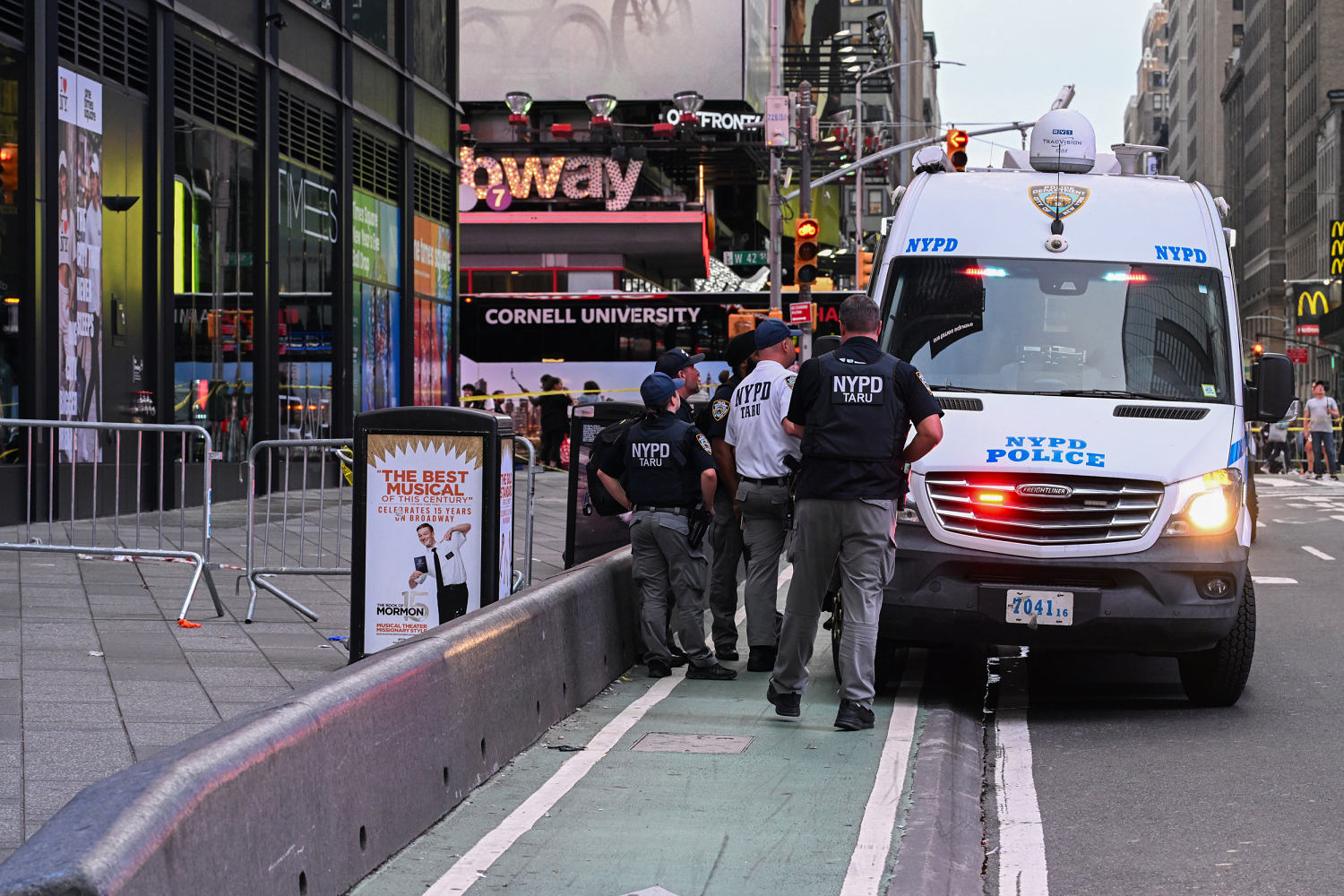
A pedestrian thoroughfare built on neon illusions can turn into a combat zone in less than twenty seconds. When 49-year-old Pamela Sisneros pulled two knives from a red Target bag on a Monday afternoon in August 2026, she initiated a rapid-fire sequence of violence at West 43rd Street and Seventh Avenue that left one person dead, another hospitalized, and the suspect shot dead by the New York City Police Department.
Standard breaking news reports treat such an event as an isolated aberration. They recount the timeline, quote Police Commissioner Jessica Tisch, note the street closures, and move on. This superficial treatment ignores the structural vulnerabilities of the busiest commercial hub in the Western Hemisphere. Midtown Manhattan operates under a constant, crushing density where law enforcement and emergency response systems are forced to react to chaos rather than prevent it.
The Twenty-Second Window of Panic
The attack unfolded with terrifying speed. According to official police briefings, the sequence began near West 41st Street when the suspect approached a 68-year-old man and stabbed him in the abdomen. Within twenty seconds, a second victim, a 32-year-old woman, was fatally stabbed further up Seventh Avenue.
In a dense urban environment, seconds dictate survival. Bystanders became immediate first responders, shouting warnings and flagging down patrol units. When officers confronted Sisneros between 42nd and 43rd streets, they engaged in four minutes of verbal negotiation. Body-worn camera footage captures the standoff. The suspect refused compliance, shouting explicit threats of lethal harm toward the personnel.
Officers deployed Tasers. The electronic control devices failed to neutralize the threat, a known limitation when dealing with heavy clothing, high adrenaline, or acute psychological crises. When non-lethal measures collapse, standard operating procedure forces officers into a binary choice: retreat and risk further civilian casualties in a packed public square, or use lethal force. They fired.
The Urban Safety Paradox
Public spaces like Times Square present a unique policing nightmare. Millions of tourists and commuters flow through a compressed geographic footprint daily. Traditional security architectures rely on high visibility and rapid reaction forces. Yet, visible deterrence does little against unprovoked, spontaneous acts of violence driven by severe mental deterioration.
Critics often ask why police cannot instantly disarm individuals wielding edged weapons without firing shots. Tactical experts understand the reality of the 21-foot rule and the sheer speed of a knife attack. A motivated assailant can cover short distances and inflict fatal wounds before an officer can holster a firearm, draw a baton, or deploy alternative gear. When an individual explicitly states an intention to kill, the margin for negotiation evaporates.
The systemic failure stretches far beyond the four minutes of confrontation on Seventh Avenue. It points to a fractured social safety net where individuals in deep psychological distress slip through institutional cracks until they manifest as public safety emergencies in high-visibility districts. Municipal leaders promise increased patrols and technological interventions, yet the fundamental vulnerability of open-access urban centers remains entirely unaddressed.
As the investigation continues and the mandatory body-camera footage faces public scrutiny, the deeper question persists. Midtown will remain a flashpoint where the friction of urban existence occasionally erupts into raw, unpreventable tragedy.
NYPD holds briefing on Times Square stabbing
This video provides the official press conference and investigative breakdown from police leadership regarding the Midtown incident.