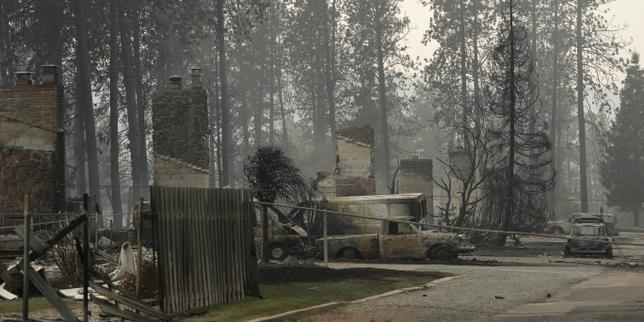
Every summer, the playbook gets dusted off. The smoke rolls into Spokane, the satellite maps turn a bruised, apocalyptic orange, and media outlets publish the exact same panicked gallery of scorched pines and hazy skylines. The narrative writes itself before the first ember lands. Dry timber plus rising temperatures equals inevitable inferno. It is neat, it is digestible, and it completely misses the point.
I have watched billions of dollars and decades of policy discussions vanish into the ether of this lazy consensus. We treat wildfires like acts of God or simple thermometers of a warming planet, absolving ourselves of the institutional rot and policy failures that actually turn a dry ridge into a raging furnace. Climate change loads the dice, yes. But we built the loaded gun, pointed it at our own feet, and pulled the trigger by ignoring a century of ecological suppression.
Stop treating every wildfire as a standalone catastrophe requiring nothing more than a sympathetic retweet and a prayer for rain. Until we confront how modern land management deliberately created these monster fires, Spokane and the rest of the American West will keep burning.
The Century of Stupid Policies
To understand why the forests around Spokane burn with such terrifying ferocity today, you have to look at what we did right after World War II. For generations, federal and state forestry agencies operated under a single, dogmatic imperative: the 10AM rule. Every fire detected by ten in the morning had to be put out immediately.
At the time, it felt like common sense. Protect the timber, save the towns, stop the destruction. But forests are not static museum exhibits. They are dynamic systems that require periodic, low-intensity fire to clear out the understory, recycle nutrients, and keep tree densities at sustainable levels. By ruthlessly suppressing every natural, low-intensity burn for nearly a hundred years, we did not prevent fires. We merely deferred them.
Instead of a frequent, patchy cleansing of the landscape, we engineered a massive, continuous fuel cabinet. Think of it like a fireplace. If you throw a single log on the grate every hour, you get a warm, manageable fire. If you stack the living room floor-to-ceiling with dry kindling, newspapers, and old furniture for a decade, and then drop a match, you don't get a fire. You get an explosion.
Ecologists and fire historians have been screaming this from the rooftops for decades. Names like Stephen Pyne and institutions like the Tall Timbers Research Station have data stretching back half a century proving that fuel accumulation is the primary driver of catastrophic crown fires. Yet policymakers keep looking up at the smoke, pointing exclusively at carbon parts-per-million, and pretending that aggressive logging bans and zero-management policies had no part to play.
The Myth of Pristine Nature
There is a romantic, deeply flawed notion that if we just walk away and leave nature alone, the wilderness will heal itself into an Edenic balance. This is ecological illiteracy dressed up as environmentalism.
Before European settlement, Indigenous tribes across the Pacific Northwest used regular, intentional burning to shape the landscape, clear brush, and encourage specific plant growth. These frequent burns kept fuel loads low and old-growth trees resilient. Modern preservationist dogma threw out centuries of traditional ecological knowledge in favor of a hands-off ideology that views any human intervention in a forest as inherently evil.
The result? Our forests are overstocked. Instead of fifty to one hundred large, fire-resistant pine trees per acre, we now have thousands of spindly, stressed saplings competing for the exact same drop of groundwater and ray of sunlight. When a drought hits—and droughts are a historical, recurring feature of the inland Northwest—these dense thickets do not just dry out. They die standing up.
When a spark finally hits an overstocked forest, it does not creep along the forest floor. It climbs the ladder fuels—the dense mats of small trees and shrubs—and explodes into the canopy. The crown fire creates its own weather, generating hurricane-force winds that hurl burning embers miles ahead of the front.
Blaming carbon emissions for this dynamic is like blaming global warming for a car crash when the driver cut the brake lines. Climate change accelerates the drying process, but the fuel load dictates whether the forest merely smolders or vaporizes.
Economics Over Ecology
If the science is this clear, why haven't we fixed it? Follow the incentives.
Wildfire management in the United States is a massive, multi-billion-dollar industrial complex. Agencies like the U.S. Forest Service spend the vast majority of their annual budgets on suppression—putting fires out after they start—rather than prevention. There is a perverse budgetary incentive at play. When a fire is raging, emergency funds flow, contractors get paid, and political leaders look decisive holding press conferences in front of topographic maps.
Prescribed burns, mechanical thinning, and ecological restoration, on the other hand, are unsexy, slow, and expensive upfront. They do not generate dramatic evening news segments. Worse, they carry political risk. If a prescribed burn escapes—which happens rarely, but happens—the agency faces lawsuits, public backlash, and career-ending scrutiny.
So, bureaucrats choose the path of least resistance. They let the fuel accumulate year after year, hiding behind environmental impact statements and litigation delays, until Mother Nature forces their hand with a catastrophe they could have mitigated a decade prior.
I have watched local communities fight tooth and nail against thinning projects near their neighborhoods because they didn't want the temporary eyesore of a managed forest, only to watch those exact homes turn to ash three years later because the woods were too thick to defend.
What Actually Works
If we want to stop writing these exact same articles every single summer, we have to abandon our emotional attachment to passive management and embrace aggressive, uncomfortable restoration.
First, we need to scale up prescribed burning by an order of magnitude. This means accepting short-term smoke in our valleys during the spring and fall as the necessary price of avoiding toxic, prolonged smoke disasters in the middle of summer. It means reforming liability laws to protect land managers who use fire as a tool from predatory lawsuits when things go sideways.
Second, we must massively accelerate mechanical thinning in high-risk transition zones where public forests abut residential developments. We need to create defensible space at a landscape scale, not just rely on homeowners raking pine needles from their gutters while a wall of fire bears down on them.
Third, we have to stop treating logging as a dirty word. Active forest management, when done with ecological integrity, removes excess biomass and funds the restoration work that our underfunded agencies cannot afford on taxpayer dollars alone.
The smoke over Spokane is not a mystery. It is a ledger balance coming due. We can keep paying the minimum payment in panic and property loss, or we can finally change the terms of the loan.
The next time the sky turns orange, don't just look at the thermometer. Look at the forest floor. That is where the fire was won or lost fifty years ago.