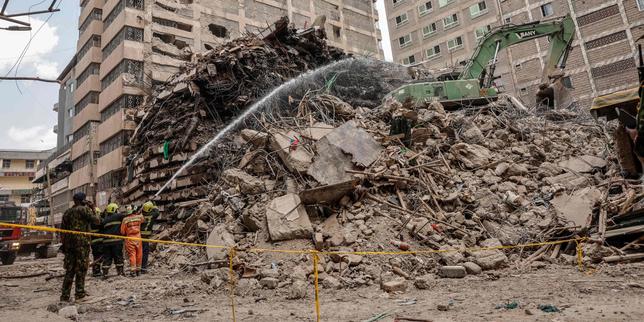
Every time concrete pancakes in Eastlands, the press runs the exact same obituary. They blame a "race to the top," point fingers at cartoonishly evil developers, and demand harsher building codes. That narrative is lazy. It is comforting, politically convenient, and dead wrong.
Buildings in Nairobi do not collapse because concrete is too tall. They collapse because capital is too expensive, land is artificially scarce, and regulatory compliance is priced out of the market for anyone trying to house the working class. If you want to understand why apartment blocks fold like wet cardboard in Kasarani, Pipeline, and Ruaka, stop looking at the greed of the builders and start looking at the spreadsheet of survival. Expanding on this topic, you can find more in: Pourquoi la colère des étudiants albanais résiste à la répression policière.
The Myth of the "Race to the Top"
The dominant media framing treats Nairobi’s skyline like a vanity project gone wrong—a reckless ego trip by developers trying to outbuild one another. This completely misunderstands the economics of East African real estate.
Nobody in Pipeline is building an eight-story walk-up out of hubris. They are doing it because Nairobi’s urban land market is broken. Decades of speculative land banking by politically connected elites have pushed the cost of serviced land in the city to absurd levels relative to local incomes. When a quarter-acre plot in a mid-tier suburb costs tens of millions of shillings before you even dig a foundation trench, horizontal development becomes mathematically impossible. Analysts at The Guardian have shared their thoughts on this trend.
Density is not the enemy. In fact, verticality is the only way Nairobi can house a population growing by hundreds of thousands every year without turning the entire Rift Valley into an asphalt parking lot. Cities like Tokyo, Hong Kong, and Singapore build infinitely higher on worse soil and active fault lines, and their buildings stay upright. The height of Nairobi’s towers is not the disease; it is the symptom of a severe housing deficit colliding with astronomical land prices.
Follow the Interest Rate, Not the Bribe
When journalists reduce building collapses to "corruption," they stop asking why bribery is cheaper than compliance.
I have sat across the table from mid-sized contractors in Westlands watching their margins evaporate in real time. To understand why corners get cut on rebar and cement ratios, you have to look at the cost of financing in Kenya. Commercial bank loans routinely carry double-digit interest rates—often hovering between 14% and 18%, and sometimes higher when fees are factored in.
Imagine a scenario where a developer borrows 100 million shillings to build affordable rental units. Every single month that project sits idle waiting for an environmental impact assessment, a county architectural stamp, or a National Construction Authority (NCA) inspection, the interest meter is burning hundreds of thousands of shillings.
In a high-interest environment, time is lethal. A six-month bureaucratic delay does not just annoy a developer; it bankrupts them. When the formal approval pipeline is designed as a tollbooth where underpaid county clerks extract rent through weaponized delays, paying a fixer to wave through an uninspected slab becomes a rational financial decision for a cornered borrower. The corruption is real, yes, but it is downstream of a punitive financial and regulatory architecture.
Why Stricter Building Codes Will Kill More People
Whenever a tragedy hits the front page of the Daily Nation, politicians inevitably promise a "crackdown" and "tougher regulations."
This is pouring gasoline on a fire. Kenya does not lack building laws. Between the Physical and Land Use Planning Act, the NCA regulations, and the county by-laws, the paper trail required to legally pour a foundation is already thick enough to stop a bullet. Adding more red tape to a system that cannot enforce its existing rules only accomplishes one thing: it pushes more construction into the informal shadow economy.
Think about how regulation actually behaves in an emerging market:
- Over-regulation raises the barrier to entry, driving out legitimate, mid-tier engineering firms that cannot afford to carry bloated compliance overhead.
- Compliance becomes a luxury good, accessible only to institutional mega-developers building high-end commercial towers in Upper Hill or luxury apartments in Kilimani—buildings that almost never collapse.
- The middle market is abandoned to quacks. Because formal engineering and architectural supervision add 10% to 15% to project costs, developers serving the 15,000-shilling-a-month rental market simply bypass professionals altogether. They hire a local fundi who eyes the concrete mix by color and guesses the column spacing based on the last building he worked on.
You cannot regulate away poverty. When the state sets regulatory standards modeled on European compliance costs in an economy where the average tenant earns a fraction of a European wage, the market does not rise to meet the standard. It goes underground.
The Structural Engineering Reality Nobody Talks About
Let’s strip away the politics and look at the actual physics of why these buildings fail. Having reviewed forensic engineering reports from East African collapses, the failure modes are shockingly repetitive—and almost none of them have anything to do with the building being "too tall."
- The Curing Time Scam: Concrete does not reach its design strength the day it is poured. Standard Portland cement requires 28 days to cure properly, reaching roughly 70% of its strength at seven days. In Nairobi’s rush to beat interest rates and collect tenant deposits, contractors routinely strip formwork after three or four days to pour the next floor. They are stacking wet weight onto green concrete.
- Column Slenderness and Punching Shear: To maximize rentable floor space, developers pressure draughtsmen to shrink structural columns and widen the spans between them. Without proper shear reinforcement, the floor slab literally punches through the top of the column like a thumb through wet paper. Once one floor drops, the dynamic shock load triggers a progressive pancake collapse all the way to the foundation.
- Soil Ignorance and Black Cotton: Large swaths of Nairobi sit on expansive black cotton soil—clay that swells dramatically when wet and shrinks when dry. Building a five-to-eight-story structure on shallow pad foundations without excavating down to bedrock or driving proper piles guarantees differential settlement. One corner of the building sinks three inches during the long rains, snapping rigid concrete beams in half.
- The "Phantom" Floor Addition: A developer gets approval for four stories. Halfway through construction, realizing the land cost won't pencil out, they add three more floors onto columns and footings designed for half the load. The structure becomes a vertical time bomb waiting for a heavy downpour or minor vibration to exceed its yield strength.
Notice a pattern? Every single one of these failures is a basic, textbook execution error. A competent structural engineer with a clipboard and a slump cone could spot any of them in ten minutes.
Answering the Wrong Questions About Nairobi’s Construction Crisis
When people search for answers after a collapse, they usually ask how to punish the owners or stop high-rise growth. Both questions miss the mark entirely.
Why don't authorities just demolish all illegal buildings?
Because doing so would trigger an immediate humanitarian and economic crisis. Millions of Nairobi residents live in structures that violate at least one zoning or building code. Mass demolitions without an alternative housing supply simply create homeless encampments and destroy the life savings of innocent middle-class buyers who purchased units in good faith. Selective demolition is a political performance, not an urban policy.
Are Chinese contractors to blame for cheap materials?
This is a popular xenophobic scapegoat that collapses under basic scrutiny. Foreign tier-one contractors build the expressways, the SGR, and the 30-story commercial towers in Westlands—almost none of which have suffered catastrophic structural failure. The killer buildings in Eastlands are almost exclusively funded by local private syndicates, chamas, and individual landlords using local labor and locally sourced, often adulterated, aggregates.
Should Nairobi cap building heights in residential zones?
Capping heights in high-demand corridors like Zimmerman or Roysambu would send rents skyrocketing overnight and accelerate urban sprawl into fragile agricultural land in Kiambu and Kajiado. Height limits without mass transit infrastructure are an economic death sentence for a growing metropolis.
The Uncomfortable Trade-Offs of Real Reform
If we actually want buildings to stop falling down, we have to accept a brutal truth: fixing this will initially make housing more expensive, and it will force the government to surrender its most lucrative patronage tool—discretionary permitting.
First, kill discretionary approvals and automate permitting. If a licensed, insured structural engineer stamps a blueprint, construction should begin immediately without waiting six months for a county official to demand "facilitation fees." Shift the liability from a faceless bureaucracy to the individual engineer's license and professional indemnity insurance. When an engineer knows a collapse means losing their livelihood and facing manslaughter charges—and that no county clerk can shield them—watch how fast concrete quality improves.
Second, decriminalize incremental, low-rise density. Right now, the gap between a single-family home and an eight-story concrete apartment block is massive. By allowing streamlined, standardized designs for three- and four-story walk-ups using alternative, lighter building technologies—like expanded polystyrene (EPS) panels or light-gauge steel framing—developers can build faster, reduce dead loads on weak soils, and cut financing timelines in half.
Third, audit the supply chain at the factory gate, not the construction site. Inspecting ten thousand individual building sites across Nairobi is impossible. Inspecting the handful of quarries, cement plants, and steel rolling mills that supply the entire city is entirely doable. Substandard, underweight rebar and diluted cement should be choked off before they ever reach a hardware store in Rongai.
Yes, strict third-party insurance mandates and supply-chain enforcement will drive marginal developers out of the market. Rents in the short term will face upward pressure as supply tightens. That is the painful price of safety. Pretending we can have ultra-cheap housing, 16% interest rates, and zero collapses is a fantasy written in blood.
Stop Blaming the Skyline
The pundits crying about a "race to the top" want a simple villain so they don't have to confront a broken system. It is easy to demonize a greedy landlord. It is much harder to dismantle a predatory banking sector, an extortionate county permitting regime, and a land market rigged to starve the working class of space.
Nairobi needs to build up. It needs to build fast. And it needs to build dense. The towers aren't falling because they are reaching for the sky—they are falling because the state has made it financially suicidal to build a solid foundation.