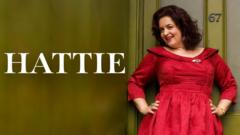
Casting a biopic isn't about finding a twin. It isn’t about who can wear the prosthetic nose with the least amount of whining. Yet, every time a network announces a new retrospective on a British icon, the industry falls into the same trap: the "Lookalike Fallacy."
When Ruth Jones was cast as Hattie Jacques for the BBC’s Hattie, the critics did what they always do. They looked at the side-by-side photos, noted the shared Welsh warmth, and declared it a "masterstroke." They were wrong. They missed the tectonic plates shifting beneath the surface of 1960s celebrity culture. To understand why Jones—as brilliant as she is in her own lane—was a safe, reductive choice, you have to stop looking at the silhouette and start looking at the internal friction.
Hattie Jacques wasn't a "cuddly" national treasure. She was a woman living in a state of permanent, high-stakes emotional dissonance.
The Myth of the Matriarch
The standard narrative surrounding Hattie Jacques is one of a jolly, oversized Matron. The Carry On films trapped her in a caricature of asexual authority or the "unwanted" woman. Most biopics, including the Jones vehicle, attempt to "humanize" this by showing the sad clown behind the makeup. They focus on her affair with John Schofield and the crumbling of her marriage to John Le Mesurier.
But here is the nuance the industry ignores: Hattie Jacques’ power didn't come from her vulnerability; it came from her deliberate subversion of it.
Jacques was an aristocrat of comedy. She had a precision that Ruth Jones—who specializes in a sprawling, naturalistic, kitchen-sink style of "common" warmth—couldn’t possibly replicate. When you watch Jones play Nessa in Gavin & Stacey, you see a character who owns her space through sheer force of personality. When you watched Hattie Jacques, you saw a woman who owned her space through containment.
By casting Jones, the BBC chose to make Hattie "relatable." But Hattie Jacques was never meant to be relatable. She was an enigma who happened to be funny.
Why Physicality is the Ultimate Red Herring
The "lazy consensus" in entertainment journalism is that if two people are plus-sized and have a good smile, they are interchangeable. This is a subtle, pervasive form of industry laziness.
In the world of acting, there is a massive difference between weight as a character trait and weight as a costume.
- Ruth Jones uses her physicality as a tool for grounding her characters in the working class. It is earthy. It is tactile.
- Hattie Jacques used her physicality as a shield. Her elegance was her weapon.
I’ve seen production houses blow millions trying to "capture the essence" of a star by focusing on the wardrobe and the silhouette. They hire the best makeup artists in the business, they get the lighting right, and they still end up with a waxwork. Why? Because they aren't casting for the rhythm of the person.
Jacques had the rhythm of a ballerina trapped in the body of a Victorian duchess. Jones has the rhythm of a pub regular who can out-talk anyone at the bar. They are both valid, but they are diametrically opposed frequencies. To cast Jones as Jacques is to suggest that all "large, funny women" are essentially the same. It’s a creative insult masked as a compliment.
The Le Mesurier Problem: Misreading the Dynamic
The "competitor" take on this story usually focuses on the scandal. They want to talk about the "menage-a-trois" at 67 Eardley Crescent. They paint Hattie as the victim of her own insecurities, seeking validation in the arms of a younger man because she didn't feel beautiful.
This is a patronizing, mid-century lens that we should have discarded decades ago.
Hattie Jacques wasn't seeking validation; she was seeking control. Her marriage to John Le Mesurier wasn't a tragedy of neglect; it was a sophisticated arrangement that she managed with the skill of a CEO. Le Mesurier, the quintessential "vague" Englishman, was the perfect foil for her.
If you want to disrupt the biopic genre, stop making them about "the secret sadness." Start making them about the secret competence. Jacques was the breadwinner, the organizer, and the gravitational center of a chaotic social circle.
The "People Also Ask" Trap
People often ask: Was Hattie Jacques happy?
The question itself is flawed. It’s a binary trap. In the entertainment industry, we love to project "unhappiness" onto anyone who doesn't fit the standard mold of a starlet. We want our icons to be tortured so we can feel better about our own mundane lives.
The honest, brutal truth? Hattie Jacques was a professional. She was a high-functioning artist who navigated a sexist, sizeist industry and became one of the highest-paid women in the country. Her "happiness" is a private metric that her biographers—and the actresses who play her—constantly misinterpret as "longing."
Another common query: Is Ruth Jones the best person to play her?
If you want a safe, BBC Four Sunday night drama that makes you feel a bit misty-eyed before the news, then yes. Jones is "safe." But if you want to understand the radical nature of a woman like Jacques, you needed someone with more ice in their veins. Someone who could portray the chilling professionalism that allowed her to survive the Carry On set while her personal life was being dismantled by the tabloids.
The Failure of "Nice" Biopics
Modern television is obsessed with being "nice." We want our heroes to be flawed but ultimately lovable. This "niceness" is the death of art.
When we rewrite the lives of women like Hattie Jacques to fit the "Ruth Jones mold"—warm, approachable, maternal—we erase the very things that made them formidable. We strip away the sharp edges that allowed them to cut through the noise of their era.
I’ve sat in rooms where executives discuss "likability" as if it’s a measurable commodity. They’re terrified of a protagonist who is aloof or genuinely difficult. But Hattie Jacques was difficult. She was demanding of herself and others. She was a perfectionist.
By softening her into a Ruth Jones-esque figure of sympathetic struggle, we do the audience a disservice. We teach them that the only way for a woman to be celebrated is to be "one of us."
The Counter-Intuitive Approach to Iconic Casting
If you want to truly honor a figure like Jacques, you don't look for a lookalike. You look for an energy match.
Think about how Cate Blanchett played Bob Dylan in I'm Not There. It wasn't about the face; it was about the nervous, twitchy, poetic energy.
Imagine a scenario where we cast someone based on their ability to project commanding silence rather than jovial chatter. That was the essence of Jacques. She could do more with a raised eyebrow than most actors can do with a three-page monologue. Jones, for all her talent, is a "big" performer. She fills the room with sound. Jacques filled the room with weight.
The Hard Truth About Nostalgia
The obsession with these "tribute" performances is really an obsession with comfort. We want to see the actors we like (Ruth Jones) playing the icons we remember (Hattie Jacques) so we can feel that British culture is a continuous, unbroken chain of "jolly good fun."
It’s a lie.
The world Hattie Jacques inhabited was a brutal, transitioning Britain. It was the end of Empire and the beginning of the permissive society. She was a bridge between those two worlds, and she felt the strain of that bridge-building every single day.
If you’re going to tell her story, tell the story of the strain. Don’t give us a cozy Welsh hug and tell us it’s a masterpiece.
Stop looking for the "cuddle." Start looking for the "claws."
Hattie Jacques wasn't a national treasure because she was nice. She was a national treasure because she was unavoidable. She was a force of nature that refused to be diminished by her era, her peers, or her own body.
Next time a biopic is announced, don't look at the headshot. Look at the eyes. If the actress doesn't look like she could dismantle a room with a single look, she isn't Hattie Jacques. She's just someone in a wig.