Silence.
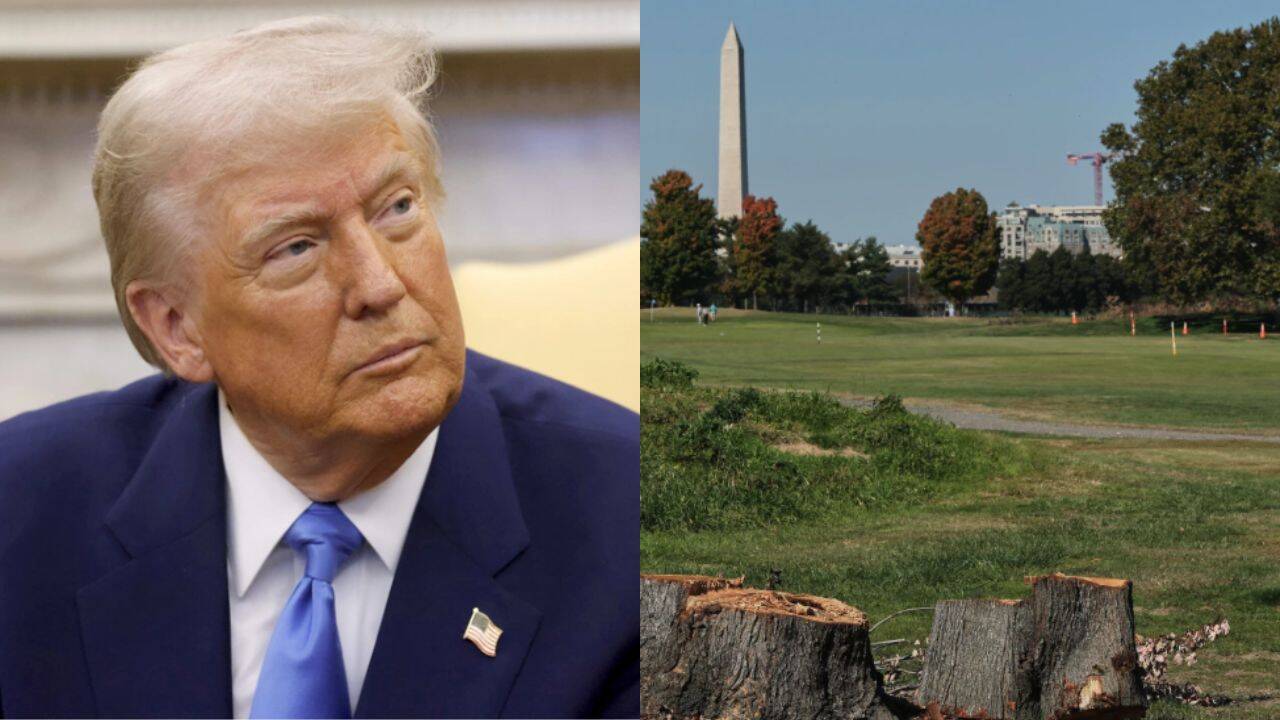
That is the first thing you notice when a chainsaw finally stops screaming along the banks of the Potomac River, leaving the humid Washington air thick with the scent of freshly torn oak and damp river mud. For generations, early morning golfers have walked the flat, sun-dappled fairways of East Potomac Golf Links, watching the Washington Monument rise above a ceiling of mature, sprawling limbs. It is a public course—built over a century ago so everyday people, not just politicians and lobbyists, could swing a club in the shadow of the nation’s capital.
Now, those same trees sit at the center of a fierce legal and political tug-of-war.
According to recent court filings and public statements, a federal judge has ordered an immediate halt to further tree removal at the historic Washington golf course, temporarily freezing an ambitious overhaul backed by President Donald Trump. In response, the president has vowed to appeal the ruling, setting up a high-stakes clash over environmental law, presidential ambition, and what happens when public heritage meets private-style redesign.
To understand why a cluster of trees on a municipal fairway has triggered a federal injunction, you have to step away from the headlines and look at the ground itself.
The Roots of a Public Sanctuary
Walk onto East Potomac Park at dawn, and you see Washington without its usual armor. Picture a hypothetical regular—let’s call him Arthur, a retired postal worker from Northeast D.C. who has played the Blue Course every Tuesday for thirty years. For Arthur, the value of the course isn't measured in championship slope ratings or manicured exclusivity. It is measured in the shade of a seventy-year-old willow oak on the fourth hole during a brutal July heatwave, and the sight of herons lifting off the water where the Potomac meets the Washington Channel.
Opened in 1920, East Potomac was designed by Walter Travis, a three-time U.S. Amateur champion who believed public golf should be accessible, strategic, and woven into the natural terrain. Over the decades, the course became more than a recreation spot. Its tree canopy evolved into an urban lung—absorbing stormwater on a low-lying peninsula prone to flooding, cooling the surrounding neighborhoods, and sheltering migratory birds along the Atlantic Flyway.
Yet anyone who has played there recently knows the course also showed its age. Drainage issues plagued the fairways after heavy rains. Clubhouses and maintenance facilities suffered from years of deferred federal upkeep. When proposals emerged to revitalize the National Links Trust properties—which include East Potomac, Langston, and Rock Creek—golfers and preservationists alike agreed that investment was overdue.
The disagreement wasn't over whether to fix the course. It was over how much of its living history had to be cut down to do it.
How a Fairway Becomes a Courtroom
Think of an urban park like an old brick house with a sprawling backyard garden. You can renovate the kitchen and fix the leaky roof without bulldozing the hundred-year-old oaks that keep the house cool in summer. Or, you can clear the lot to build something grander, faster, and entirely new.
In recent months, plans tied to the Trump administration’s push to dramatically reshape and elevate the profile of Washington’s premier public golf facility accelerated tree-clearing operations across the peninsula. Supporters of the overhaul, including administration officials and allied golf architects, argued that aggressive tree removal is standard agronomic practice. Dense canopies, they noted, block sunlight and airflow, starving the turfgrass of what it needs to stay firm, fast, and tournament-ready. From their perspective, removing overgrown or non-native trees wasn't destruction; it was restoration—opening up sightlines to the monuments and bringing championship-caliber conditioning to a neglected public asset.
Preservationists, local environmental groups, and nearby residents saw something very different.
As heavy machinery began felling mature trees, conservation advocates sounded the alarm, filing suit in federal court. Their argument rested on procedural and environmental ground: under federal laws like the National Environmental Policy Act, major alterations to historic parkland require thorough environmental impact assessments, tree surveys, and public comment periods before the saws start running—not after the stumps are already in the ground.
I remember standing near the edge of Hains Point a few winters ago after a severe windstorm brought down just two massive oaks along the river trail. Even that small loss changed the entire feel of the stretch; the wind whipped harder off the water, and the familiar skyline suddenly looked exposed, almost raw. Multiply that sensation across acres of cleared fairway, and you begin to understand the visceral reaction of people who treat East Potomac not as a blank canvas, but as an irreplaceable neighborhood commons.
The Injunction and the Appeal
When the U.S. district judge stepped in to block further tree removal, the ruling focused squarely on the irreversible nature of the work. You can amend a legal brief. You can re-seed a fairway. You cannot put an eighty-year-old tree back together once it has been fed through a woodchipper.
In granting the temporary halt, the court signaled that plaintiffs had raised substantial questions about whether federal agencies bypassed mandatory environmental and historic-preservation reviews before authorizing the clearing. For preservationists, the decision felt like an emergency brake pulled just before the point of no return.
President Trump’s reaction was swift and unmistakable. Vowing to appeal the injunction, he framed the ruling as another example of bureaucratic and judicial obstruction standing in the way of beautifying the capital and delivering world-class facilities for the public. To his supporters, halting a project meant to upgrade an aging municipal course over tree-clearing disputes epitomizes the regulatory gridlock that makes building anything in America slow and expensive.
Both sides are looking at the exact same stretch of riverfront land and seeing two completely different futures.
One vision sees a gleaming, sun-drenched championship venue—a showcase of American golf where open vistas frame the Capitol dome and modern turf gleams like Augusta National. The other sees a fragile urban ecosystem and a historic democratic space whose character depends on the very trees that shade its fairways and anchor its soil against rising river tides.
What Really Sits Beneath the Stumps
It is easy to dismiss a fight over golf course trees as a niche squabble between bureaucrats and golfers. That would be a mistake.
East Potomac sits on a narrow peninsula formed largely from dredged river sediment, surrounded on three sides by water. Its root systems are not decorative; they are structural. Every mature tree taken off that land removes a natural sponge capable of drinking hundreds of gallons of stormwater during increasingly intense Mid-Atlantic downpours. At the same time, Washington’s urban heat island effect means neighborhoods just across the river rely on green corridors like East Potomac to moderate summer temperatures.
Yet the tension runs deeper than ecology. It touches an uncomfortable truth about how public spaces are governed. Too often, public parks suffer from decades of quiet underfunding until a powerful figure or private-style vision steps in with the money and momentum to remake them overnight. When that happens, communities are forced into an impossible choice: accept rapid, top-down transformation without full public vetting, or fight in court and risk watching the facility continue to crumble while lawyers argue over briefs.
We don't yet know how the appellate court will rule, or how many trees will ultimately remain standing when the legal dust settles. That uncertainty hangs over the peninsula as heavily as the river fog.
Out on the fourth hole, the yellow caution tape flutters softly in the breeze off the Potomac, tied around the trunk of an oak that survived the first wave of saws. Tomorrow morning, the golfers will tee off beside it, watching the sun climb through its branches while lawyers prepare their next filings downtown.