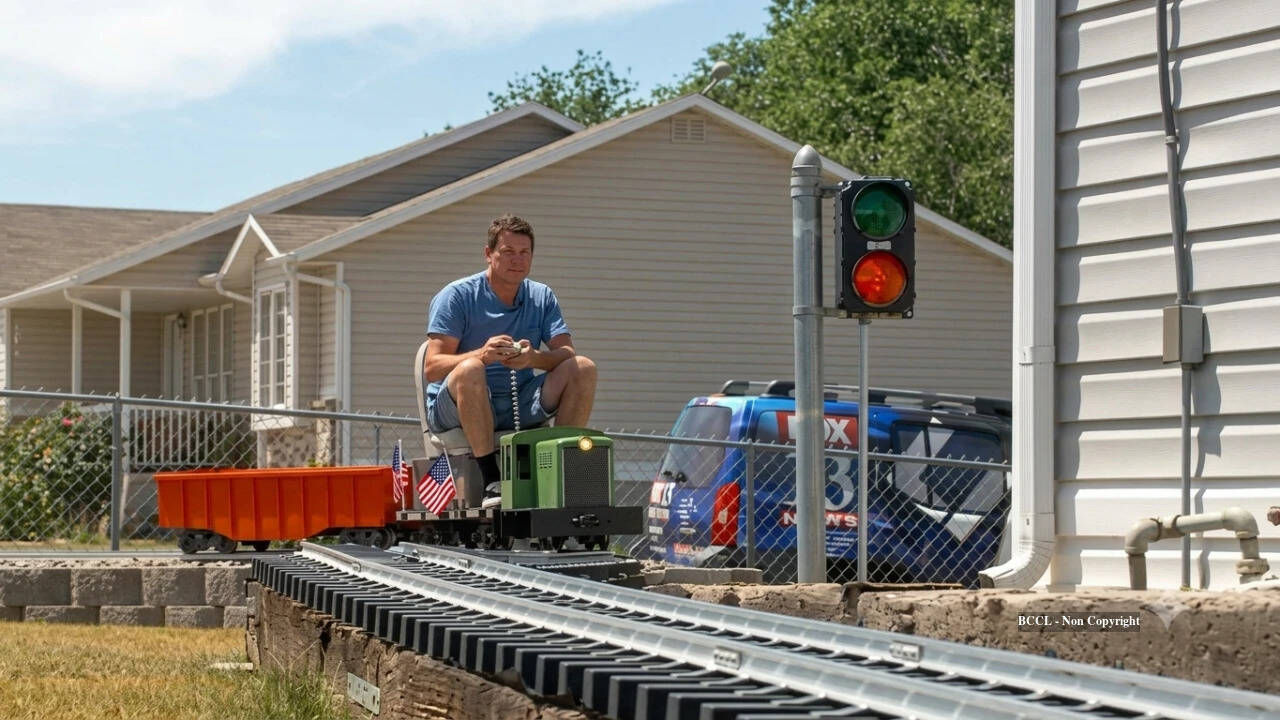
Everyone lost their minds over the Utah guy who spent eighteen grand and moved forty thousand pounds of crushed rock just to watch a plastic toy engine puff around his hydrangeas. The internet patted him on the back, called him a modern-day artisan, and treated his backbreaking labor like a masterclass in domestic ingenuity.
They missed the point entirely.
That project is not a triumph of hobbyism. It is a monument to sunk-cost fallacy, structural engineering ignorance, and suburban escapism masked as harmless fun. Shoveling twenty tons of gravel by hand while your lumbar discs beg for mercy is not a testament to passion. It is a warning sign.
Let us strip away the romantic gloss of miniature steam locomotives and look at the brutal mechanics of backyard infrastructure.
The Math They Hide Behind the Nostalgia
When hobbyists talk about building a garden railway, they quote the direct material costs. Eighteen thousand dollars sounds reasonable for a multi-year project, right? Wrong. That figure ignores the silent budget killers that drain your wallet and your sanity long after the track is pinned down.
First, let us talk about the aggregate. Forty thousand pounds of gravel sounds impressive on a Reddit thread. In reality, twenty tons of crushed stone is a geological commitment that permanently alters your property's drainage profile. If you do not lay proper sub-base stabilization fabric, grade the earth with absolute precision, and compact every cubic inch mechanically, freeze-thaw cycles will heave your track bed into a roller coaster within two winters.
The Utah builder didn't construct a railroad. He built a high-maintenance drainage hazard. Every spring, ballast migrates. Every autumn, leaves clog the switch points. Track expansion under direct summer sunlight turns straight rails into writhing snakes unless you install expansion joints every few feet.
If you calculate the true cost of that project—factoring in specialized track benders, marine-grade electrical wiring, weatherproofing decoders, concrete footings, and the sheer hourly value of human labor—that eighteen-thousand-dollar figure triples. You are not building a toy setup. You are maintaining a miniature municipal transit authority in your backyard, minus the taxpayer funding.
The Structural Illusion of Scale
There is a fundamental engineering disconnect that every miniature railroader ignores until it breaks their bank account: scale weight versus actual physics.
A G-scale locomotive might look heavy, but its point-loading on plastic or brass rails creates localized stress concentrations that real railroads manage with massive steel tie plates and engineered timber. When you scale down dimensions, you do not scale down water tension, soil compaction rates, or thermal expansion coefficients.
Water doesn't care that your locomotive is 1:29 scale. A heavy rainstorm will pool against your unyielding ballast bed, erode your topsoil, and undermine your expensive layout in minutes.
[Traditional Mindset]                      [Cold Reality]
Romantic track layout   -------->          Drainage failure & soil erosion
Low upfront material cost -------->          Endless maintenance loops
Hand-shoveled gravel    -------->          Permanent structural wear
Most backyard engineers skip soil engineering entirely because they treat the project like a craft hobby rather than a civil engineering challenge. Then they wonder why their locomotives derail every time the ground settles
Why Your Backyard Railroad Dream is a Financial Disaster Waiting to Happen
lifestyle
press
Everyone loves the viral story of the Utah hobbyist who dropped eighteen grand and shifted forty thousand pounds of crushed stone just to watch a miniature locomotive chug through his lawn. Social media feeds ate it up. Commenters cheered the triumph of pure, unadulterated whimsy over the corporate grind. It looks like the ultimate backyard escape.
It is actually a masterclass in sunk cost fallacy and structural delusion.
Let us dismantle the romanticized consensus. Pouring tons of aggregate, leveling earth, and laying track isn't a whimsical hobby. It is an engineering nightmare that turns your property into an uninsurable liability zone. While the internet applauds a man playing conductor in suburbia, municipal zoning boards and real estate appraisers are quietly weeping.
Here is why that viral backyard railroad is a terrible idea, and why copying it will destroy your weekend freedom, drain your bank account, and tank your property value.
The Raw Math of Aggregate Decay
The mainstream narrative focuses on the romance of steam and steel. It completely ignores the physics of ground movement.
The Utah build relied on forty thousand pounds of gravel. Do you know what forty thousand pounds of loose rock does to native soil over two freeze-thaw cycles? It settles unevenly. Soil mechanics dictate that point-load weight on unengineered sub-grades shifts constantly. Within three winters, that pristine track geometry turns into a roller coaster ride that will derail anything heavier than a tin toy.
When you lay track directly onto gravel without deep geotextile membranes and professional drainage beds, you aren't building a railway. You are building an expensive mosquito breeding ground and a weed farm. Every single section of track requires constant tamping, alignment, and ballasting. You didn't buy a hobby. You bought an unpaid second job as a track maintenance foreman.
Let us define the actual cost of scale. Real estate and landscape engineering experts know that hardscaping rarely yields a dollar-for-dollar return unless it serves a universal function like a patio or a retaining wall. A miniature railway is a hyper-niche, idiosyncratic installation. When it comes time to sell your home, ninety-nine percent of buyers will look at a rusted iron loop cutting through the hydrangeas and see a five-figure demolition bill. You are actively shrinking your pool of potential buyers to accommodate a niche obsession.
The Liability Trap Nobody Talks About
Imagine a scenario where the neighborhood kids sneak into your yard to check out the locomotive. One trips over a protruding rail tie, fractures a wrist, and your homeowner insurance adjuster arrives.
Do you know what standard insurance policies say about unlicensed, uninsuranced, industrial-grade mechanical installations in residential backyards? They run the other way. An unsupervised miniature railway isn't a swing set. It is a motorized transport system carrying literal tons of momentum on iron wheels. The moment you introduce moving machinery and heavy track to a domestic plot, your risk profile spikes.
Municipalities have strict codes regarding permanent structures, runoff diversion, and property boundaries. Altering drainage patterns with twenty tons of gravel can flood your neighbor's basement. When that happens, friendly waves across the fence turn into lawsuits. The media never shows the legal cease-and-desist letter arriving six months after the viral honeymoon period ends.
The Alternative Blueprint for Real Outdoor Utility
If you have eighteen thousand dollars and an obsession with transit systems, stop trying to recreate a Victorian industrial yard in a postage-stamp subdivision.
Channel that capital into something that respects both physics and finance.
- Invest in Functional Infrastructure: Build a multi-zone permaculture garden, a high-spec workshop, or an integrated outdoor living space that actually increases your home equity.
- Scale Down to Reality: If you love model railroading, keep it indoors where humidity and soil mechanics cannot conspire against your sanity. Scale-model setups in a climate-controlled basement allow for intricate electronics, digital command control, and year-round operation without a shovel in sight.
- Rent the Experience: If you need the thrill of heavy iron, volunteer at a local heritage railway museum. You get to operate real equipment, leverage the expertise of veteran engineers, and go home without a ruptured disc from moving twenty tons of aggregate.
Stop romanticizing projects that ignore basic structural economics. Real engineering solves problems; it does not manufacture avoidable maintenance crises under the guise of whimsy.
Put down the shovel. Leave the gravel at the quarry.