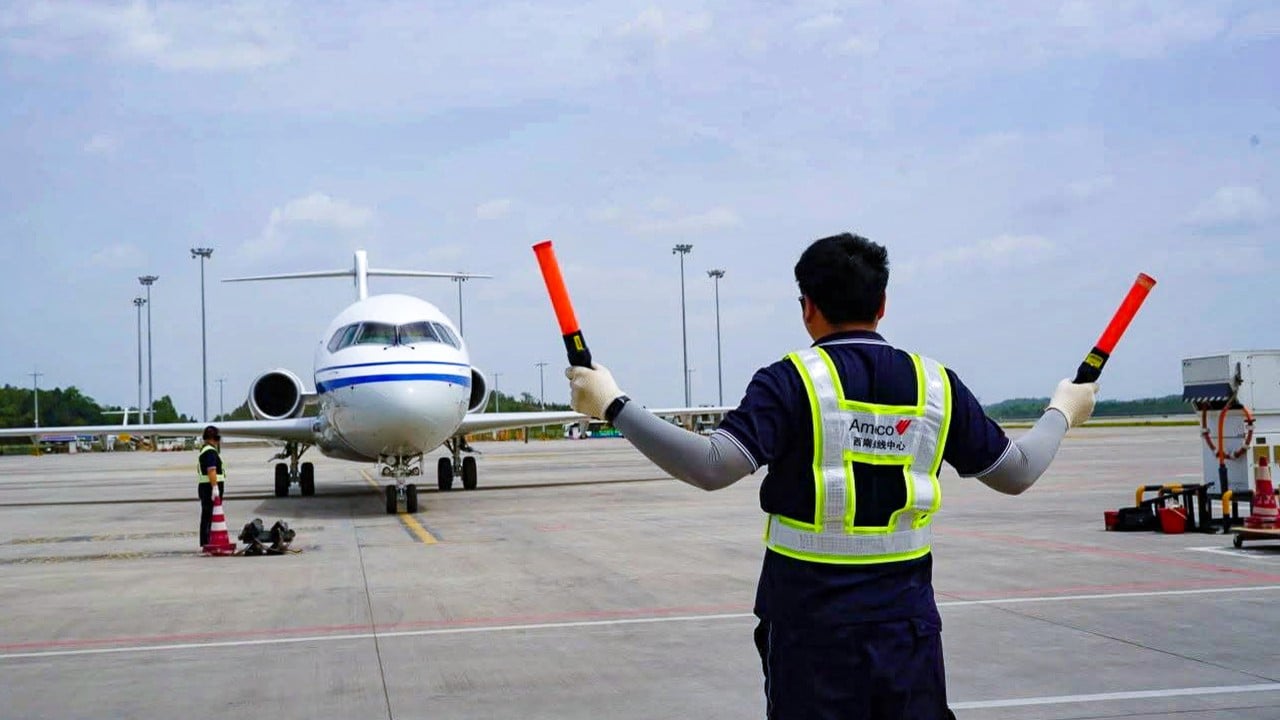
The media recently threw a collective tantrum because an Air China C909 sucked a bird into its engine.
Western aviation pundits immediately pounced. They framed the incident as a "real-world test" proving that China’s commercial aviation program is stumbling under pressure. The subtext of their narrative was clear: Comac’s regional jet is not ready for prime time, and Beijing is learning how hard it is to play in the big leagues. Meanwhile, you can explore other stories here: The Won Won Gamble That Changed Everything.
What an incredibly lazy, amateur take.
A bird hitting an airplane is not a "test of geopolitical readiness." It is Tuesday. To understand the complete picture, we recommend the excellent article by Wired.
Every single day, major airliners built by Boeing and Airbus ingest birds, suffer lightning strikes, and endure hard landings. Framing a routine wildlife hazard as a unique existential crisis for Chinese aerospace reveals a profound ignorance of how commercial aviation actually works. If we used the same logic to judge Western manufacturers, we would have grounded every 737 and A320 decades ago.
The obsession with parsing every minor operational hiccup of the C909—formerly known as the ARJ21—misses the actual structural disruption happening right under our noses. China is not failing the "real-world test." They are executing a slow, deliberate, and highly insulated industrial strategy that Western OEMs are completely unequipped to counter.
The Normalization of Deviance vs. Standard Aviation Reality
Let’s dismantle the premise that this bird strike matters from a engineering standpoint.
Every commercial aircraft engine certified by global regulators must pass rigid ingestion trials. Engineers literally fire dead birds out of a compressed-air cannon into a running engine at hundreds of miles per hour. The engine does not need to survive intact; it just needs to contain the failure safely without shedding high-energy debris through the casing or catching fire.
The C909’s CF34-10A engines—supplied by GE Aerospace, a Western titan—did exactly what they were designed to do. They handled the kinetic impact, the crew followed standard operating procedures, and the aircraft landed safely.
To call this a "growing pain" for Chinese jets is a massive misunderstanding of aviation mechanics.
- Fact: The FAA receives over 10,000 wildlife strike reports per year in the United States alone.
- Fact: Ingestion events happen to seasoned airlines with decades of experience on airframes that have flown millions of hours.
- Fact: The airframe itself does not attract birds based on its country of origin.
When an Airbus A320 hits a flock of geese over New York, we call the pilot a hero and praise the resilience of modern engineering. When a Comac C909 hits a bird in China, commentators write think-pieces about the systemic fragility of the Chinese supply chain.
This double standard is worse than biased; it is a dangerous distraction for Western aerospace executives who think they are still winning on merit alone.
The Wrong Question: "Can Comac Compete Globally Right Now?"
If you listen to mainstream financial analysts, they will tell you that Comac poses no immediate threat to the Airbus-Boeing duopoly because the C909 and C919 lack global FAA/EASA certification and cannot win orders in Europe or North America.
They are asking the wrong question. Comac does not need to sell a single aircraft to Delta, Lufthansa, or Ryanair to break the global duopoly.
Imagine a scenario where a manufacturing company owns its own captive market of 1.4 billion people, controls three of the largest airlines on earth (Air China, China Eastern, China Southern), and possesses an infinite balance sheet unburdened by quarterly Wall Street demands.
That is the reality. The Chinese domestic market is large enough to sustain Comac through its entire iterative learning curve.
I have watched Western aerospace suppliers pour billions into joint ventures in China, thinking they were buying access to a permanent customer base. They weren't. They were paying tuition fees to train their future replacement. Comac is using the domestic market as a giant, protected sandbox. Every bird strike, every component failure, and every maintenance delay inside China is a data point that stays within their ecosystem, allowing them to refine their engineering processes without facing the existential threat of bankruptcy or shareholder revolts.
Dismantling the "Immature Supply Chain" Myth
Another favorite talking point of the Western aviation establishment is that China is overly reliant on foreign suppliers for critical components. The C909 uses Honeywell avionics, Parker Hannifin flight controls, and GE engines. The consensus view is that Western sanctions or export controls could cripple Comac at any moment.
This view drastically underestimates the leverage at play.
Western tier-one suppliers are trapped in a golden cage. They cannot afford to walk away from the Chinese market because their commercial aviation margins depend on the massive volume of orders coming from Chinese airlines. If Washington or Brussels forces a hard decoupling, it will destroy the profitability of the very Western companies that lawmakers think they are protecting.
Furthermore, Comac’s reliance on Western components is a temporary bridge, not a permanent vulnerability.
Stage 1: Import Western Systems (Current C909/C919 Architecture)
       │
       ▼
Stage 2: Joint Ventures & Localized Manufacturing (Tech Transfer)
       │
       ▼
Stage 3: Domestic Substitution (CJ-1000A Engines / Indigenous Avionics)
The C909 was never meant to be a revolutionary aircraft. It is an industrial training tool. By forcing domestic engineers, mechanics, regulators, and airlines to work with an imperfect, heavy, derivative airframe for over a decade, China built the institutional muscle required to build the C919 and design the widebody C929.
Focusing on a bird strike on a regional jet is like laughing at a bodybuilder for dropping a barbell on his foot during a warm-up set. It doesn't mean he's weak; it means he's training.
The Brutal Reality of the Global Fleet Crisis
The final piece of lazy consensus is that global airlines will always prefer Boeing and Airbus because of their massive global support networks.
Good luck with that logic in the current market.
The global aviation supply chain is completely broken. Boeing is paralyzed by quality control crises, labor disputes, and regulatory scrutiny. Airbus is sold out of delivery slots for its single-aisle jets until the next decade. Airlines are desperate for lift. They are flying 25-year-old planes and paying exorbitant lease rates just to keep schedules intact.
In this environment, an alternative aircraft that actually rolls off the assembly line is an existential threat to the status quo.
Comac does not need to build a better plane than Airbus or Boeing. They just need to build a serviceable plane that is available right now. With GallopAir in Brunei already operating Chinese jets and interest growing across Southeast Asia and Africa, the geopolitical firewall protecting Western aerospace is beginning to crack.
Stop Looking at the Sky; Look at the Factory Floor
The uncomfortable truth that nobody wants to admit is that commercial aerospace is transitioning from a technology-driven industry to a manufacturing-capacity-driven industry. The baseline physics of flying a tube full of passengers through the air at Mach 0.8 have been solved for fifty years. The winner of the next fifty years will not be the company that designs the most elegant winglet; it will be the country that can actually build high-tech machinery at scale without five-year backlog delays.
The C909 bird strike was not a sign of Chinese aviation struggling under real-world conditions. It was a demonstration that their aircraft are fully integrated into daily, high-tempo commercial operations. They are absorbing the hits, collecting the data, and scaling production while the West argues about narrative points.
If you are evaluating the future of aerospace based on standard wildlife encounters, you are looking at the wrong metrics. The real-world test isn't happening in the air over an airfield in China. It’s happening on the balance sheets and factory floors of Seattle and Toulouse, where the inability to deliver reliable aircraft on time is doing far more damage than a bird ever could.
Turn off the news tracking individual flight incidents. Start tracking the machine tool deliveries, the titanium supply lines, and the domestic engine certification timelines. That is where the war is being won, and right now, the incumbent players are losing ground while celebrating a dead bird.