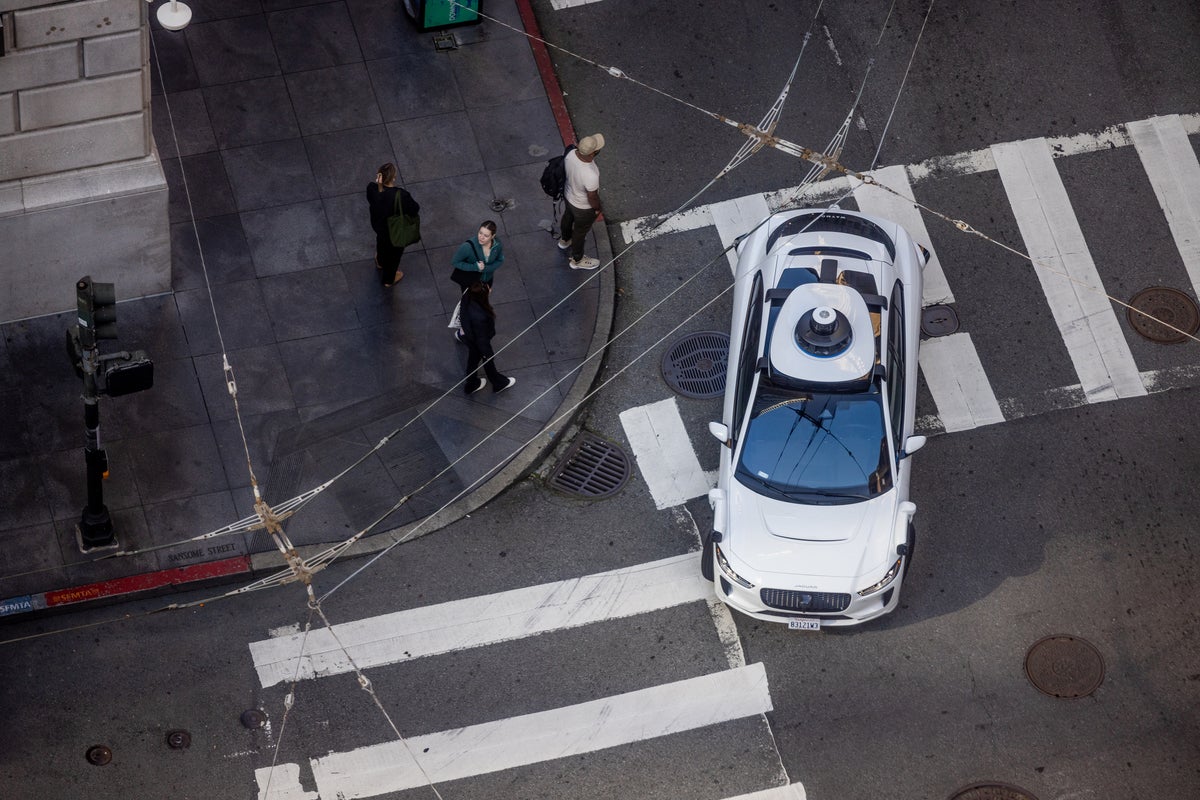
When a vehicle crashes, the reflexive human impulse is to assign blame. In the early hours of Sunday in the Pico-Union neighborhood of Los Angeles, a collision involving a Waymo robotaxi resulted in injuries that sent at least two people to the hospital. While the immediate reporting focuses on the involvement of the autonomous vehicle, the incident highlights a deeper, more complex friction between software-driven transportation and the chaotic reality of urban streets.
The incident occurred at approximately 5:44 a.m. Preliminary accounts suggest a sequence of events where the Waymo vehicle was not the primary instigator. According to statements provided by the company, a pedestrian was struck by a human-operated sedan outside of a designated crosswalk. The force of that impact, combined with the driver’s reaction, caused the sedan to veer across the street and collide with the autonomous vehicle. In this instance, the machine was a participant in a kinetic event initiated by human error, yet the presence of the robotaxi creates a unique legal and public perception burden.
We must look past the binary of "at fault" or "not at fault" to understand why these accidents remain a flashpoint. Autonomous systems are designed to operate within predictable parameters, utilizing lidar, radar, and cameras to maintain safety buffers. However, city driving is rarely predictable. Humans jaywalk, drivers speed, and traffic laws are treated as suggestions rather than mandates. When these variables collide with an algorithm, the outcome is often a violent realization that no amount of sensor data can entirely insulate a vehicle from external negligence.
The statistics surrounding autonomous driving often feel like a battlefield of conflicting metrics. Proponents point to data showing significant reductions in injury-causing crashes compared to human-operated vehicles. Critics argue that the reporting requirements for these companies are inconsistent, leading to a distorted view of safety. The truth sits in the middle. While Waymo vehicles generally exhibit more cautious driving behaviors than the average human, they are effectively tethered to the performance of everyone else on the road. A robotaxi can calculate the perfect braking distance, but it cannot override the laws of physics if a distracted driver slams into its side at 50 miles per hour.
The legal complexity of such crashes is equally daunting. In a conventional accident, insurance adjusters and police officers look for citations and witness statements. When a robotaxi is involved, the investigative process shifts to data logs. Investigators must determine if the vehicle’s software made a decision that worsened the situation or if it performed exactly as designed within the constraints of an unavoidable collision. This process is opaque by nature. It relies on proprietary telemetry that is often shielded from the public eye until a formal legal discovery process begins.
Consider a hypothetical scenario where an autonomous vehicle detects a hazard and initiates a hard-braking maneuver to avoid a collision. If a trailing vehicle, driven by a human, fails to stop in time and causes a rear-end crash, the autonomous vehicle technically triggered the event by stopping, yet the human driver failed to maintain a safe following distance. This is the gray area where the industry currently resides. We are witnessing the integration of cold logic into a hot-headed environment, and the transition period is proving to be predictably messy.
The Burden of Perpetual Surveillance
Every mile driven by a fleet vehicle is recorded, analyzed, and stored. This creates an unparalleled level of transparency regarding how the vehicle behaved, but it also creates a double standard. We do not have the same level of access to the internal state of a human driver who causes an accident. We do not know what a human driver was looking at, their heart rate, or their reaction time unless they voluntarily provide it. For autonomous companies, the digital trail is a liability, even when the data exonerates the vehicle.
The regulatory environment in California reflects this unease. The Department of Motor Vehicles and federal safety agencies are constantly updating their oversight mechanisms. They require detailed reporting of collisions involving bodily injury or property damage. Yet, these regulations are playing catch-up with the speed of deployment. As robotaxis move from controlled testing to massive, city-wide operations, the sheer volume of "routine" accidents—the low-speed bumps and fender-benders—will inevitably increase. The public is conditioned to view these not as statistical inevitabilities, but as failures of the technology itself.
Assessing Real-World Risk
We often fail to account for the "exposure gap." A human driver’s risk profile is influenced by fatigue, substance use, and emotional state. An autonomous system’s risk profile is static, updated only through software patches. When a fleet is scaled up, the software encounters more edge cases. These are the rare, bizarre road scenarios that aren't represented in training data. An autonomous vehicle might handle a million miles of standard commuting without issue, only to fail when it encounters an unmarked construction zone or a chaotic emergency situation.
The industry prefers to talk about "miles driven" as the ultimate gauge of safety. They argue that as the fleet grows, the system learns and improves. This is true in a technical sense. Machine learning models thrive on edge cases. Every accident provides a new dataset to refine the perception and planning layers of the software. But this is of little comfort to the individual caught in a collision today. The promise of future safety is a poor consolation for current risk.
The Future of Liability
The shift toward autonomous transportation will eventually force a transformation in insurance and liability models. We are moving toward a world where manufacturers or fleet operators assume a greater share of responsibility for vehicle operation. This creates a powerful financial incentive for these companies to prioritize safety above everything else. If they are the ones paying the claims, they will be the ones pushing for better infrastructure, clearer road markings, and potentially even communication protocols between vehicles.
We are currently in the most dangerous phase of this evolution: the transition. We have enough autonomous vehicles on the road to make accidents a regular occurrence, but not enough to change the fundamental behavior of the human drivers surrounding them. We are forcing algorithms to navigate a human world that isn't built for machines. The tension in Pico-Union this weekend is just one chapter in a much longer narrative about how we decide to share our streets. The question is not whether the technology can eventually be safer than a human, but how many crashes we are willing to tolerate while we wait for that day to arrive.