Adolf Hitler was born on April 20, 1889, in a quiet three-story building in Braunau am Inn, a small Austrian town near the German border. He only lived there for a few months before his family moved away. Yet for decades, that single address at Salzburger Vorstadt 15 has caused immense headaches for local authorities, historians, and politicians.
Neo-Nazis kept showing up. They took photos. They left flowers. Some even gave the illegal Hitler salute outside the windows. The building had become an unwanted shrine for far-right extremists from across Europe.
Austria needed a permanent fix. After decades of legal squabbles, public debate, and architectural competitions, the government made a bold call. They decided to convert the yellow 17th-century building into a active police station and human rights training center.
The strategy sounds counterintuitive at first glance. Why give a hated historical building to law enforcement? According to Austrian officials and architectural planners, the entire point is to give the site the exact opposite symbolism of what extremists want. By putting state police officers there, the government strips away any dark mystery, effectively neutralizing its attraction to hate groups.
The Problem With Braunau am Inn
For decades after World War II, Austria struggled with how to manage its connection to Nazi history. The country often framed itself as the first victim of Nazi aggression, a narrative that delayed honest discussions about local complicity. Salzburger Vorstadt 15 sat squarely at the center of that awkward silence.
The house belonged to a local woman named Gerlinde Pommer, whose family owned the property for generations. During the Nazi regime, Martin Bormann bought the building at an inflated price to turn it into a cultural center. After the war, the Pommer family got it back through restitution laws.
Starting in the 1970s, the Austrian Ministry of Interior rented the house from Pommer to prevent improper use. Over the years, it served as a library, a technical school, and later a workshop for people with disabilities. But in 2011, relations broke down completely.
Pommer refused to allow renovations that would make the building wheelchair accessible. She also turned down government offers to buy the house outright. For five years, the structure stood completely empty while the government paid around 4,700 euros a month in rent just to keep it locked up.
That stalemate ended in 2016. The Austrian parliament passed a special law to expropriate the property from Pommer, ending years of legal limbo. A lengthy legal battle over compensation followed, with courts eventually ordering the government to pay her roughly 1.5 million euros.
Decades of Indecision and Legal Battles
Once the state officially owned the building, the real debate began. What should actually happen to Hitler's birthplace?
Opinions were split across the spectrum. Some argued the building should be razed to the ground. Tear it down, crush the bricks, plant grass, and erase the address entirely. Advocates for demolition insisted that leaving any physical structure gave neo-Nazis a physical touchstone for pilgrimage.
Historians and heritage experts pushed back hard against demolition. They argued that wiping away the building was an act of historic denialism. Destroying the structure would look like Austria trying to erase a painful chapter of its past rather than confronting it head-on. Besides, the building sits within a protected historical town center, meaning complete destruction faced legal heritage hurdles.
Other proposals surfaced over the years. Some wanted to transform it into a Holocaust museum, an educational center, or a house of reconciliation.
A special commission made up of historians, sociologists, and politicians evaluated every option. Their conclusion was clear. Setting up a museum or educational memorial at the site might actually backfire. It could turn the building into an even bigger magnet for tourists and right-wing extremists seeking to trace Hitler's life path.
The commission recommended a neutral, administrative use. Making it part of daily public service would strip away any aura of infamy.
Turning a Symbol of Hate Into Neutral Ground
In 2019, Austria launched an international architectural design competition to redesign the complex. The goal was to remove any visual elements that could be exploited by far-right sympathizers while respecting the historic architecture of Braunau's old town.
Austrian architecture firm Marte.Marte won the contest with a minimalist design. Their plan alters the facade slightly, updates the roofline, and connects the main building to adjacent structures.
The visual transformation is deliberate. It makes the building look like a normal, functional civic building. Nothing about the exterior invites drama or reverent silence. It simply blends into the surrounding streetscape.
The plan moves the regional police headquarters and the Braunau district police command into the building. Police officers are the primary guardians of constitutional rights and public order in modern Austria. Placing them in Hitler's birthplace sends a direct message about the rule of law replacing fascist authoritarianism.
Police trainees in Upper Austria will also receive regular human rights training at the facility. Instead of ignoring the dark past, the venue will serve as a active reminder of what happens when democratic institutions fail.
Why Demolition Was Never That Simple
It's easy to say "just tear it down." But physical destruction rarely erases political extremism.
When authorities demolished Hitler's Berghof complex in Bavaria or his underground bunker in Berlin, it didn't stop neo-Nazis from seeking out the empty lots. Extremists often revere empty ground or simple markers just as much as physical walls.
If Austria had leveled Salzburger Vorstadt 15, the vacant space could have easily become an open-air shrine. A park, a parking lot, or a blank wall can serve as a backdrop for extremist photo ops just as easily as an old building facade.
By occupying every square foot with active police operations, the state eliminates empty space entirely. You can't gather outside or conduct quiet tributes when armed officers and police vehicles are moving in and out of the courtyard all day long.
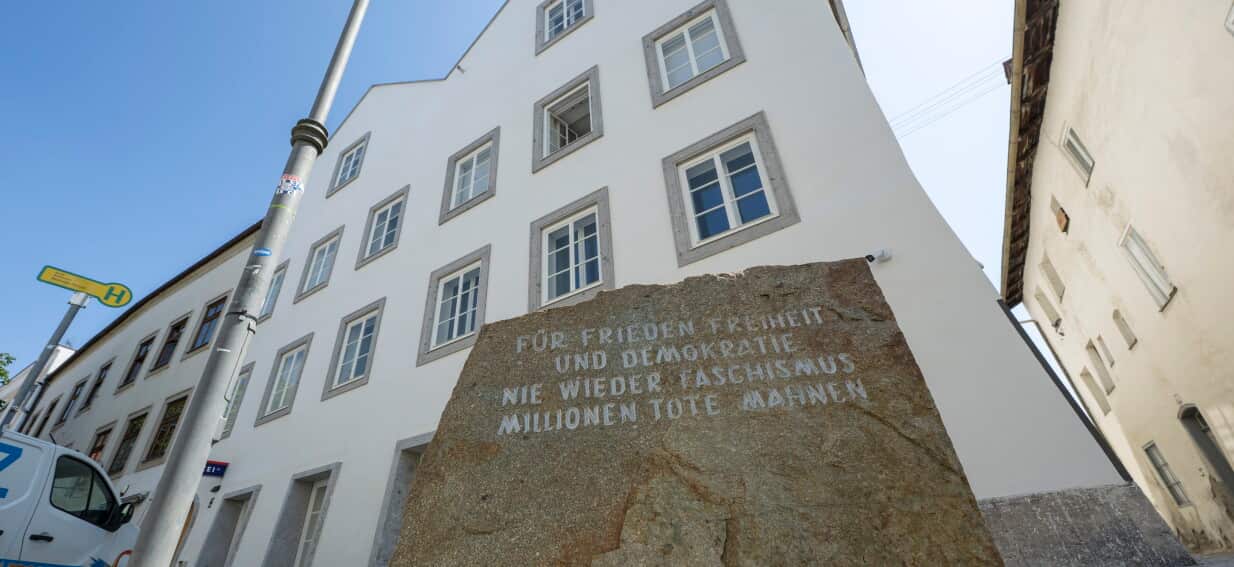
There's also the memorial stone outside the house. In 1989, the mayor of Braunau placed a stone block from the quarry of the nearby Mauthausen concentration camp on the sidewalk in front of the building. The inscription reads: "For peace, freedom and democracy. Never again fascism. Millions of dead warn us."
During the redesign debates, some suggested moving the memorial stone to a museum in Vienna. Local residents and anti-fascist organizations protested strongly. They argued that removing the stone would look like an attempt to hide the town's history. The government ultimately agreed to leave the memorial stone in place on public ground outside the police station.
What Happens Next for the Infamous House
Construction and renovation work on the complex started after several delays, with total costs estimated around 20 million euros. The facility is expected to be fully operational with police units moved in by late 2025 or early 2026.
Transforming a historical site of this magnitude is never smooth. Critics still argue that placing a police station there carries its own complicated messaging, given the historical role of police during the Nazi era. But most experts agree that functional, state-run neutrality is vastly superior to leaving the house vacant or turning it into a tourist hub.
If you are following how nations manage difficult historical memory, Braunau am Inn offers a practical case study. Erasing history rarely works, but glorifying it through over-exposure can backfire just as fast. The middle road—converting a site of hate into a working office for public safety—shows how modern democracies can strip power from toxic symbols.
To understand how other countries handle similar sites, look up how Germany manages the site of the former Führerbunker in Berlin, where simple informational panels replaced grand structures to avoid creating shrines. You can also research the work of the Mauthausen Memorial to see how Austria educates the public on Holocaust history at former concentration camp sites.